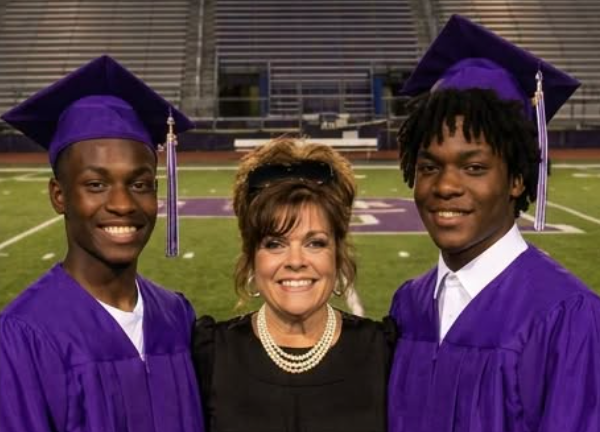
I Raised Two Boys Who Were Left at My Door — Twenty Years Later, They Revealed a Family Secret
The wicker basket sat in the middle of my dining table like a quiet reminder from another lifetime. One broken reed curled beside the handle, and the faded blue lining was still exactly as I remembered it from the morning, twenty years earlier, when I first saw two tiny babies lying inside.
Across from me, my grown sons, Caleb and Noah, sat unusually still. Their plates were untouched. Neither one seemed able to meet my eyes for more than a few seconds.
“Mom,” Caleb finally said, his voice careful, “please don’t leave us because of what we kept from you.”
I stared at him.
“What could you possibly have done that would make me leave you?”
Noah reached across the table and placed his hand over Caleb’s.
Then he said the words that changed the story I had believed for twenty years.
“Raymond gave us the basket.”
For a moment, I did not understand.
Raymond had been my closest friend for decades. He was the person who had brought groceries when I was sick, attended school plays when the boys were young, helped repair things around the house and remembered every birthday without needing a reminder.
“What do you mean, Raymond gave you the basket?”
Caleb swallowed.
“He told us the truth about where we came from.”
I looked again at the old basket.
For twenty years, I had believed it represented a mystery that had entered my life one morning without explanation.
Now I was learning that the mystery had a much longer history.
Before Caleb and Noah came into my life, I had experienced a painful divorce. My former husband, Ben, had decided that the family he imagined for himself would not be possible with me. My dwarfism had complicated my ability to have children, and eventually our marriage ended under the weight of expectations neither of us could overcome.
I remember the night Ben left with remarkable clarity.
I sat alone in my living room, surrounded by boxes and memories, trying to understand how a future I had spent years planning could disappear so quickly.
That evening, Raymond arrived at my door carrying two pizzas.
He did not give me a speech.
He did not tell me everything would be fine.
He simply sat beside me, opened the pizza boxes and stayed.
That became Raymond’s way.
He showed up.
A year later, I opened my front door and found the wicker basket on my porch.
Inside were two infant boys wrapped safely together.
There was no explanation that made sense to me. No message that answered my questions. No obvious indication of where they had come from.
The authorities became involved, and the children entered the foster-care system while the circumstances surrounding their arrival were investigated.
I tried to convince myself that I needed to step away.
Instead, I kept visiting them.
At first, I told myself I was simply concerned.
Then I realized I was already emotionally attached.
I learned their routines. I remembered the little things they liked. I began imagining what their lives might look like if they had a permanent home.
Eventually, I understood something I had been afraid to admit.
I wanted to be their mother.
When I told Raymond, he did not hesitate.
He helped me organize the paperwork, drove me to appointments and waited with me during the legal process. When I was nervous before court, he reminded me to breathe. When the process seemed overwhelming, he encouraged me to keep going.
Eventually, Judge Marsh approved the adoption.
Caleb and Noah became my sons.
The years that followed were ordinary in the best possible way.
There were birthday candles, school projects, lost shoes, family vacations, homework battles and countless mornings when everyone was running late.
There were scraped knees and childhood illnesses, sports practices and school performances.
There were teenage disagreements, driving lessons and the quiet pride I felt when college acceptance letters arrived.
Through all of it, Raymond remained present.
He never demanded recognition.
He never treated his help as something I owed him for.
He simply remained part of our lives.
I had always called it friendship.
I had never stopped to ask whether he felt something more.
Now Caleb and Noah were telling me that the story had begun long before I knew it.
Raymond had secretly worked with professionals to explore a path to parenthood for me. He had helped arrange a surrogacy and paid expenses from his own savings. The boys’ arrival was eventually connected to a carefully planned legal process that allowed them to enter foster care before they became part of my family.
The basket had not appeared by accident.
Raymond had created the opportunity for me to become their mother.
He had known how deeply I wanted a family, but he also knew I would never want someone to simply hand me a life and tell me I owed them something in return.
According to my sons, Raymond believed I needed a genuine choice.
He wanted me to decide whether I wanted to adopt them without feeling pressured by him.
That explanation did not make my anger disappear.
When Raymond arrived at my house later that evening, I asked him to sit down.
“Why didn’t you tell me?”
He looked at the basket.
“Because I was afraid you would feel that you owed me your life.”
I shook my head.
“You changed my life without asking me.”
“I know.”
There was no argument in his voice.
No attempt to defend himself.
That almost made the conversation harder.
Raymond admitted that his feelings for me had begun years earlier. He had cared about me before my marriage ended, but he had never wanted to interfere with it. After the divorce, he saw how vulnerable I was and decided that telling me how he felt might place another burden on me.
So he remained quiet.
“I never wanted you to choose me because of Caleb and Noah,” he said.
I looked at him.
“Gratitude is a terrible foundation for a relationship.”
The sentence stayed with me.
I was still angry.
I was still confused.
And I was not prepared to turn twenty years of friendship into a romance simply because I had finally learned what he had been carrying privately.
I told him exactly that.
“I need time.”
He nodded.
“You should have as much time as you need.”
For several days, I thought about everything.
I thought about the first night he brought pizza after my marriage ended.
I thought about the adoption paperwork.
I remembered him sitting in hospital waiting rooms when the boys were sick, cheering at school events and helping with ordinary problems that nobody would ever write about.
Most importantly, I thought about Caleb and Noah.
Nothing about the truth changed what they were to me.
They were my sons.
The years we had shared were real.
The bedtime stories were real. The birthday celebrations were real. The difficult conversations were real. The laughter around the kitchen table was real.
The first page of their story had changed.
The rest of the story had not.
Three days after Raymond told me everything, I went to his house carrying two coffees.
He opened the door and looked surprised.
“I don’t know what happens next,” I told him.
“I don’t either.”
“But if there is going to be a next chapter, it has to be honest.”
He nodded.
“Completely.”
I handed him the coffee.
“We start there.”
We did not rush into anything.
We talked.
We asked difficult questions.
We acknowledged that good intentions did not automatically make every decision right. Raymond understood that his secret had crossed an important boundary, even though he believed he had been protecting my freedom to choose.
I understood something too.
Love could explain a person’s choices without excusing every one of them.
Over time, trust began to grow in a different way.
The wicker basket now sits on a shelf in my living room.
For years, I had treated it like evidence of a mystery.
Now I see it as a reminder of how complicated life can become.
Caleb and Noah still tease me about keeping it.
“I could never throw it away,” I tell them.
“It looks terrible,” Noah says.
“It has history.”
“So do we.”
He smiles when he says it.
And I smile back.
Because he is right.
Our family did not begin in the way I thought it had.
But it became a family through twenty years of choices, commitment and everyday love.
I once believed the greatest miracle was finding two babies on my doorstep when I had almost given up hope of becoming a mother.
Now I understand that the deeper miracle was everything that came afterward.
The mornings.
The birthdays.
The arguments.
The forgiveness.
The ordinary moments nobody photographs.
And finally, the truth.
The basket gave me one choice years ago, even though I did not know who had created the opportunity.
The truth gave me another choice twenty years later.
This time, I knew everything.
And that made the choice entirely mine.