I Came Home Early From Deployment and Found My 4 Year Old Daughter Alone but My Husbands Warning About the Closet Shocked Me
He looked at the letters. At the unopened packages. At the stuffed camel in my hands.
Then he looked up at the banker’s boxes on the shelves.
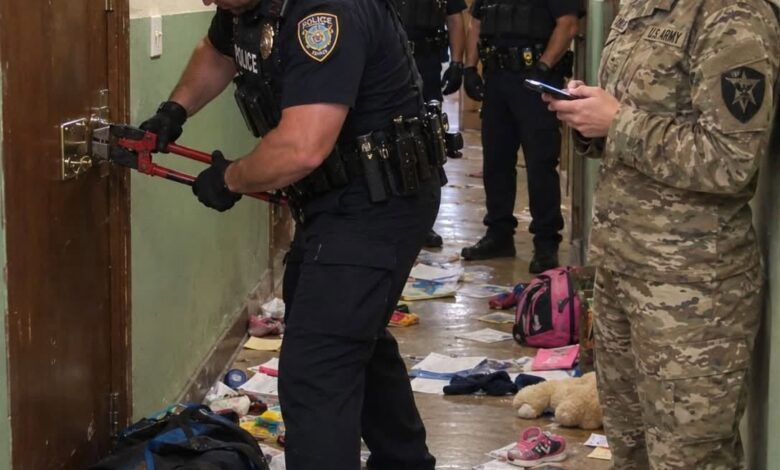
“Ma’am,” he said gently. “I need to look at those boxes.”
I nodded.
I couldn’t talk.
On the phone, Derek wasn’t screaming anymore.
He wasn’t saying anything.
I could hear him breathing. And the steel drums. Far away.
Officer Bell took down the first box.
POA.
He opened it.
Inside was a folder.
He took out a document. Three pages. Stapled.
He read it.
His face changed.
He handed it to me.
DURABLE GENERAL POWER OF ATTORNEY
I, HANNAH ELIZABETH NOLAN, of Chesapeake, Virginia, hereby appoint DEREK JAMES NOLAN as my attorney-in-fact…
At the bottom of the third page, there was a signature.
Hannah E. Nolan.
And a date.
March 22.
I left for deployment on March 18.
I was in Kuwait on March 22. Processing through Camp Arifjan. In a tent. With two hundred other soldiers.
“I never signed this,” I said.
My voice was very quiet.
“I was overseas,” I said. “On March 22nd. I was in Kuwait. I can prove it. I have orders. Flight manifests. Base records.”
I looked at the signature.
It looked like mine. Almost.
The H was right. The loop of the N. But the E was wrong. I don’t write my middle initial like that. And the l in Nolan was too tall.
Somebody had practiced.
The notary stamp at the bottom said Patricia A. Nolan. Notary Public. Commonwealth of Virginia.
Derek’s mother.
She’s been a notary for twenty years. She works part-time at a title company in Chesapeake.
Officer Bell took down the next box.
FINANCIALS.
Credit card applications. Capital One. Discover. Chase Sapphire. All in my name. All with my Social Security number. All with that same forged signature.
Approval letters. Credit limits. Ten thousand. Fifteen thousand. Twelve thousand.
Statements. Balances. Nineteen thousand. Fourteen thousand. Eleven thousand.
Forty-four thousand dollars.
In my name.
Then the box marked HOUSE.
A home equity line of credit application. Navy Federal. On our house. My name. My forged signature. Using the power of attorney.
Sixty thousand dollars.
Approved in May.
Drawn down in full by July.
“Where did sixty thousand dollars go?” I whispered.
Officer Bell flipped through the statements.
“Transferred to an account at Wells Fargo,” he said. “Not your joint account.”
He looked at the account holder’s name.
“Patricia A. Nolan,” he said.
Then the box marked LAWYER.
Inside was a folder from a law firm in Virginia Beach. Harmon & Dyer, Family Law.
A retainer agreement. Signed by Derek. Dated June.
And a draft.
A legal document. Typed. Unsigned. Not yet filed.
IN THE JUVENILE AND DOMESTIC RELATIONS DISTRICT COURT FOR THE CITY OF CHESAPEAKE
PETITION FOR SOLE LEGAL AND PHYSICAL CUSTODY
DEREK JAMES NOLAN, Petitioner,
v.
HANNAH ELIZABETH NOLAN, Respondent.
I read it.
Petitioner alleges that Respondent has repeatedly and voluntarily abandoned the minor child for extended periods due to military deployment.
Petitioner alleges that during the most recent deployment, Respondent failed to maintain meaningful contact with the minor child. Respondent did not send letters, packages, or gifts. Respondent participated in only four video calls in a six-month period, each of less than two minutes’ duration.
Petitioner alleges that the minor child has developed a primary attachment to Petitioner and to the paternal grandmother, Patricia A. Nolan, who has served as a consistent caregiver.
Petitioner alleges that the minor child no longer recognizes Respondent as a primary attachment figure and exhibits indifference toward her.
Petitioner requests sole legal and physical custody of the minor child, with supervised visitation to Respondent at Petitioner’s discretion.
I put it down.
Respondent did not send letters, packages, or gifts.
Twenty-six letters.
Four packages.
In a plastic bin.
In a locked closet.
Ten feet from my daughter’s bedroom.
Respondent participated in only four video calls.
She’s napping. She’s at my mom’s. She’s in a mood.
The minor child no longer recognizes Respondent as a primary attachment figure.
Mama? Are you really here?
The last box was the one marked MOM’S NOTES.
Inside was a spiral notebook.
Green. College-ruled. Patricia’s handwriting. Neat. Slanted. Precise.
Officer Bell opened it.
He read the first page.
He handed it to me.
March 19. Day 1. H. left yesterday. L. cried at bedtime. Asked for Mommy. Told her Mommy is very busy. Gave her the tablet.
March 24. Day 6. First letter arrived from H. D. put it in the bin. Told L. Mommy forgot to write. L. cried. Good.
April 2. Day 15. H. called for video. D. told her L. was napping. L. was in the next room. Watching TV.
April 18. Day 31. Second package arrived. Bin. L. asked if Mommy sent anything for Easter. Told her no. She went quiet. Didn’t cry this time. Progress.
May 6. Day 49. L. asked if Mommy still loved her. Told her Mommy loves the Army more. L. asked what the Army was. Told her it’s where Mommy goes instead of being with you.
I stopped reading.
I couldn’t.
I turned the pages.
Every week. Every letter that arrived. Every call that got deflected. Every time Lily asked about me.
Good.
Progress.
She’s forgetting.
On the last page. Dated three weeks ago:
August 29. Day 164. L. didn’t ask about H. at all this week. Not once. Harmon says this will look very strong in court. Plan to file when H. returns. She won’t fight it. She’ll be too ashamed when she sees L. doesn’t know her.
Cruise booked. Sept. 15. Kaylee will stay with L.
Kaylee canceled.
And they went anyway.
I don’t remember standing up.
I don’t remember walking to the front door.
I remember the sunlight. Bright. September. Hot.
I remember the ambulance in the driveway. The back doors open.
I remember Lily on the stretcher inside. Small. With the IV in her arm. And Mr. Biscuit under her chin.
I remember climbing in.
I remember sitting down next to her.
I remember putting Gerald the camel in her lap.
She looked at it.
Brown. Plush. With a little tag in my handwriting.
GERALD.
“Who’s this?” she whispered.
“That’s Gerald,” I said. “I sent him to you. In April. From where I was. He’s a camel.”
Lily looked at the camel.
She looked at me.
“You sent him?”
“I sent him,” I said. “And twenty-six letters. And three more boxes. And a book that reads you Goodnight Moon in my voice.”
Lily stared at me.
Her lower lip started to shake.
“Grandma said you didn’t write,” she whispered.
“I know, baby.”
“Grandma said you were too busy,” she said. “She said you loved the Army more.”
I took her face in my hands.
Her thin, small, too-sharp face.
“Lily,” I said. “Look at me.”
She looked at me.
“I wrote you every single week,” I said. “Every Sunday. I never missed one. Not one. I drew you camels and hearts and a rock that looks like a heart.”
Her eyes filled.
“I put the rock in an envelope,” I said. “In June. So you could keep it in your pocket. So you’d know I was thinking about you.”
Lily’s face crumpled.
And then she cried.
Out loud.
For the first time.
Loud. Wailing. The way four-year-olds are supposed to cry. With her whole body. With her mouth open. With snot running down her face.
She cried so loud Tonya jumped.
I held her.
I let her cry.
I didn’t tell her to be quiet.
When she finally stopped, she was hiccuping. Exhausted.
She looked up at me.
“Mama,” she whispered. “Can I have my rock?”
They kept Lily at Children’s Hospital for four days.
Moderate dehydration. Mild malnutrition. Elevated kidney numbers that came back to normal by day three. A diaper rash so bad it had blistered. She’d been wearing pull-ups. She’d been changing herself. She’d run out on the second day.
The doctor, a pediatrician named Dr. Amara Osei, sat with me in the family room on the first night.
“She’s going to be okay,” she said. “Physically. She’s resilient. Kids are.”
“And otherwise?”
Dr. Osei was quiet for a moment.
“She told the nurse something,” she said. “When they were giving her a bath.”
“What?”
“She said she was quiet so nobody would know she was alone,” Dr. Osei said. “She said if she cried loud, the neighbors would hear. And then Daddy would get in trouble. And it would be her fault.”
I put my face in my hands.
“She’s four,” Dr. Osei said quietly. “She was protecting him.”
I read her the letters.
That first night. In her hospital bed. With the IV still in her arm.
All twenty-six.
In order. From March to September.
Dear Lily, Today I saw a camel. It was bigger than our car. It had a very silly face. I named him Gerald.
She held up Gerald. “This Gerald?”
“That’s him. Well. A copy of him.”
Dear Lily, It is very hot here. Hotter than the hottest day at the beach.
“Hotter than Virginia Beach?”
“So much hotter.”
Dear Lily, I found a little rock that looks like a heart.
I opened the envelope.
The rock fell out into my hand.
Small. Gray. Smooth. Shaped almost exactly like a heart. I found it in a dry riverbed outside the wire on a patrol in May.
I put it in her palm.
She closed her fingers around it.
She didn’t let go of it for four days.
I played her the recordable storybooks.
Goodnight Moon. The Kissing Hand. Guess How Much I Love You.
She pressed every button on every page.
She made me sit there while she pressed them all again.
My voice. Recorded in a plywood room eight thousand miles away. Reading to her.
Goodnight room. Goodnight moon.
When I finished, she looked at me.
“Mama,” she said. “You were thinking about me. The whole time.”
“The whole time, baby.”
“Even when you were at the camel place?”
“Especially at the camel place.”
She was quiet for a long time.
Then she said, “Grandma lied.”
I didn’t say anything.
“Grandma lied,” Lily said again. “And Daddy lied.”
She looked at Gerald.
“They put Gerald in the closet,” she said.
The cruise ship Allure of the Seas docked at the Port of Baltimore on Sunday morning at 7:14 a.m.
Maryland State Police were waiting at the bottom of the gangway.
Along with two detectives from the Chesapeake Police Department. And an agent from the Army Criminal Investigation Division. Because forging a power of attorney in a deployed soldier’s name and using it to steal her military pay is a federal matter.
Derek Nolan was arrested at 7:41.
Felony child neglect. Felony forgery. Uttering a forged instrument. Identity theft. Larceny.
Patricia Nolan was arrested at 7:43.
Felony forgery. Fraudulent notarization. Conspiracy. Identity theft. Larceny. Accessory to child neglect.
Derek’s uncle Ray and his wife weren’t charged. They didn’t know. They thought Kaylee was watching Lily.
Jenna was not arrested.
Because on Friday afternoon, two days before the ship docked, Jenna Nolan called me.
From the ship. On a satellite phone she’d paid thirty-four dollars for at the purser’s desk.
“Hannah,” she said. She was crying. “Hannah, it’s Jenna. Is Lily okay? Please tell me Lily’s okay.”
“She’s in the hospital,” I said. “She’s going to be okay.”
Jenna made a sound.
“I didn’t know,” she said. “I swear to God, Hannah, I didn’t know. Derek said Kaylee was staying with her. I talked to Kaylee on Sunday night. She said she’d be there Monday morning.”
“Kaylee canceled.”
“I know,” Jenna said. “I know that now. I didn’t know Monday. We were already at the port. Derek and Mom went to the bathroom together. They came back. They said everything was handled.”
“I saw Derek’s face,” Jenna said. “On Thursday. When you called. When he went into the bathroom and started screaming about the closet.”
She was sobbing.
“I followed him,” she said. “I heard everything. I heard him say don’t let them search the house. I heard him say the linen closet.”
She took a breath.
“Hannah,” she said. “I know what’s in there.”
“I’ve known since July,” Jenna said. “I came over to borrow the steam cleaner. Derek was at work. Mom was there with Lily. Mom was putting a package in the closet.”
“A package from me.”
“A package from you,” Jenna said. “With the Army return address. And Lily was right there. In the hallway. Asking Is that for me? And Mom said No, sweetie, that’s for Daddy.”
Jenna’s voice broke.
“I asked Mom about it later,” she said. “In the car. She said it was none of my business. She said Derek was going to get custody and I’d better keep my mouth shut if I wanted to keep seeing my niece.”
“I should have called you,” Jenna said. “In July. I should have called the police. I should have done something.”
“Why didn’t you?”
Jenna was quiet for a long time.
“Because I’m scared of my mother,” she said. “I’ve been scared of her my whole life. So has Derek.”
Jenna gave a statement to the Maryland State Police on the dock in Baltimore. Before Derek and Patricia were taken off the ship.
She told them everything.
The packages. The letters. The notebook. The conversation in the car.
She told them about the custody lawyer. About the plan. About the cruise.
She told them about a phone call she overheard in August. Patricia on the phone with someone at the title company. Asking how long it would take to sell a house using a power of attorney if the owner was overseas.
They were going to sell my house.
While I was gone.
The trials took eleven months.
Derek pleaded guilty in July. To felony child neglect, three counts of forgery, and identity theft.
He got six years. Four suspended. Two to serve.
Patricia went to trial.
She took the stand in her own defense. In a navy blue suit. With her reading glasses on a chain.
She said she was protecting her granddaughter. She said I was an absent mother. She said the Army had stolen me from my child and someone had to step in. She said the letters would only have confused Lily. She said she was doing what any loving grandmother would do.
The prosecutor, an assistant Commonwealth’s attorney named Diana Reyes, stood up.
She held up the green spiral notebook.
She read one entry.
Out loud. To the jury.
May 6. Day 49. L. asked if Mommy still loved her. Told her Mommy loves the Army more.
Then she put the notebook down.
She held up a small gray rock.
Shaped like a heart.
“This rock,” she said, “was found in a dry riverbed eight thousand miles from here. By a soldier on patrol. Who picked it up because it reminded her of her daughter.”
She held it up to the jury.
“She mailed it in June,” Ms. Reyes said. “In an envelope. With a letter that said Keep this in your pocket so you know I’m thinking about you.”
She turned to Patricia.
“You put it in a plastic bin,” she said. “In a locked closet. Ten feet from that little girl’s bed. And you wrote in your notebook that she was forgetting.”
The jury was out for two hours.
Patricia Nolan was convicted on all counts.
Eight years.
I left active duty in December.
I didn’t have to. My commander told me I didn’t have to. He said they’d give me compassionate reassignment. A stateside job. No deployments. As long as I needed.
I took it for six months.
Then I resigned my commission.
Not because I didn’t love the Army.
I did. I do.
But Lily needed me to be home.
Not just stateside. Home. Every night. At bedtime. In person.
Not in a recording.
I joined the Reserves. One weekend a month. Two weeks a year.
I work for the Department of Defense now. As a civilian analyst. At a building in Norfolk. Eight to four-thirty.
I pick Lily up from kindergarten every day at four forty-five.
Lily is five now.
She’s in kindergarten at Grassfield Elementary. Mrs. Okonkwo’s class. She can write her name. She can read Goodnight Moon by herself.
She talks to her stuffed animals in full paragraphs again. Mr. Biscuit and Gerald have long conversations about camels.
She cries out loud.
When she falls down. When she’s sad. When she doesn’t get the purple cup.
She cries loud and she doesn’t apologize.
She sees a therapist. Every Thursday. A woman named Dr. Simone Hayward who specializes in young children and trauma. Lily calls her Dr. Simone.
Dr. Simone told me something in October.
“She asked me a question today,” she said. “She asked if it was her fault. That Daddy and Grandma went away.”
I closed my eyes.
“I told her no,” Dr. Simone said. “I told her grown-ups made choices. And grown-ups have to be responsible for their choices.”
“What did she say?”
Dr. Simone smiled.
“She said, Like when I got the peanut butter?” she said. “That was my choice. Because I was hungry. And I’m responsible.”
I didn’t know whether to laugh or cry.
I did both.
Evelyn Price comes for dinner every Wednesday.
She brings a pie. She reads to Lily. She sits on the porch with me after Lily goes to bed and we drink iced tea and don’t say much.
She still blames herself.
“He talked to me through that camera,” she said once. “Through the doorbell. He said the babysitter was upstairs. And I believed him. I walked home.”
“Evelyn.”
“I walked home, Hannah.”
“Evelyn,” I said. “Do you know what you did?”
She looked at me.
“You saw her,” I said. “At the window. Nobody else did. You were the only person on this whole street who noticed a four-year-old standing in a window in a dirty nightgown.”
Evelyn’s eyes filled.
“And you came over,” I said. “You rang the bell. You tried.”
I took her hand.
“You were the first person who tried,” I said. “That matters.”
Jenna comes on Sundays.
She’s in therapy too. She moved out of her mother’s house. She lives in an apartment in Portsmouth now. She works at a veterinary clinic.
She brings Lily things. Not expensive things. Little things. A sticker book. A plastic camel she found at a dollar store. A rock from the beach at Fort Monroe that looks almost like a heart. Almost.
Lily keeps it next to mine. On the windowsill in her room.
Jenna told me something on a Sunday in January.
We were in the kitchen. Making pancakes. Lily was in the living room with Gerald.
“Mom used to lock our closets,” Jenna said. “When Derek and I were kids. If we did something wrong. She’d take the thing we loved most and lock it in the hall closet.”
I stopped flipping pancakes.
“My Barbie dream house,” Jenna said. “Derek’s baseball glove. For weeks. Sometimes months. We could see the closet door every time we walked down the hall. But we couldn’t open it.”
She looked at the hallway.
“She said it would teach us,” Jenna said. “That the things we love can be taken away. And we have to earn them back.”
I looked at the hallway.
At the linen closet. Between the bathroom and Lily’s room.
The bifold doors were open now. Always.
“Derek learned that from her,” Jenna said quietly. “Locking things away. Taking what somebody loves and putting it where they can see the door but can’t open it.”
She looked at me.
“He did it to you,” she said. “And to Lily.”
In February, Lily asked me about the closet.
We were walking past it. On the way to her bath.
She stopped.
She looked at the open bifold doors. At the towels and sheets on the shelves. At the vacuum cleaner. At the box of Christmas ornaments on the top shelf.
Back to normal.
“Mama,” she said. “Is this where Gerald was?”
“Yes, baby.”
“And all my letters?”
“All of them.”
She looked at the closet for a long time.
“I don’t like it,” she said.
“I know.”
“Mama,” she said. “Can we change it?”
“Change it how?”
Lily thought about it.
The way she does. With her head tilted. Very seriously.
“Can it be a good closet?” she said. “Instead of a bad one?”
We changed it.
It took a weekend.
Evelyn helped. And Jenna. And Officer Marcus Bell, who came on a Saturday in a T-shirt and jeans with a drill and a toolbox.
He said he’d been thinking about that closet for five months. He said he dreamed about it. The brass padlock. The bolt cutters. The plastic bin.
“I’ve opened a lot of doors in twenty-six years,” he said. “That one stuck with me.”
We took the bifold doors off.
All the way off. We put them in the garage.
We moved the towels and the sheets to a cabinet in the bathroom. The vacuum cleaner to the laundry room. The Christmas ornaments to the attic.
We painted the inside.
Lily picked the color.
Yellow. Bright, sunshine yellow. Like the dress she wore to her first day of kindergarten.
Officer Bell built shelves. Low ones. At Lily’s height. Three of them.
Jenna sewed cushions. Big, soft ones. Purple and pink. For the floor.
Evelyn brought a reading lamp. A little brass one shaped like a crescent moon.
And on the shelves, we put the letters.
All twenty-six of them.
Not in envelopes. Not in a bin.
Out. Open. In clear plastic sleeves. Standing up on the shelves like books. So Lily could see them. Every one. Every drawing. Every camel. Every lopsided heart.
We put the recordable storybooks on the middle shelf.
Goodnight Moon. The Kissing Hand. Guess How Much I Love You.
And on the top shelf, at Lily’s eye level, we put Gerald the camel.
And the heart-shaped rock.
And the almost-heart-shaped rock Jenna found at Fort Monroe.
Side by side.
Over the doorway, where the bifold doors used to be, Officer Bell screwed in a little wooden sign.
Lily painted it herself. With help.
Purple letters. On a yellow board. A little crooked.
LILY’S LETTER CLOSET
ALWAYS OPEN
She reads in there every night now.
Before bed. With the crescent moon lamp on. Curled up on the purple cushion with Gerald and Mr. Biscuit.
She picks a letter. Any letter. And she reads it.
She can read most of the words now. The ones she can’t, she makes up.
Last week, I was walking past.
She was in there. In her pajamas. With the lamp on.
Reading Letter Number 14. From June.
Dear Lily, I found a little rock that looks like a heart.
She looked up at me.
“Mama,” she said. “Are you going to go away again? To the camel place?”
I sat down on the hallway floor.
Right where I sat that day. In my uniform. With Gerald in my hands.
“Sometimes,” I said. “For two weeks. Once a year. For the Army. But not for a long time. Not like before.”
Lily thought about that.
“Will you write me?”
“Every day,” I said. “Every single day.”
“And will I get them?”
I looked at her.
At my daughter. Five years old. In a yellow closet. With twenty-six letters on the shelves around her.
Asking if she’ll get them.
“Yes,” I said. “You’ll get every single one.”
“How do you know?”
I reached up.
I touched the little wooden sign over the doorway.
ALWAYS OPEN.
“Because there’s no lock anymore,” I said.
Lily looked up at the sign.
She looked at the doorway where the bifold doors used to be. Where a brass padlock hung for six months. Where her father screamed don’t open it through a speakerphone from a cruise ship.
“No lock,” she said.
“No lock,” I said.
She went back to her letter.
People ask me sometimes what I learned.
From the deployment. From coming home three weeks early. From the house. The closet. The padlock. The bolt cutters.
They expect me to say something about trust. About marriage. About the military and what it costs families.
I tell them about the letters.
Twenty-six letters. Four packages. Three recordings of my voice reading Goodnight Moon.
Every single one of them arrived.
Every single one of them was delivered. To the right address. On time. By the United States Postal Service.
They just never reached her.
Because somebody put them behind a door.
And locked it.
And told her nobody wrote.
That’s what I learned.
Love isn’t proven by whether you send it.
It’s proven by whether it gets through.
And sometimes, between the person who sends it and the person who needs it, there’s a closet.
And a lock.
And somebody standing in front of it saying don’t open that, you’ll destroy everything.
They’re right.
You will.
You’ll destroy the lie.
So open it.
Every time.