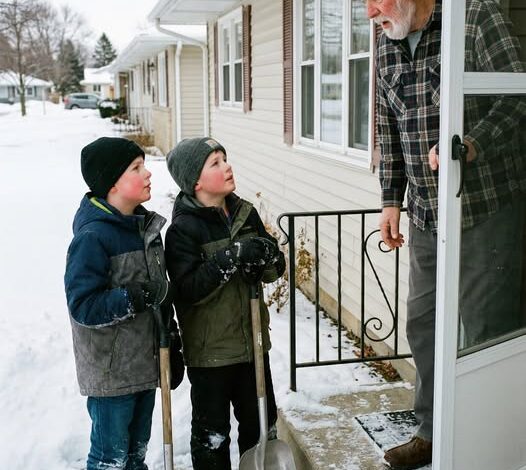
I almost let two half-frozen boys clear six inches of ice for twenty bucks, until I learned they were trying to buy their mothers heart medicine before she missed another dose
It was 6:48 on a bitter Saturday morning when the knock came. The kind of cold that cuts straight through walls and settles into your bones. I opened the door expecting wind, maybe a drifting pile of snow—but instead, I found two boys standing on my porch, thin jackets pulled tight, cheeks raw from the cold.
“Please, mister,” the older one said, voice steady but urgent. “We can shovel your driveway. The walk. The steps. All of it.”
I stood there a moment, taking them in. The older one looked about fifteen, trying hard to carry himself like a man. The younger couldn’t have been more than twelve, small and trembling, but holding his shovel like it mattered. Between them, they had two tools—one cracked plastic blade, the other patched together with tape and what looked like a shoelace.
I should have sent them away.
My driveway isn’t small. It’s long, uneven, and the snowplow always leaves behind a frozen ridge at the end that feels closer to cement than snow. I’m seventy-one, my knees aren’t what they used to be, and most mornings I measure effort like it costs something—because it does.
“How much?” I asked.
The older boy hesitated just long enough to show he hated the number he was about to say. “Twenty dollars.”
“Each?”
He shook his head. “No, sir. Total.”
For a second, I almost agreed without thinking. Twenty dollars for that kind of job? It would’ve been a steal. I’m not proud of how quickly the thought came. Comfort has a way of dulling your sense of fairness when you’re used to choosing the easier path.
But then I looked at them again.
Not hopeful. Not casual. Not kids looking for spending money.
Scared.
“Fine,” I said. “But do it right.”
They nodded immediately, relief flashing across their faces like I’d just handed them something bigger than permission.
I went back inside, poured coffee, and watched through the window.
They worked like time mattered.
No talking. No stopping to check phones or complain. The older boy attacked the heavy ridge at the end of the driveway, chopping into it with everything he had, shoulders tightening with each swing. The younger followed behind, scraping and dragging snow with that broken shovel, pushing past the limits of it—and himself.
Forty minutes in, the younger one stopped. Not laziness—he dropped onto the bottom step like his legs just gave out. Bent over, breathing hard into his gloves.
The older one was at his side instantly. A hand on his back. Quiet words I couldn’t hear. Then he handed over the better shovel and took the taped-up one without hesitation.
That’s when something shifted in me.
I set the coffee aside, filled two mugs with hot chocolate, pulled on my boots, and stepped outside.
“Break,” I said.
They froze, both of them, like they expected bad news.
I handed them the mugs.
The younger boy wrapped both hands around his, like he was holding onto something fragile and important. The older one looked at me directly for the first time. “Thank you, sir.”
I nodded toward the shovel wrapped in tape. “That thing’s done. Go to my garage—left wall. Bring me the steel one.”
He blinked, unsure he heard right.
“You heard me.”
He ran.
When he came back carrying the heavy steel shovel, the look on his face wasn’t excitement—it was something quieter, something like respect mixed with disbelief.
They got back to work, faster now, stronger. The new shovel bit into the snow like it belonged there, and they used it like they knew they’d been given a chance.
An hour later, my driveway looked better than it had in years. Clean edges. Walkway cleared. Steps scraped down to bare concrete. The younger boy even brushed snow off the porch railing with his sleeve, like the job wasn’t finished until everything looked right.
They came to the door, hats off, faces flushed red from the cold.
“All done,” the older one said.
I looked past them at the driveway, then back at them. “Names?”
“Eli.”
“Ben,” the younger said quietly.
I pulled out my wallet and counted out the money into Eli’s hand.
He frowned immediately. Then his expression dropped.
“Mister… this is too much.”
“It’s one hundred and forty dollars,” I said. “That’s what the job’s worth.”
Ben just stared, mouth slightly open. Eli shook his head, already trying to hand it back.
“We said twenty.”
“I know what you said,” I replied. “That doesn’t make it right.”
Ben started crying first. No sound, just tears slipping down a face still stiff from the cold. Eli held himself together for a moment longer, then looked away, blinking hard.
“What’s going on?” I asked.
He hesitated, like saying it out loud might make it worse. Then the words came, flat and practiced.
“Our mom skipped her pills yesterday.”
That landed heavy.
“She’s got a heart condition. Needs medicine every day. The refill costs too much. She said she’d wait until Monday.” He swallowed. “This morning she got dizzy getting ready for work.”
“She still went?”
He nodded. “She cleans rooms at a motel. If she misses another shift, they’ll cut her hours.”
Ben wiped his face with his glove. “The pharmacy said they’d hold it until noon… if we bring enough.”
Enough.
Not extra. Not comfortable. Just enough.
These two had gone out in this cold, with broken tools, knocking on doors—not to earn spending money, but to keep their mother from missing another dose of the medication keeping her alive.
I reached into my wallet again and added more.
Eli shook his head immediately. “No, sir, we can’t—”
“You can,” I said. “Medicine first. Then food. Real food. And you tell your mom her driveway was handled by professionals.”
Ben let out a small, broken laugh. Eli looked down at the money like it might vanish if he blinked.
“She kept saying we’d figure something out,” he said.
I nodded. “Looks like you did.”
They didn’t walk away—they ran. Nearly slipping on the packed snow, clutching that money like it was oxygen.
I stood there long after they were gone.
People talk a lot about what’s wrong these days. About kids not working, about families not holding together, about how nobody cares like they used to.
That morning proved otherwise.
I saw two boys carrying a weight most adults wouldn’t handle well. No complaints. No excuses. Just action.
And I saw something else too—something less comfortable.
It’s easy to mistake desperation for a fair price. Easy to accept what someone offers when they’re in a position where they can’t ask for more.
That’s not fairness. That’s forgetting.
Those boys didn’t need charity. They needed someone to recognize the value of what they were doing—and meet it with something honest.
My driveway got cleared that morning, sure.
But that wasn’t the thing that mattered.
For the first time in a long time, the house didn’t feel quite so empty.