I Adopted a 3-Year-Old Girl After a Fatal Crash – 13 Years Later, My Girlfriend Showed Me What My Daughter Was ‘Hiding’
Thirteen years ago, I walked into my shift at the ER as a brand-new doctor. By the time the sun came up, I’d walked out as somebody’s father—and I didn’t even know it yet.
Back then, I was 26, six months out of med school, still convincing my hands not to shake when things got loud and bloody. We were just settling into the usual chaos of a graveyard shift when the paramedics burst through the doors with a wreck that looked like it had taken out someone’s entire world.
Two stretchers. White sheets already pulled over still faces.
And a third gurney carrying a three-year-old girl with big, wild eyes and a seatbelt bruise across her chest.
She wasn’t crying. She was too far past that. Her gaze jittered around the room like it was trying to find someplace familiar and finding nothing.
Her parents were gone before the ambulance even reached us.
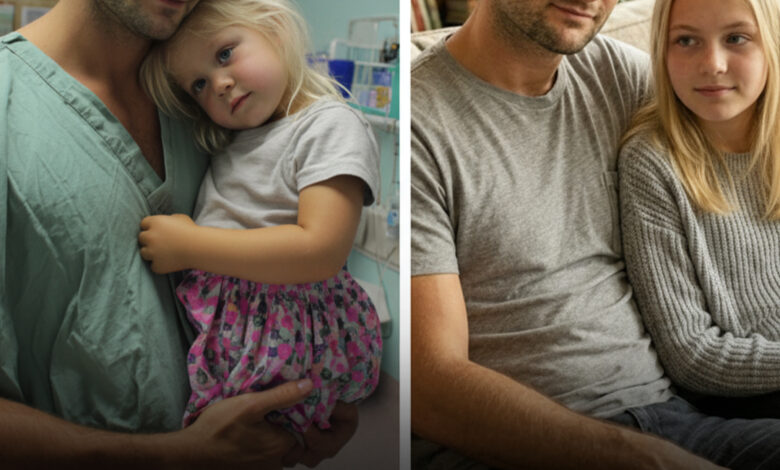
I wasn’t supposed to be the one who stayed with her. I had charts, labs, other patients. But when the nurses tried to move her, she grabbed my arm with both hands and clung like I was the last solid thing in the universe.
“I’m Avery. I’m scared. Please don’t leave me and go. Please…” she whispered, over and over, as if repeating it might stop the entire world from disappearing.
I should have stepped away. Instead, I sat down.
We found a sippy cup in pediatrics and filled it with apple juice. Someone dug up a picture book about a bear who lost his way home and found it again, and she made me read it four times because the end was happy. Maybe she needed proof that some stories still ended that way.
At one point, she touched my ID badge with a small, tentative finger and said, “You’re the good one here.”
I had to excuse myself to the supply closet just to remember how to breathe.
Social services showed up the next morning. They spoke in low voices, using words like “placement,” “no known relatives,” “temporary foster,” and “we’ll do our best.” The caseworker knelt in front of Avery and asked if she knew any grandparents, any aunties, any uncles. Anyone at all.
Avery shook her head. She didn’t know addresses or phone numbers. She knew her stuffed rabbit was named Mr. Hopps and that her curtains at home were pink with butterflies. That was it.
What she did know was that she did not want me to leave.
Every time I stood up, her whole body tensed, her eyes wide with that same raw panic. She’d learned in one violent instant that people can disappear without warning. Anything that looked like me walking away she treated like a new emergency.
The caseworker pulled me aside.
“She’s going into temporary foster care,” she said. “We have a family who can take her.”
The words came out before I could stop them.
“Can I take her? Just… just for tonight. Until you find someone permanent.”
She blinked like I’d suggested taking home a tornado.
“Are you married?”
“No.”
“You’re single. You work nights. You’re barely out of residency.”
“I know.”
“This isn’t a babysitting gig,” she said quietly.
“I know that too.” I did. But I also knew I couldn’t watch that little girl, who’d already lost everyone, be carried away by yet another stranger if there was any other option.
She made me sign so many forms I thought my hand would cramp. That was the first time I wrote my name next to hers.
One night became a week. A week turned into months and then a year, full of home inspections, background checks, parenting classes crammed between 12-hour shifts. I went from prescribing meds to comparing car seats and arguing with insurance about pediatric therapy.
The first time she called me “Daddy,” we were standing in the cereal aisle, fluorescent lights buzzing overhead.
“Daddy, can we get the dinosaur one?” she asked, pointing at a cartoon T-rex on a box.
She froze immediately, like she’d broken some cosmic rule. Her eyes darted up to mine, braced for correction.
I crouched down so we were eye to eye.
“You can call me that if you want to,” I told her.
Her face crumpled in this way that was grief and relief all tangled together. She nodded hard, like she was signing a contract.
Six months later, the adoption was official. But the truth is, she’d become mine in all the ways that mattered long before any judge signed a document.
My life rearranged itself around her.
I gave up the wild shifts and requested something steadier. I learned the art of chicken nuggets at midnight and keeping Mr. Hopps within reach at all times. I opened a college fund the minute I could manage it, even though we were far from rich. I showed up for every school play, every parent-teacher meeting, every soccer game where she mostly chased butterflies.
If there was a bleacher, I was on it.
She grew into this bright, sharp, brilliantly stubborn kid who pretended she hated when I cheered but would always scan the crowd to make sure I was there.
By sixteen, she had a sense of humor as dry as mine and, according to the one photo the police had salvaged of her biological mother, the same eyes. She’d flop into the passenger seat after school and sigh dramatically.
“Okay, Dad, don’t freak out,” she’d say. “I got a B+ on my chemistry test.”
“That’s good, honey.”
“Good? It’s tragic. Melissa doesn’t even study and she got an A. There is no justice in this world.” She’d roll her eyes, but the corner of her mouth would give her away.
She was—she is—my whole heart.
Dating wasn’t really on my radar. When you’ve watched someone lose everything in one night, you get cautious about bringing new variables into your home.
Then I met Marisa.
She was a nurse practitioner—sharp, capable, polished. She handled my worst ER stories without flinching, remembered Avery’s bubble tea order, and didn’t seem fazed that my evenings often revolved around homework and carpool.
Avery was wary at first, then polite, then cautiously friendly. Marisa offered rides, asked about debate club, and never pushed too hard. I let myself imagine a life where I wasn’t doing this completely alone.
After eight months, I bought a ring and tucked it into a small velvet box in my nightstand. I started to believe that maybe I didn’t have to choose between being a father and having a partner.
Then one evening, Marisa came over looking like someone who’d found a problem and was thrilled to be the one to solve it.
“We need to talk,” she said, bypassing hello. She held out her phone with the kind of dread-drenched urgency you see in bad TV dramas.
On the screen was black-and-white footage from the hallway camera she’d insisted we install “for security.” It showed a hooded figure moving toward my bedroom, entering, then heading straight to my dresser.
My dresser where the safe is.
The figure crouched, punched in the code, opened the safe, and pulled out cash—bills I kept as an emergency reserve alongside Avery’s account documents.
My stomach dropped so fast I felt dizzy.
Marisa swiped to another clip. Same hoodie. Same frame.
“I didn’t want to believe it,” she said, her voice soft, tinged with righteous sorrow. “But your daughter’s been… off lately. And then I saw this.”
My brain scrambled for something sane to hold onto. Some other explanation.
“Avery wouldn’t steal from me,” I said. It came out more like a plea than a statement.
“You say that because you’re blind where she’s concerned,” Marisa replied, her expression tightening. “You’ve made her your whole world. That’s not healthy.”
I stood up, blood roaring in my ears. “I need to talk to her.”
“Don’t confront her yet,” she snapped, grabbing my wrist. “She’ll just lie. You need to be strategic.”
“This is my daughter,” I said, pulling free.
“And I’m trying to protect you,” she shot back. “She’s sixteen, not an angel. You have to be realistic.”
I went upstairs anyway.
Avery was at her desk, headphones around her neck, highlighter in hand. She looked up and smiled.
“Hey, Dad. You okay? You look like you saw a ghost.”
I had, in a way.
“Avery,” I said, my voice rough, “have you been in my room when I’m not home?”
Her smile faded. “What? No. Why?”
“Just answer me.”
Confusion shifted into hurt, then defensiveness, all in a heartbeat. “No, I haven’t. Why would I?”
“Something’s missing from my safe.”
She stared at me, eyes wide, then furious in that very Avery way.
“Are you serious right now?” she demanded. “You think I would steal from you?”
“I don’t want to think that,” I said. “But there’s video of someone in a gray hoodie going into my room.”
For a second she just froze. Then she turned to her closet, flipped through hangers, and stepped back.
“My gray hoodie,” she said. “The big one I wear all the time. It’s gone. I thought it was in the laundry. This is literally the third time I’ve looked for it.”
Something cold settled deep in my stomach.
I went back downstairs. Marisa was waiting in the kitchen, scrolling through her phone, looking tense but composed. Like someone playing the role of “concerned, supportive partner.”
“Avery’s gray hoodie is missing,” I said.
She shrugged. “Teenagers lose clothes all the time.”
“Marisa,” I said slowly, “what code did you see being entered in that video?”
She blinked. “What?”
“The safe code. You said you saw someone open it. What code did you see?”
Her eyes flashed. “Why does that matter?”
Because the camera angle didn’t show the keypad.
I pulled out my phone and opened the security app—another thing she’d “set up for me.” I scrolled back before the clip she’d shown me.
There it was.
A few minutes earlier, the camera caught Marisa in the hallway.
Holding Avery’s gray hoodie.
I hit play. The footage showed her walking into my bedroom, hoodie draped over one arm. Opening my dresser. Kneeling in front of the safe. Typing the code. Taking out cash. Looking directly up into the lens for a split second with a small, satisfied smile.
Then, later, another figure—face hidden, hoodie up—repeating the motions, this time framed to look like it could be any teenager in the world.
My teenager.
I turned the phone toward her.
“Explain this.”
Marisa stared at the screen. All the color drained from her face before it hardened again.
“You don’t understand,” she said. “I was testing her. Testing you.”
“By stealing from me and framing my kid?” My voice echoed in the kitchen. “Are you out of your mind?”
“She’s not your daughter,” Marisa snapped, the words coming out fast and sharp. “Not really. She’s not your blood. You’ve poured everything into her—your time, your money, your future. And for what? She’ll leave at eighteen and you’ll be alone. I was trying to open your eyes.”
There it was. The truth she’d been circling around for months.
“Get out,” I said.
She laughed once, harsh and disbelieving. “You’re doing it again. Choosing her over me.”
“There’s no ‘again,’” I replied. “There’s just this. And I’m choosing my child.”
She reached into her purse, and for a second I thought she was grabbing her keys. Instead, she pulled out the velvet ring box.
“I knew it,” she said, smirking a little. “I found this when I was looking for a charger. You were going to propose.”
I took the box out of her hand.
“Fine. Keep your charity case,” she added bitterly. “But I’m not leaving empty-handed.”
“Try it,” I said, stepping toward the door and yanking it open. “I already have the footage. And your name is on it.”
Her face flickered between anger and calculation. She finally huffed, lifted her chin, and walked past me.
“You’ll regret this,” she called over her shoulder. “She’ll break your heart one day and you’ll wish you’d listened.”
Maybe. But it wouldn’t be today.
I locked the door. When I turned around, Avery was standing on the stairs, fingers curled around the banister, eyes huge and wet.
“Dad,” she whispered, voice shaking. “I didn’t… I swear I didn’t—”
“I know,” I said, crossing the room in two strides and pulling her into my chest. “I know, baby. I am so, so sorry I even let my brain go there for a second.”
Her shoulders trembled. “I heard her say I’m not your daughter.”
“She’s wrong,” I said into her hair. “She is so unbelievably wrong.”
“I’m not your blood,” she said quietly, like it was a fact she’d been carrying for years.
“Blood is biology,” I told her. “Family is what we choose and fight for. You chose me that night in the ER when you grabbed my arm and refused to let go. I chose you every day after. That’s not changing because someone is cruel and insecure.”
She let out a shaky laugh-sob hybrid. “You sound like a corny movie.”
“Too bad,” I said. “You’re stuck with me.”
She clung harder.
The next day, I filed a police report for the theft and gave the hospital’s HR department a heads up before Marisa could twist anything. I submitted the footage to both. It wasn’t about revenge. It was about refusing to let someone try to destroy my kid’s sense of safety in her own home.
A few days later, my phone lit up with a message from Marisa: We should talk. You owe me a chance to explain.
I blocked the number.
That evening, I printed out Avery’s college account statements and spread them across the kitchen table.
“This is boring grown-up stuff,” I told her, “but I want you to see it. Every deposit, every plan. This is yours.”
She frowned down at the papers. “You don’t have to show me all this.”
“Yes, I do,” I said. “Because I need you to understand something. I’m not doing any of this for a hypothetical perfect daughter. I’m doing it for you—the one who spilled chocolate milk on my work pants, the one who used to wake me up at 3 a.m. to ask if spiders can understand English, the one who calls me from the school parking lot because she forgot her gym shoes again.”
She rolled her eyes, but she was smiling now.
“You’re my responsibility,” I said. “But more than that, you’re my choice. My daughter. All in. No footnotes.”
She reached across the table and took my hand, her grip steady and warm.
“You’re my choice too, you know,” she said. “I could have screamed bloody murder that night in the ER until they gave me to someone else.”
I laughed. “You did scream bloody murder.”
“Yeah, but I screamed and held on to you,” she said. “That’s different.”
She was right.
Thirteen years ago, a three-year-old girl with a bruised chest and a stuffed rabbit decided I was “the good one.” Since then, I’ve made a lot of mistakes. I’ve second-guessed myself, lost my temper, burned dinners, and gotten scared. But I’ve never stopped trying to live up to that version of me she saw in that moment.
Some people will never understand that family isn’t about matching DNA. It’s about the hand you hold in the worst moment of their life—and the choice to keep holding it, again and again, even when other people tell you to let go.
She chose me once.
I’ll spend the rest of my life choosing her back.