He Sat Down to Use the Bathroom Then His Life Changed in Seconds The Hidden Danger of a Shattered Toilet
1. The Toilet Rocks When You Sit Down
A properly installed toilet should remain stable during ordinary use.
If it moves from side to side, shifts forward or rocks when someone sits down, something may be wrong.
The cause could involve loose mounting hardware, an uneven floor or an installation problem.
The movement may seem minor, but it should not be ignored.
Repeatedly using an unstable toilet can place additional stress on its structure.
Arrange an inspection instead of testing the fixture repeatedly.
2. A Visible Crack Appears on the Bowl
This is one of the clearest warning signs.
Look for unusual lines, fractures or chips in the ceramic.
Pay particular attention to:
The upper rim.
The lower bowl.
The base.
Areas around mounting points.
The connection between the bowl and tank.
A crack may initially appear very small.
However, it can indicate that the material has been compromised.
Do not assume that a crack is harmless simply because the toilet still holds water.
A damaged ceramic bowl should be taken out of use until a qualified professional has assessed it.
3. Water Appears Around the Base
Water around the toilet base is not always evidence of structural failure.
It may result from condensation, a plumbing leak or a damaged seal.
Nevertheless, recurring moisture should be investigated.
Water can gradually damage flooring and the materials supporting the toilet.
If the floor becomes soft or unstable, the fixture may no longer have adequate support.
This is particularly important in bathrooms with wooden subfloors.
A small leak that seems unimportant today may become a much larger repair problem later.
4. The Toilet Makes an Unusual Cracking Sound
A new sound should not automatically be dismissed.
Ceramic fixtures may make noises for several reasons, including movement, contact with surrounding objects or changes in the mounting arrangement.
However, a sudden cracking sound accompanied by movement or visible damage should be treated seriously.
Do not sit on the toilet again to see whether the sound happens a second time.
Have it inspected.
5. The Fixture Has Recently Been Struck
A toilet that has been hit by a heavy object should be examined, even if there is no obvious damage.
An impact may produce a fracture that is difficult to see.
This is especially relevant after renovation work, furniture movement or accidental dropping of heavy equipment.
A visual inspection may identify obvious problems, but a qualified professional should assess damage when the structural integrity is uncertain.
The Bathroom Safety Mistakes Many Families Overlook
Toilets are not the only potential source of injury in bathrooms.
The room contains several hard surfaces, slippery areas and fixtures that can become dangerous when damaged.
Many accidents happen because people become so familiar with their surroundings that they stop noticing small changes.
Here are some common mistakes worth avoiding.
Ignoring a Loose Toilet Seat or Fixture
A loose seat is not necessarily a sign that the ceramic bowl is about to break.
However, excessive movement can make the toilet uncomfortable and unstable.
It is important to distinguish between a loose seat and movement of the entire bowl.
If the bowl itself shifts, the problem deserves professional attention.
Using the Toilet as a Support
Some people use the toilet to support their weight when getting up or reaching for something.
Others place heavy objects on the tank.
Although ordinary fixtures are designed for normal use, they should not be treated as steps, stools or storage platforms.
Applying force in an unexpected direction can increase the risk of damage.
Leaving Water on the Floor
A wet bathroom floor creates a separate danger.
People may slip when entering or leaving the shower, particularly if they are barefoot.
A fall can result in injuries even when the toilet remains completely intact.
Use appropriate non-slip surfaces, clean up water when safe and investigate recurring leaks.
Ignoring Problems During Home Renovation
Bathroom renovations can involve heavy tools, tiles, pipes and construction materials.
A toilet may be damaged during installation or while other work is being performed nearby.
After renovation, it is sensible to check that the fixture is stable and has no visible damage.
If anything appears unusual, arrange an inspection before returning it to regular use.
How to Make Your Bathroom Safer Without Spending a Fortune
Preventing accidents does not always require expensive equipment or a complete renovation.
Many useful safety improvements involve simple habits.
Inspect the Toilet Regularly
Take a moment to look at the bowl, base and mounting areas.
You do not need specialized tools for a basic visual inspection.
Look for cracks, chips, unusual movement and recurring water around the base.
If something appears wrong, arrange professional assistance.
Keep the Floor Dry
Water should not be allowed to accumulate around the toilet.
A dry floor reduces slipping risks and makes it easier to notice plumbing leaks.
Bathroom mats should also be designed for wet environments and should not slide easily across the floor.
Avoid Heavy Impacts
Take care when moving furniture, storage units and cleaning equipment through the bathroom.
A heavy object striking a toilet may create hidden damage.
If an impact occurs, do not automatically assume that the fixture is unaffected.
Arrange Professional Installation
A toilet should be installed on an appropriate, stable surface.
The mounting system must be suitable, and the fixture should not rock or move during ordinary use.
If the floor is uneven or damaged, that problem should be addressed rather than concealed.
Replace Damaged Ceramic
A cracked toilet bowl should not be treated as an ordinary repair project.
When structural damage is present, replacement is generally the safer option.
The decision should be made after an appropriate inspection.
Keep Emergency Access Clear
Bathrooms are often small.
Avoid placing heavy storage items where they could fall or obstruct movement.
Keep essential emergency supplies accessible elsewhere in the home.
Family members should also know how to contact emergency services if an accident occurs.
These simple measures cannot prevent every unexpected event, but they can reduce avoidable risks.
Does a Broken Toilet Mean the Entire Plumbing System Is Dangerous?
Not necessarily.
This is an important distinction because dramatic images can easily create unnecessary fear.
A toilet is made up of several separate components.
These include:
The ceramic bowl.
The water tank.
The mounting hardware.
The water supply connection.
The drainage connection.
The surrounding floor.
A failure in one component does not automatically mean that all the others are defective.
For example, a cracked bowl may be caused by an impact or an existing fracture.
A leaking connection may be a plumbing problem rather than a structural failure of the ceramic.
Similarly, a damaged tank does not necessarily mean that the bowl has lost its strength.
The actual cause must be assessed.
Can a Toilet Really Explode?
Sensational headlines sometimes describe a shattered toilet as an explosion.
However, this wording can be misleading.
Ceramic can fracture suddenly and produce a loud noise, scattering pieces across the bathroom.
That does not establish that an internal explosion occurred.
Possible causes include impact, pre-existing cracks, manufacturing defects or stress associated with poor support.
Without examining the damaged fixture, it is impossible to determine which explanation applies.
The difference matters.
Understanding the actual cause is more useful than assuming that every broken toilet has suffered an internal pressure explosion.
What Happens After a Serious Bathroom Accident?
The immediate injury is only one part of the problem.
When a toilet breaks and someone is seriously hurt, the household may face several additional challenges.
The bathroom may become unusable.
Water may need to be shut off.
A plumber may need to remove the damaged fixture.
The injured person may require follow-up appointments, wound care or rehabilitation.
For families, the sudden disruption can be stressful.
Medical Recovery May Take Longer Than Expected
The recovery period depends on the nature of the injury.
A superficial cut may heal relatively quickly.
A deep laceration involving tendons, nerves or blood vessels may require more extensive treatment.
For hand injuries, doctors may assess:
Finger movement.
Grip strength.
Sensation.
Blood circulation.
Wound healing.
Signs of infection.
If tendons or nerves have been damaged, specialist treatment may be necessary.
Some patients may also benefit from occupational or physical therapy to regain normal hand function.
It is important not to assume that a wound has fully healed simply because the bleeding has stopped.
Follow-up care can be essential.
The Emotional Impact of a Sudden Accident
There is also a psychological side to an unexpected household injury.
Bathrooms are private spaces.
People generally expect to feel comfortable and safe there.
When a serious accident happens during an ordinary routine, the experience can be particularly unsettling.
Someone who has been injured may become anxious about using the bathroom again.
They may worry about whether another fixture in the house is damaged.
They may also feel frustrated by the inconvenience of medical appointments, repairs and temporary changes to everyday life.
Family members can experience similar stress.
They may need to help with daily activities, arrange transportation and manage the practical consequences of the accident.
These reactions are understandable.
However, not everyone will experience lasting anxiety after an accident.
The best approach is to provide practical support without blaming the injured person.
If fear or distress continues to interfere with normal activities, speaking with a healthcare professional may help.
Why Families Should Avoid Blaming the Injured Person
When an accident happens, people naturally want to understand why.
Sometimes questions about weight, behavior, age or the way someone used a household fixture arise immediately.
But without an investigation, assigning blame is inappropriate.
A toilet may break because of an earlier impact, a manufacturing problem, improper installation or another factor.
The photographs alone cannot establish what happened.
The priority should be medical care, safety and identifying the actual cause.
If the incident is investigated, the damaged fixture and its installation may need to be examined by qualified professionals.
This is far more useful than making assumptions based on a photograph.
The Photographs: What They Reveal and What They Cannot Prove
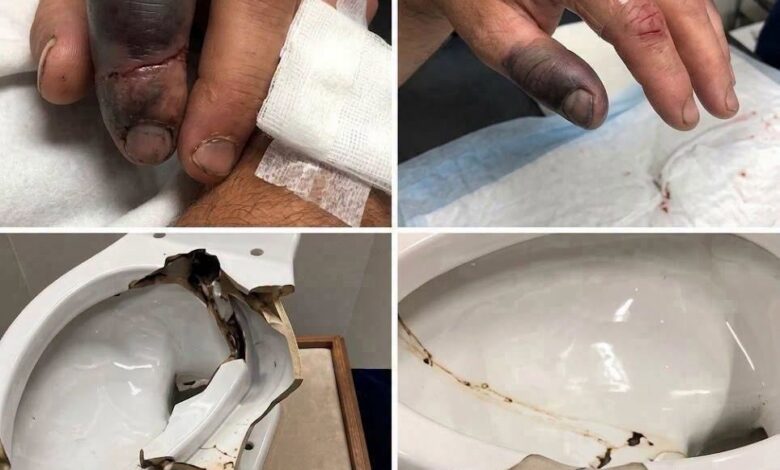
The images accompanying the circulating story are particularly attention-grabbing.
One appears to show a severely injured hand.
Another depicts a damaged ceramic toilet with broken sections around the bowl.
Together, they create a disturbing picture of what can happen when a bathroom fixture fails.
However, photographs have limitations.
They can show visible damage, but they cannot independently establish the sequence of events.
For example, an image of a broken toilet cannot tell us:
Whether the toilet was already cracked.
Whether an object struck it.
Whether it was installed correctly.
Whether the floor beneath it was damaged.
Whether the person was sitting on it when it broke.
Whether the injured hand belongs to the person described in the headline.
These details require a reliable account or an investigation.
The distinction is especially important when images are shared repeatedly across social media.
A photograph may be genuine while the caption attached to it is incomplete, exaggerated or unrelated.
Readers should therefore distinguish between what an image actually demonstrates and what a headline asks them to believe.
The visible damage is a reason to discuss ceramic safety.
It is not sufficient evidence to reconstruct an entire accident.
The Truth Behind the Story: Is This a Confirmed Incident?
After examining the full five-part article, there is an important clarification.
The original publication does not provide a verified identity, hospital record, location or independent news report confirming the man’s accident.
More importantly, the publication itself carries a disclaimer stating that the story is fictional and that any resemblance to real people or events is coincidental.
This means the dramatic account should not be presented as confirmed news.
The images may illustrate a damaged toilet and an injured hand, but they do not prove that the photographs show one identifiable man who suffered the exact incident described in the headline.
There is also no verified information establishing his medical diagnosis, whether he underwent surgery or how long his recovery took.
That does not mean the underlying household hazard is imaginary.
Ceramic toilets can break.
Broken porcelain can cause serious cuts.
Deep hand injuries can damage tendons, nerves and blood vessels.
And a damaged toilet should be removed from use until it has been properly assessed.
These are genuine safety concerns.
The fictional nature of the headline should not distract from the practical lesson.
Why Sensational Headlines Can Be Misleading
A headline such as “He Went to the Bathroom, Unaware That There Was a…” creates an immediate question.
Readers naturally want to know what was hidden and what happened next.
When the story uses images of broken ceramic and an injured hand, the emotional impact becomes even stronger.
However, dramatic storytelling and verified reporting are not the same thing.
A responsible reader should look for:
A clearly identified location.
A date of the incident.
A reliable news organization or medical source.
An identifiable statement from relevant authorities.
Evidence connecting the photographs to the reported event.
Without these details, the account should be treated as an illustrative or fictional scenario rather than a confirmed real-life accident.
The distinction is important because real household safety advice does not need an invented victim to be meaningful.
Final Thoughts: The Most Dangerous Warning Sign May Be the One You Ignore
The idea of a toilet suddenly breaking beneath someone is frightening precisely because it involves an object people rarely question.
It is part of everyday life.
Most households use the same bathroom fixtures for years without thinking about how they are installed or whether they have developed hidden damage.
But familiarity should never replace basic maintenance.
A toilet that rocks, develops a visible crack, makes unusual noises or shows signs of impact deserves attention.
A small problem should not be ignored until the fixture becomes unusable.
And if a toilet does break, the priority should be to protect anyone nearby, obtain medical help for injuries and keep people away from dangerous fragments.
The story’s dramatic headline is fictional, but the underlying lesson is worth remembering.
A familiar household object can become dangerous when its structural integrity is compromised. Sometimes, noticing one small crack today can prevent a much more serious problem tomorrow.