Grandma Raised Her Granddaughter Until The Girls Father Took Her To Court
I wish I had. Or maybe I’m glad I didn’t. I still don’t know which.
The morning of the hearing, Hazel came downstairs wearing her favorite green sweater.
It was a little too small for her now. The sleeves came above her wrists. Doris had knitted it for her two Christmases ago.
“Are you sure you want to wear that?” I asked. “It’s getting tight.”
“I’m sure,” she said. “It’s green.”
I wore my old blue dress.
I couldn’t afford a cab. Brandon’s lawyers had probably spent more on one morning than I spent on groceries in a year. But we took the number 14 bus downtown, the same way we went to the library on Saturdays.
Hazel held my hand the whole way. Her backpack was on her lap. She kept one arm wrapped around it.
The courthouse was a big stone building with tall columns and a lot of steps. My knee hurt on every one of them.
Brandon was waiting outside the courtroom. He was standing next to his attorney. A tall man with silver hair and a briefcase that probably cost more than my furnace.
Caroline was standing a little apart from them. By the window. She was holding a coffee cup with both hands.
She smiled when she saw Hazel.
“Good morning, sweetheart,” she said.
Hazel nodded politely.
Brandon looked at me. Then he looked at my blue dress. Up and down.
“Ready to get this over with?” he said.
I didn’t answer him.
Inside, the courtroom seemed enormous. Dark wood everywhere. High ceilings. A big seal of the state on the wall behind the judge’s bench.
I’d never been inside a real courtroom before. Only on television.
The judge was a woman. Maybe sixty. She had short gray hair and reading glasses and a calm face that didn’t give anything away. The nameplate in front of her said Hon. Patricia Delgado.
Brandon’s attorney went first.
He talked for a long time. He talked about Brandon’s financial stability. His good job. His income, which he said out loud, and which was more money than I’d earned in the last ten years combined.
He talked about Brandon’s beautiful home. His marriage to Caroline. His church. The excellent private school just three miles from the house. Opportunities Hazel would have there that she couldn’t have with me.
Then he showed photographs.
He put them up on a big screen at the front of the courtroom.
The swimming pool. The tennis court. The big green bedroom with the white desk. The kitchen, with marble countertops and two ovens and not a single crumb anywhere.
I looked down at my hands in my lap.
Our house has peeling paint. Our furniture is old. Our kitchen has one oven, and it runs hot on the left side, and there’s a burn mark on the counter from when I set a pot down too fast in 2009.
I suddenly felt so ashamed. Sitting there in my old blue dress, with my accordion folder that wouldn’t close.
Then I looked over at Hazel.
She wasn’t looking at the screen.
She was looking at me.
Brandon’s attorney said Hazel deserved to live with her biological father.
He admitted that Brandon had been absent. He called it “a difficult period.” He said Brandon had been young and grieving and overwhelmed. He said Brandon had matured. He said Brandon deeply regretted the lost time and wanted nothing more than to make up for it.
Then the judge asked Brandon some questions herself.
“Mr. Keller,” she said. “How often have you visited Hazel during the past eleven years?”
Brandon shifted in his chair.
“Not as often as I should have, Your Honor.”
“How many times?”
He hesitated.
The courtroom was very quiet.
“None,” he said.
The judge wrote something down.
“And since you returned in March,” she said, “what steps have you taken to build a relationship with her?”
“I’ve contacted her. I’ve called.”
“Have you spent any time together? Outings? Meals? Anything?”
Brandon cleared his throat.
“She’s been reluctant, Your Honor.”
I wanted to stand up and say something. My hands were shaking in my lap.
But I waited. Priya at the law library had told me: wait your turn. Don’t interrupt. Judges don’t like it.
So I waited.
Finally, the judge turned to me.
“Mrs. Hollis,” she said. “You’re representing yourself today?”
“Yes, Your Honor.”
“All right. You may speak.”
I stood up slowly. My knee cracked. Somebody behind me coughed.
I had written a whole speech in my notebook. Three pages. I’d practiced it in front of the bathroom mirror every night for a week.
I looked down at my notebook.
I couldn’t read a single word. My eyes were too blurry.
So I just talked.
“Your Honor,” I said. My voice was trembling. “I’ve been there for every birthday. Every single one. Eleven chocolate cakes. I’ve been there every time she was sick. Every ear infection. The chicken pox. The time she broke her wrist falling off the monkey bars. Every time she scraped her knees.”
I looked over at Hazel.
“She is my whole world,” I said. “Please. Please don’t take her away from me.”
Then I tried to explain the rest.
How Brandon came to my house a week after the funeral with two bottles and a pack of diapers. How he set the bag down and walked out. How he never called. Not once. How I’d filed for guardianship and he hadn’t even come to court.
How frightened Hazel was about moving. How she couldn’t sleep. How she’d started bringing Mr. Buttons to bed again.
I held up my accordion folder.
“I have all her records,” I said. “Every report card. Every doctor’s visit. Everything. Since she was a baby.”
The judge nodded. She had the bailiff take the folder.
Then I sat down.
I was sure I hadn’t said enough. I was sure I’d said it all wrong.
My whole body was shaking.
Before the judge could say anything else, Hazel slowly pulled her hand out of mine.
She stood up.
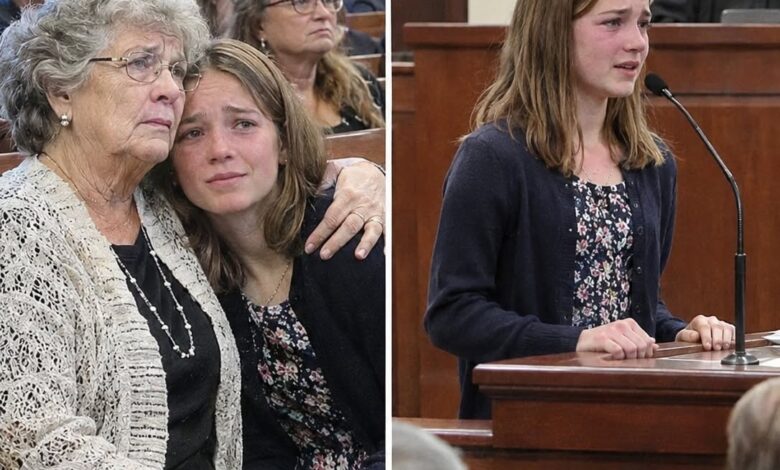
“Your Honor,” she said. “May I say something?”
My heart stopped.
The judge looked at her. Her face softened, just a little.
“Of course,” she said. “But first, you need to promise to tell the truth, young lady. Do you promise?”
“I promise,” Hazel whispered.
The judge pointed to the witness stand. It was a little wooden box beside her bench, with a chair and a microphone.
Hazel walked up to it. She was carrying her backpack. She climbed into the chair. Her feet didn’t even touch the floor. They dangled. Her green sweater sleeves were up above her wrists.
She looked so small.
Hazel took a deep breath.
“Your Honor,” she said, “a few days ago, I overheard my father talking on the phone. In our kitchen. When he came to our house.”
Brandon’s head snapped up.
“I was on the stairs,” Hazel said. “Grandma didn’t know. I wasn’t supposed to be there.”
She took another breath.
“And I know why he really wants me.”
Brandon went pale.
The judge leaned forward.
“What did you hear, Hazel?”
“He said his wife thinks Grandma kept him away from me,” Hazel said.
She looked over at Caroline. Caroline was sitting in the second row behind Brandon, holding her coffee cup. She’d gone very still.
“But that’s not true,” Hazel said. “Grandma never kept him away. He just never came.”
Then she unzipped her backpack.
She reached inside.
And pulled out an old, folded letter.
I knew it the moment I saw it.
Pale blue paper. Little white flowers printed along the top. Emily’s stationery. She’d bought a whole box of it at a gift shop on her honeymoon. Brandon must have taken a few sheets when he packed up their apartment.
He’d written that letter a month after he walked out of my house. Just once. It came in the mail with no return address.
I’d kept it all these years. In the shoebox in Emily’s cabinet. Because it was the only thing he ever wrote down about why he left.
I hadn’t known Hazel found it.
I hadn’t known she even knew where to look.
“Grandma kept this,” Hazel said. Her voice was small but clear. “It was in Mom’s cabinet. In the shoebox with her letters.”
She held it out toward the judge.
“May I show you?”
The judge nodded. The clerk came over and took the letter from Hazel and carried it up to the bench.
Brandon’s face had gone completely white. Like paper.
Caroline was staring at him.
“Brandon,” she said. Out loud. In the courtroom. “What is that?”
He didn’t answer her.
The judge unfolded the letter. She put on her reading glasses. She read it.
It was short. It didn’t take long.
When she was done, she looked up. Over her glasses. Right at Brandon.
“Mr. Keller,” she said. “Did you write this letter?”
Brandon looked down at the table in front of him.
His attorney leaned over and whispered something in his ear.
Brandon shook his head at him.
“Yes,” he said quietly. “I wrote it.”
“Do you dispute its contents?”
A long pause.
“No,” Brandon said.
Hazel’s voice shook.
“Can I tell you what it says?”
The judge looked at her for a long moment. Then she nodded.
Hazel looked straight at her father.
“He wrote that he was too young to raise me,” she said. “He wrote that he didn’t want a baby ruining his future.”
Behind Brandon, Caroline put her hand over her mouth.
Hazel kept going.
“And he wrote that Grandma shouldn’t contact him. Unless it was absolutely necessary. He wrote absolutely and he underlined it.”
The courtroom was completely silent.
I could hear the clock on the back wall ticking.
The judge looked at Brandon.
“Is that accurate, Mr. Keller?”
He nodded slowly.
“I was young,” he said. “I made a mistake.”
Hazel spoke again. Louder this time.
“But you told Caroline that Grandma wouldn’t let you see me.”
Brandon turned around in his chair. He looked at his wife.
“Caroline,” he said. “I can explain.”
Caroline stood up. She stepped back. Away from him. Her coffee cup was still in her hand. Her knuckles were white around it.
“You told me you spent years trying to find your daughter,” she said. Her voice was shaking. “You told me you hired a lawyer. You told me she wouldn’t answer your letters. You cried, Brandon. You cried at our wedding rehearsal, telling my father about it.”
“I was ashamed,” Brandon said.
Caroline stared at him.
She didn’t say anything else.
She didn’t need to.
The judge turned back to Hazel.
Her voice was gentle now.
“Hazel,” she said. “Is there anything else you’d like me to understand?”
She reached into her backpack again.
This time, she pulled out a small photo album. Blue, with a cardboard cover. The corners were bent.
I knew that album too. We’d made it together last summer, at the kitchen table, on rainy afternoons. With a glue stick and stickers and a box of my old photographs.
There were pictures of her first birthday. Her face covered in chocolate cake.
Her first day of kindergarten, holding a lunch box with a cartoon cat on it.
Our little Christmas tree with Emily’s paper star on top.
Me running behind her bike in the church parking lot, holding the back of the seat. My hair was still mostly brown in that picture.
Hazel opened the album.
“These are the things Grandma did with me,” she said.
She held it up so the judge could see.
She turned a page.
“She came to every school concert. Even the one in second grade where I only had to say one line. I said, The turkey is coming! That was my whole part. She came anyway.”
She turned another page.
“She stayed up when I was sick. When I had the stomach flu she slept on my floor so she could hear me.”
Her voice broke.
“She’s the person who knows me,” Hazel said.
The judge waited. She didn’t rush her. She handed a box of tissues to the clerk, who carried it over to the witness stand.
Hazel took one. She wiped her eyes. She blew her nose. Loudly. Into the microphone.
Somebody in the back of the courtroom laughed softly. Not mean. Just human.
Then the judge asked her.
“Hazel. What would you like to happen?”
Hazel looked at me.
“I want to stay with Grandma,” she said.
“My dad has a beautiful house. I know that. I saw the pictures. It’s really pretty.”
She glanced at Brandon.
“But he doesn’t know my favorite color. He doesn’t know my friends. He doesn’t know Maddie. He doesn’t even know what I like for breakfast.”
I covered my mouth with my hand.
“Grandma knows all those things,” Hazel said.
Then she said something I’ll never forget as long as I live.
“My dad says he can give me a better life,” she said.
She looked right at the judge.
“But Grandma already gave me my life.”
I started crying. Right there in the courtroom. I couldn’t stop it. I didn’t try.
Hazel turned back to the judge.
“I don’t want to hurt my dad,” she said. “I don’t. But I don’t want to leave the only home I’ve ever known just because he changed his mind.”
The judge nodded slowly.
“Thank you, Hazel,” she said. “That was very brave.”
The clerk helped Hazel down from the witness stand. She walked back to our table with her backpack and her album. She sat down next to me.
She put her hand back in mine.
It was ice cold.
The hearing went on a while longer.
Brandon’s attorney stood up and talked about how a child of eleven can’t always understand what’s best for her. About how Brandon had made mistakes but people can change. About how love can grow if it’s given a chance.
He sounded less sure than he had at the beginning.
The judge asked Brandon more questions. About the story he’d told Caroline. About why he’d said I kept him away. About the letters he claimed he’d written that I’d never answered.
“There were no other letters,” Brandon said finally. “Just the one.”
The judge wrote that down too.
Then she asked me a few questions. About my health. About my knee. About what would happen to Hazel if something happened to me.
“My friend Doris,” I said. “She’s sixty-eight. She’s agreed to be named as backup. I have it in writing. It’s in the folder.”
The judge flipped through the folder. She found it.
Then she took a recess. Twenty minutes.
Hazel and I sat on a bench in the hallway. Neither of us said anything. I held her hand.
Across the hall, Brandon and his attorney talked in low voices by the water fountain.
Caroline was not with them.
She was standing at the far end of the hall by the window. Alone. Looking out at the parking lot.
When we went back in, I could barely breathe.
The judge sat down. She put on her reading glasses. She looked at her notes.
She talked for a while. About the law. About the best interests of the child. About stability, and continuity of care, and the bond between a child and the person who has raised her.
She talked about Brandon’s eleven years of absence. About the letter. About the story he’d told his wife.
She talked about Hazel. About what Hazel had said on the stand.
“This child knows exactly where her home is,” the judge said. “And so does this court.”
She ruled that Hazel would remain in my care. The guardianship would stay in place.
If Brandon wanted any kind of relationship with his daughter in the future, he could ask the court for supervised visitation. Slowly. At Hazel’s pace. And any future change at all would have to put Hazel’s well-being first.
“Not money,” the judge said, looking at Brandon over her glasses. “Not houses. Not pools. Her well-being.”
I closed my eyes.
Then Hazel threw her arms around my neck so hard my chair tipped back.
“We’re staying together?” she whispered into my ear.
“Yes, sweetheart,” I said. “Yes. We’re staying together.”
Brandon stood up. He didn’t say anything. He didn’t look at us.
Caroline walked past him on her way to the door. She didn’t speak to him. She didn’t look at him either.
But as she passed our table, she slowed down.
She looked at Hazel. Then at me. Her eyes were wet.
“I’m so sorry,” she said quietly. “I didn’t know.”
Then she walked out of the courtroom alone.
I didn’t look back at Brandon.
Outside the courthouse, on the top of the big stone steps, Hazel slipped her hand into mine.
“Yes, sweetheart?”
“Are you mad I took the letter?”
I stopped. I looked at her.
“When did you find it?” I asked.
“The night you said not tonight, ” she said. “After you went to bed. I knew it was in Mom’s cabinet. You looked at it when you said it.” She looked down at her shoes. “I read it under my blanket with a flashlight. And then I put it in my backpack. And then I didn’t sleep at all.”
I knelt down on the courthouse steps. My knee screamed. I didn’t care.
“I’m not mad,” I said. “I’m not mad at all. I just wish you hadn’t carried that worry all by yourself.”
“I was scared he’d take me,” she said.
“So was I,” I said. “So was I, sweetheart.”
Then she smiled. The first real smile I’d seen on her face since March.
“Can we have pancakes when we get home?”
I laughed. Through my tears, I laughed out loud on the courthouse steps.
“Of course.”
“With chocolate chips?”
“Extra chocolate chips.”
“Like, extra extra?”
“Like the whole bag,” I said.
We took the number 14 bus home.
Hazel sat by the window. She held her backpack on her lap. She didn’t hold it as tight as she had that morning.
Halfway home, she fell asleep on my shoulder.
I looked out the window at the city going by. The same streets. The same stores. The same gray sky.
And I thought about Emily. About her laughing on that beach with the wind in her hair, very pregnant, not knowing anything that was coming.
I wished she could see her daughter.
I think maybe, somehow, she did.
Our house still needed paint when we got home.
The front step still wobbled. The furniture was still old. The rug still had the grape juice stain on it.
But when Hazel ran up the walk and through our front door, she turned around in the doorway.
“Come on, Grandma!” she shouted. “We’re home!”
I followed her inside.
I made pancakes. With the whole bag of chocolate chips. They were mostly chocolate with a little bit of pancake holding them together.
Doris came over. She’d been waiting by her phone all day. She cried when we told her. Then she ate four pancakes.
Hazel called Maddie and screamed into the phone so loud I had to hold it away from my ear.
That night, when I went to tuck her in, Mr. Buttons was back on the shelf. Not on her pillow.
“You don’t need him tonight?” I asked.
“Nah,” Hazel said. “I’m okay.”
I turned off her lamp.
“Grandma?” she said in the dark.
“Yes?”
“I love you.”
“I love you too, sweetheart. More than anything.”
Three weeks later, a truck pulled up in front of our house.
Two men got out. They were carrying ladders and drop cloths and buckets of paint.
I went out on the porch in my apron.
“I didn’t order anything,” I said.
“Yes, ma’am,” one of the men said. He checked his clipboard. “Paid in full. Full exterior paint job. Front step repair. The lady said you’d say that.”
“What lady?”
He handed me an envelope.
Inside was a note on plain white paper. Not cream. Not thick. Just ordinary.
Mrs. Hollis,
I’m not trying to buy anything. I just couldn’t stop thinking about your kitchen window.
I’m sorry for what I believed. I’m sorry I didn’t ask more questions. I’m sorry I stood in your living room and told your granddaughter things about her father that weren’t true.
She’s a remarkable girl. You did that.
— Caroline
P.S. I’ve moved out. I’m staying with my sister for a while. I thought you should know.
I stood on my porch for a long time holding that note.
Then I went back inside and called the number at the bottom of it.
Caroline answered on the second ring.
“Mrs. Hollis?”
“Call me Margaret,” I said. “And I’ll let them paint. On one condition.”
“Anything.”
“Hazel’s turning twelve in September,” I said. “You come to the party. You don’t bring anything. Just come. She’ll want to show you her room. It’s not as big as the one you made her. But it’s green.”
There was a long silence on the other end of the line.
Then I heard her start to cry.
“I’d like that,” she said. “I’d really like that.”
The painters did the whole house. White, with dark green shutters. Hazel picked the green.
They fixed the front step. It doesn’t wobble anymore.
I miss the wobble a little, honestly. It was how I always knew when someone was coming up to the door.
Brandon didn’t call for a long time.
In August, a card came in the mail. For Hazel. It was a birthday card, a month early.
It was green.
Inside, in his handwriting, it said:
Hazel. I know I don’t know you. I know it’s my fault. If you ever want to tell me what you like for breakfast, I’d like to know. No pressure. No houses. Just breakfast. — Brandon
He didn’t sign it Dad.
I thought that was the most honest thing he’d ever written.
Hazel read it at the kitchen table. Twice.
“What do you think I should do?” she asked.
“I think that’s up to you, sweetheart,” I said. “Whatever you decide is okay. You don’t have to decide today. Or this year. Or ever.”
She thought about it.
She took a pencil and a piece of notebook paper. She wrote something on it, very carefully. She folded it up and put it in an envelope.
She didn’t show me what she wrote. I didn’t ask.
But I saw the envelope before she sealed it. One word, at the top of the page, in her neat round handwriting.
Pancakes.
Caroline came to the birthday party in September.
She came with nothing in her hands, like I’d asked. She sat at our kitchen table on one of our mismatched chairs and ate chocolate cake with rainbow sprinkles off a paper plate.
Hazel showed her her room. The little one at the top of the stairs. Green walls. Mr. Buttons on the shelf. Emily’s beach photo on the dresser.
“It’s perfect,” Caroline said.
“I know,” Hazel said.
That night, after everyone had gone home, Hazel and I sat on the front porch. On the new step that doesn’t wobble.
The sun was going down. The neighbor’s sprinkler was ticking. Somewhere down the street, a dog was barking.
“Grandma,” Hazel said. “Can I ask you something?”
“Were you scared? In court? When the lawyer showed all the pictures of the pool and stuff?”
I thought about lying. Then I didn’t.
“Yes,” I said. “I was very scared. I thought maybe I hadn’t given you enough.”
She looked at me like that was the strangest thing she’d ever heard.
“Grandma,” she said. “You gave me everything.”
She leaned her head against my shoulder.
For eleven years, I’d worried that I couldn’t give Hazel everything she deserved.
The big house. The pool. The new car on her sixteenth birthday. The fancy school.
I’d lain awake at night counting what I didn’t have.
That day in the courtroom, she reminded me that I’d given her something no expensive house could ever replace.
A place where she knew she was wanted.
Every single day.
From the very first one.