At 13 We Shaved Our Heads for a Classmate Battling Cancer but 17 Years Later He Invited Us to a Dinner Well Never Forget
Will —
You were the one who called them. That night in November, in eighth grade. My mom told me years later. You heard I was scared and you called Jake and Ryan and you got your dad’s clippers.
You were the one who said “We’re in this together.” I’ve said those words to every scared kid I’ve ever treated. Every single one. I tell them a story about three boys who shaved their heads. I tell them they’re not alone.
If something happens, I want Ivy to grow up with a history teacher. Somebody who’ll tell her where she came from. Who’ll tell her about Montague Street and Lino’s and Culver’s and the roof of your garage. Who’ll tell her who her dad was before he was sick. And who her dad was because of you.
You’re the storyteller, Will. You always were.
Tell her the story.
— D.
I couldn’t see anymore. I couldn’t see the paper or the candle or the table.
I held out my hand. Ryan put the pen in it.
I signed the last page. William James Harper. My hand was shaking so badly the signature was barely legible.
I slid it across the table to Daniel.
“I’ll tell her the story,” I said. “But I’m going to tell it with you there. At her graduation. At her wedding.”
Daniel put his face in his hands.
Part Nineteen: The Clippers Again
We didn’t eat the chicken parm. It got cold on the table.
We sat there in that little private room at Lino’s for two more hours, the four of us. We talked about everything. The transplant. Ivy. The fifty percent. Mrs. Kowal. Medical school. Jake’s twins. Ryan’s night shifts. The time Jake broke his wrist jumping the creek in Sinnissippi Park.
We laughed a lot. We cried more.
At ten o’clock, Mr. Gallo’s son, Tony, who runs Lino’s now, knocked on the door. He was sixty, gray-haired, in a white apron. He remembered us. He remembered the four bald boys from 2009.
He looked at Daniel’s bald head in the candlelight. He looked at the three envelopes and the three tear-streaked faces.
He didn’t ask any questions.
He went back into the kitchen. A few minutes later, he came back with four plates of tiramisu.
“On the house,” Tony said. “Like my father did. For the day you got better.”
He set them down. He put his hand on Daniel’s shoulder for a moment. Then he left.
After the tiramisu, Jake stood up.
“Wait here,” he said.
He went out to his pickup in the parking lot on East State Street. He came back five minutes later carrying something in a plastic Walmart bag.
He set it on the table.
It was a pair of Wahl electric clippers. Brand new, still in the box.
“I bought them on the way here,” Jake said. “At the Walmart on North Perryville. Just in case.” He looked at Daniel’s beanie on the table. “I had a feeling.”
Daniel stared at the clippers. Then he started to laugh. Then he started to cry. Then both.
“You guys,” he said. “You don’t have to do this. You’re thirty years old. You have jobs. Will’s a teacher, he’ll have to explain it to a hundred and fifty teenagers.”
“Yeah,” I said, standing up. “We do.”
I picked up the box. I opened it.
“We’re in this together,” I said.
Part Twenty: The Men’s Room
Tony Gallo let us use the men’s room in the back of Lino’s. It’s a small room with black-and-white tile and a single sink and a mirror with a crack in the corner from 1974.
Jake went first again. He sat on a folding chair Tony brought from the kitchen, with a dish towel around his shoulders. I ran the clippers right down the middle of his head, front to back. A thick stripe of graying black hair fell onto the black-and-white tile.
We stood there looking at it.
Then Jake started laughing. Then Ryan. Then me.
It took us about forty minutes. We took turns, the way we did when we were thirteen. Jake did me. I did Ryan. Ryan’s thinning red hair came off in soft clumps on the floor, and he picked one up and looked at it and said, “Huh. I’m going to miss that. What’s left of it.”
Daniel sat on the edge of the sink the whole time, watching us, laughing so hard he had to hold his side.
When we were done, the four of us stood side by side in front of the cracked mirror in the men’s room at Lino’s.
Four bald heads. Three of them lumpy and pale and nicked and uneven. One smooth and gray from chemotherapy.
We looked terrible.
We looked like four old potatoes.
Daniel looked at the four of us in the mirror for a long time.
Then he put his arms around our shoulders. Jake on one side, Ryan and me on the other.
“Seventeen years,” he said quietly. “And you still don’t know how to use clippers.”
Part Twenty-One: Madison
The transplant was on Monday, November 18th, at the University of Wisconsin Hospital in Madison.
All three of us were there.
Jake left his business with his foreman for the week. Ryan traded his night shifts with three other nurses. I took a week of personal days, and my principal said, when I told him why, “Take two.”
Laura came with me. And Grace, who’s eight, and who’d been asking questions ever since I came home from Rockford with a shaved head.
“Why did you shave your head, Daddy?” she’d asked, that Sunday morning, staring at me across the breakfast table.
“So my friend doesn’t feel alone,” I said.
Grace thought about that very seriously.
“Is he sick?” she asked.
“Yes,” I said.
“Can I meet him?” she asked.
Mrs. Kowal was there too. Maureen. Sixty-four now, gray-haired, smaller than I remembered, in a hospital gown, with a bandage on her arm from the stem cell harvest the day before. She was sitting in a wheelchair in the hallway outside Daniel’s isolation room on the eighth floor.
She saw the three of us coming down the hallway. Three bald heads.
She put her hand over her mouth. Then she started to cry.
“Oh, boys,” she whispered. “Oh, boys. Not again.”
“Again,” Jake said, and leaned down and hugged her in her wheelchair.
Part Twenty-Two: Ivy
Ivy was there too, with Mrs. Kowal. Four years old, with Daniel’s dark eyes and curly brown hair in two pigtails. She was holding a stuffed elephant with a bandage on its trunk.
She looked up at the three of us standing in the hallway. Three bald men she’d never met.
She studied us very seriously. The way Daniel used to study things.
“You look like my daddy,” she said.
Jake knelt down in front of her. He’s six-foot-two and two hundred and forty pounds, and he got down on one knee on the hospital floor so he’d be eye to eye with a four-year-old.
“That’s on purpose,” he said. “We’re your daddy’s best friends. From when he was a little boy.”
Ivy looked at his bald head. She reached out one small hand and touched it.
“It’s scratchy,” she said.
“Yeah,” Jake said. “Mine grows back fast.”
Ivy looked at Ryan. Then at me.
“Are you Uncle Will?” she asked me.
I stared at her. “How did you know that?”
“Daddy has a picture,” Ivy said. “On the refrigerator. Of four boys with no hair.” She pointed at each of us. “That’s Uncle Jake. That’s Uncle Ryan. That’s Uncle Will.” She pointed at her stuffed elephant. “And that’s Daddy.”
She was quiet for a moment.
“Daddy says you’re the reason he’s brave,” she said.
Part Twenty-Three: The Long Weeks
The transplant itself was anticlimactic, the way Daniel said it would be. A bag of Maureen’s stem cells, about the size of a bag of blood, dripping into the port in Daniel’s chest through an IV line over two hours. He watched TV the whole time. We watched through the window in the door of his isolation room, because we couldn’t go in. His immune system was gone. One cold could kill him.
Then came the long weeks.
Daniel was in isolation on the eighth floor for thirty-eight days. The chemo and radiation before the transplant had wiped out his entire immune system. He had no white blood cells. He couldn’t fight anything. He got mouth sores so bad he couldn’t eat or talk. He got a fever on day nine that spiked to a hundred and four, and they moved him to the ICU for three days, and Ryan sat in the ICU waiting room the whole time because he knew what every number on every monitor meant.
We couldn’t go in. But we came.
Jake drove up from Rockford every Saturday. Ninety minutes each way. He brought Ivy a different toy every week and sat with her in the family lounge on the eighth floor and built Lego castles while Mrs. Kowal napped on the couch.
Ryan drove up from Des Moines every Tuesday. Four and a half hours each way. He’d stand at the window of Daniel’s room in his scrubs and talk to him on the phone, and Daniel would hold the phone to his ear on the other side of the glass, and they’d talk for two hours about nothing. About hockey. About bad nurses and good doctors. About the time in 2012 when Ryan threw up on the Tilt-A-Whirl at the Winnebago County Fair.
I drove up from Indianapolis every Friday night after school. Five hours each way. I’d sit in the family lounge with Ivy and read her stories. Mostly The Very Hungry Caterpillar, because she liked the holes in the pages. And then, when she was asleep on the couch, I’d go to the window of Daniel’s room and tell him stories through the phone.
Stories about us. About Montague Street and Lino’s and Culver’s and the roof of my garage.
“Tell me the one about the drive-in,” he’d say, his voice hoarse from the mouth sores. “The one where you and Ryan got caught.”
So I’d tell it. And he’d laugh, behind the glass, until he coughed.
Part Twenty-Four: Engraftment
On day twenty-three after the transplant, Daniel’s white blood cell count started to rise.
It’s called engraftment. It means the stem cells from his mother had found their way into his bones and started making new blood. Healthy blood. Leukemia-free blood.
His doctor, a tall, gentle hematologist from Kenya named Dr. Wanjiru, came out into the hallway to tell us. Mrs. Kowal was there. And Ryan, who’d driven up on a Thursday because he had a feeling. And Ivy, holding her elephant.
“His counts are coming up,” Dr. Wanjiru said, smiling. “His mother’s cells are working. They’ve found their way home.”
Mrs. Kowal put her face in her hands in her wheelchair and wept.
“My cells,” she said. “Twice. I gave him life twice.”
Ryan knelt beside her wheelchair and held her hand.
Ivy looked up at Dr. Wanjiru, confused. “What does that mean?” she asked.
Dr. Wanjiru knelt down in front of her.
“It means,” she said, “that your daddy’s body is learning how to be strong again. With some help from your grandma.”
Ivy thought about that.
“Like Uncle Will and Uncle Jake and Uncle Ryan helped him,” she said. “When he was little.”
Dr. Wanjiru looked up at Ryan, puzzled. Ryan just smiled and touched his bald head.
Part Twenty-Five: Home
Daniel went home on December 26th. The day after Christmas.
We were all there when he came out of the isolation room on the eighth floor for the first time in thirty-eight days. In a wheelchair, wearing a surgical mask, thinner than I’d ever seen him, with his gray beanie on his head.
Ivy ran down the hallway and threw herself at his legs. He picked her up. The nurses told him not to. He did it anyway. He held his daughter in his lap in the wheelchair and buried his face in her pigtails and didn’t let go for a long time.
Then he looked up and saw the three of us standing in the hallway.
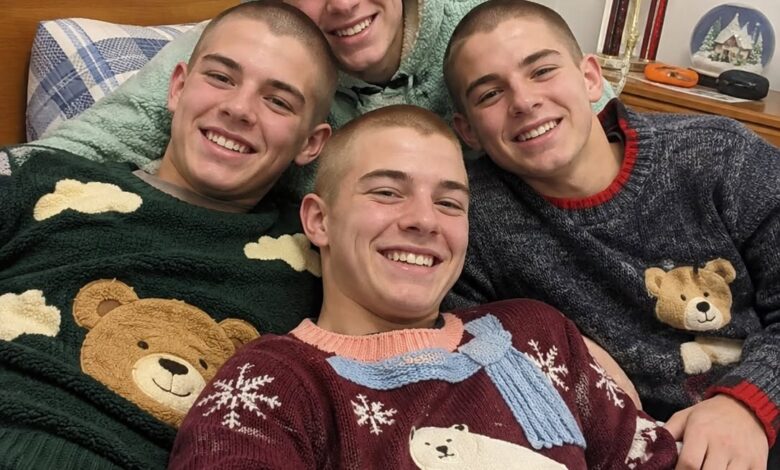
Three bald heads. We’d kept them shaved. Every Saturday for six weeks, in Jake’s garage in Rockford, or Ryan’s apartment in Des Moines, or my kitchen in Indianapolis, with the clippers from the Walmart on North Perryville. We’d send each other photos. Bald selfies. Ryan started a group chat called The Potatoes.
Daniel looked at the three of us for a long time.
Then he pulled off his gray beanie.
There was hair on his head. Just a little. A faint dark fuzz, like a newborn’s. Coming back.
“Look,” he said. “It’s coming back.”
Part Twenty-Six: One Year
The doctors said the first year would be the hardest. They were right. There were infections. There was a hospital stay in March for something called graft-versus-host disease, when Maureen’s new immune cells got confused and started attacking Daniel’s skin and his gut. It was terrifying. It got better with steroids.
There were bone marrow biopsies every three months, to check for leukemia. Every one of them came back clean.
We kept showing up.
Jake built Ivy a tree house in Daniel’s backyard in Madison over three weekends in April. With a rope ladder and a little window and a sign over the door that Ivy painted herself in purple letters. NO SICK PEPLE ALOWED (EXCEPT DADDY).
Ryan took the night shift. Literally. Whenever Daniel had a bad night, a fever, or nausea, or a panic attack about the leukemia coming back, he’d call Ryan at two in the morning, and Ryan would be awake, because Ryan is always awake at two in the morning, and they’d talk until it passed.
And I told the story. To Ivy. Every time I visited. About Montague Street and Lino’s and Culver’s and four bald boys on the roof of a garage in Rockford, looking at the stars.
And once a month, on the last Saturday, the four of us had dinner. Sometimes at Lino’s in Rockford. Sometimes in Madison, or Des Moines, or Indianapolis. Wherever. Four chairs. Four place settings.
We stopped shaving our heads after Daniel’s hair grew back in. But every November, on the anniversary of Montague Street, we do it again. All four of us. Together. Daniel too.
He says it’s the only time of year he looks good bald.
Part Twenty-Seven: Two Years
On November 18th, two years after the transplant, Daniel had another bone marrow biopsy at UW Hospital.
Dr. Wanjiru called him three days later. He was at his clinic in Madison, examining a seven-year-old with leukemia. He stepped out into the hallway to take the call.
He called each of us afterward. Jake first. Then Ryan. Then me.
When I answered, he didn’t say hello.
“Two years,” he said. “Clean. No leukemia. Dr. Wanjiru says I’m past the hardest part. She says the odds are in my favor now.”
I sat down on the floor of my classroom at North Central High School, in the middle of my planning period, and cried.
“Fifty-fifty,” I said, when I could talk.
“I won the coin toss,” Daniel said.
Part Twenty-Eight: Thirty-Two
His thirty-second birthday was the following Saturday.
He sent the same text he sent two years earlier, to all three of us, word for word.
Hey, brother. I’m turning 32 next Saturday. I want to have dinner with you and Jake and Ryan. Just the four of us. At Lino’s, in Rockford. It would mean the world to me if you could make it.
And then, a minute later, a second message.
Please come. I really need all three of you there.
This time, I smiled when I read it.
This time, I knew.
Tony Gallo led me to the same little private room in the back of Lino’s. Jake and Ryan were already there. We hugged. Jake’s beard was grayer. Ryan’s hair was thinner. Mine was starting to go gray at the temples.
The same small round table. The same red-checked tablecloth. The same candle in a Chianti bottle.
But this time, there were five chairs.
The door opened behind us. Daniel came in.
He’d gained back the weight. His face was full and healthy. His dark hair was thick and curly again, curlier than it was before the transplant, which Dr. Wanjiru said happens sometimes. He looked like himself. He looked like the kid on Montague Street, grown up.
And he was holding his daughter’s hand.
Ivy. Six years old now, in a purple dress, with her pigtails and her stuffed elephant with the bandage on its trunk.
“I hope you don’t mind,” Daniel said. “I brought a guest.”
We sat down. Five chairs. Five place settings. Tony Gallo brought out five plates of chicken parmigiana without being asked.
Halfway through dinner, Ivy put down her fork and looked around the table at the four of us.
“Uncle Will,” she said. “Tell the story.”
“Which one?” I asked.
“The one about the clippers,” she said. “When Daddy was thirteen. When you all looked like potatoes.”
So I told it. The whole thing. Mrs. Kowal’s phone call on a Sunday night in November. Jake and Ryan riding their bikes over in the dark. My dad’s Wahl clippers in the bathroom cabinet. Ryan’s red curls on my bathroom floor. Three little potatoes standing in front of a mirror. The front porch on Montague Street. Mrs. Kowal crying. Oh, boys.
And a skinny bald boy sitting on the edge of his bed in a gray beanie, staring at the floor. Looking up.
What happened to your hair?
When I got to the end, Ivy was quiet for a long time. She looked at her father. Then at each of us.
“And then what happened?” she asked.
I looked across the table at Daniel. He was smiling at me, with his eyes full.
“Then,” I said, “we stayed.”
Ivy thought about that very seriously, the way six-year-olds do. Then she picked up her fork again.
“That’s a good story,” she said. “Tell it again next year.”
Daniel laughed. Jake laughed. Ryan laughed so hard he knocked over his water glass.
And I promised her I would. Every year, at Lino’s, around a table with one more chair than it used to have, for as long as the four of us are around to sit at it.
Categories:
Stories