A teenage girl tried to steal a book, but the brooch she gave me made me lose my job and start a whole new life!
The golden hue of late afternoon sunlight filtered through the tall, grime-streaked windows of the bookstore, illuminating the dancing dust motes that haunted the classics section. I was in the middle of a familiar ritual, sliding leather-bound volumes back into their rightful places, enjoying the sanctuary of the silence. To me, a bookstore isn’t just a place of commerce; it is a cathedral of shared human experience. The air always smells of vanilla, old paper, and the quiet weight of a thousand different lives waiting to be read. It was in this peaceful atmosphere that the bell above the door gave a sharp, melodic ring, signaling the entrance of the person who would inadvertently dismantle my life and rebuild it into something unrecognizable.
I noticed her immediately. She was a teenager, perhaps sixteen, nearly swallowed by an oversized hoodie with a backpack that sagged under its own weight. Her movements were erratic, characterized by a nervous energy that felt out of place among the steady, slow-moving patrons of the shop. She hovered near the paperback aisle, her hands trembling as she scanned the titles. There was a profound sadness in her posture, a sort of apologetic slouch that made my chest tighten with an instinctive worry. I watched from the shadows of the biography shelf as she reached out, her fingers ghosting over a worn spine, before she swiftly tucked an old, weathered book into her open bag.
My heart sank. I knew the protocol—I was supposed to be firm, to call security, to treat this as a clinical violation of store policy. But as I approached her, I didn’t feel like an enforcer; I felt like a witness to a tragedy.
“Hey,” I said, keeping my voice low so as not to startle the few other customers. “Can we talk for a moment?”
The girl’s face went a ghostly shade of white. She froze mid-step, her shoulders hunching up as if she expected a blow. When she finally turned to look at me, her eyes were already swimming in tears that seemed to have been stored up for a long time. She didn’t try to run or deny it. Instead, she began to sob—a jagged, hollow sound that echoed through the quiet aisles.
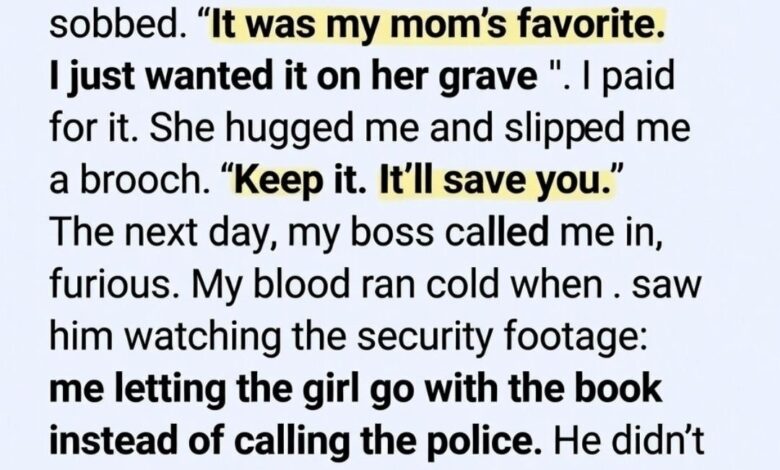
“I’m sorry,” she whispered, the words barely audible through her weeping. “I wasn’t doing this for fun. I’m not a thief. It’s just… it was my mom’s favorite. She used to read this exact story to me every single night before the sickness took hold. She passed away last year, and I just wanted to give it back to her. I wanted to leave it on her grave so she’d have her favorite thing with her.”
The corporate handbooks and the strict rules of retail suddenly felt like brittle, meaningless things. Looking at her, I didn’t see a shoplifter; I saw a grieving child trying to bridge the gap between the living and the dead. Without a second thought, I took the book from her backpack, walked over to the register, and swiped my own card to pay for it.
She stared at me in stunned silence, her expression shifting from terror to a look of pure, unadulterated hope. To her, I had performed a miracle, but to me, I was simply honoring the memory of the mother she had lost.
“Thank you,” she said, her voice cracking. Suddenly, she lunged forward and hugged me, a desperate, fierce embrace as if I were the only solid ground in her crumbling world. When she finally pulled back, she took something small and cold from her pocket and pressed it firmly into my palm.
“Please,” she insisted, closing my fingers over the object. “Take this. Keep it. My mother always said it was lucky. I think it’s supposed to be with you now. It will help you someday.”
It was an antique brooch, shaped like a delicate, silver flower with a solitary, brilliant blue stone set into the center. I tried to protest, but she was already backing away, a sad but grateful smile on her face as she disappeared through the front door and into the bustling city outside.
The fallout was swifter than I expected. The following morning, my manager, a man who viewed the world entirely through the binary of profit and loss, called me into his office. He didn’t waste time with a lecture. He simply swiveled his monitor toward me and hit play on the security footage. There I was, clear as day, taking a book from a thief and letting her walk out the door without a citation.
“I don’t want to hear the story,” he said, cutting off my attempt to explain the girl’s grief. “You facilitated a theft. You broke the fundamental trust of this establishment. You’re fired.”
I walked out of the store with my meager box of belongings, but curiously, I didn’t feel the weight of failure. Instead, I felt a strange sense of buoyancy. That job had always been a placeholder, a quiet corner where I could hide from my own ambitions. Being forced out felt like being pushed into the sunlight.
A week later, I found myself sitting in the lobby of a major architectural firm—a dream company that I had previously deemed far beyond my reach. On a whim, or perhaps guided by a lingering sense of connection to that girl, I had pinned the silver flower brooch to the lapel of my blazer. During the interview, as I was discussing my portfolio, the hiring manager suddenly stopped mid-sentence. Her eyes were fixed on my jacket, her expression one of utter bewilderment.
“Where did you get that brooch?” she asked, her voice hushed and urgent.
I told her the truth—the whole story of the girl in the bookstore, the stolen book for a mother’s grave, and the gift of gratitude. She didn’t respond at first. She simply stood up and gestured for me to follow her. She led me down a hall of glass-walled offices to a grand corner suite where an older man sat behind a mahogany desk, looking tired and weary.
The moment his eyes landed on the silver flower, he went remarkably still. His face drained of color as he reached out a trembling hand toward the blue stone.
“That belonged to my wife,” he whispered. “She wore it every single day of our marriage.”
He began to tell a story that mirrored the one I had heard in the bookstore, but from the perspective of the left-behind. He explained that his daughter, Mia, had been devastated by her mother’s death, but the tragedy was compounded when she discovered he wasn’t her biological father. In her grief and confusion, she had lashed out, and they had become bitter strangers living under the same roof. On the day she finally ran away, the brooch had vanished with her.
“I never stopped looking for her,” he said, his voice thick with a father’s regret. “But she didn’t want to be found. I didn’t know how to tell her that biology didn’t matter—that she was my daughter regardless of everything else.”
The interview transformed into a bridge of reconciliation. Because I had seen the girl and treated her with dignity instead of judgment, I had become the link back to his lost child. He hired me on the spot, not out of charity, but because he believed that someone who valued humanity over rules was exactly what his firm needed.
Today, the firm is no longer just my workplace; it is the site of a restored family. Mia eventually returned home, and she often stops by the office to visit her father. Every time she passes my desk, she gives me a knowing smile—a silent acknowledgement of that afternoon in the dust-filtered light of the bookstore. The brooch remains pinned to my jacket, a shimmering reminder that a single, impulsive act of kindness has the power to ripple through lives, mending broken hearts and leading us toward the destinies we were always meant to find.