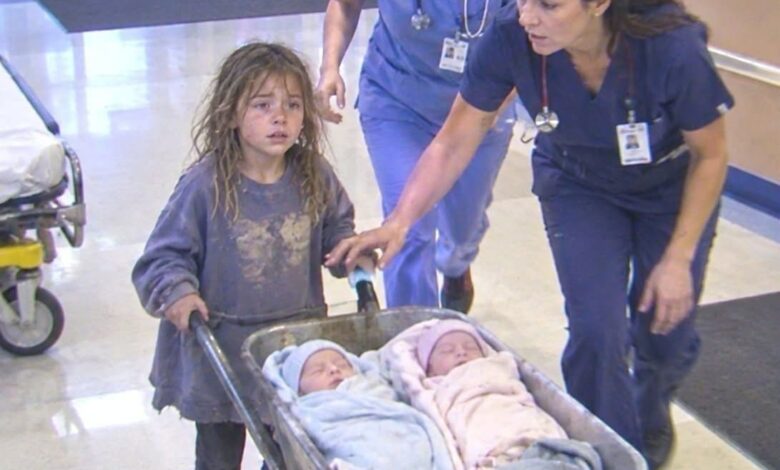
A Six Year Old Pushed a Wheelbarrow to Save Her Twin Brothers
Despite the urgency she had shown pushing the wheelbarrow, she now seemed unsure what she was allowed to do.
Her mother lifted one hand from the blanket.
That was enough.
The girl crossed the room and carefully pressed herself against the side of the bed.
Her mother touched the back of her sweatshirt.
Neither spoke for several seconds.
Then the child pulled away.
“I took the babies.”
Her mother looked confused.
“Where?”
“Here.”
The mother stared at her.
A nearby nurse explained the rest in as few words as possible.
The wheelbarrow.
The walk.
The emergency room.
The key.
By the time she finished, the mother’s hand covered her mouth.
“You pushed them here?”
The girl nodded.
Then came the fear she had apparently carried since the ambulance arrived.
“Are you mad?”
Her mother immediately shook her head.
“No.”
“I left the house.”
“I know.”
“You said I wasn’t supposed to.”
Her mother’s expression tightened.
Sometimes a rule that once made perfect sense becomes useless in the face of something larger.
She reached for her daughter’s hand.
“You were supposed to get help if you were in danger.”
The girl studied her.
“We were?”
“Yes.”
“All of us?”
“All of you.”
The answer seemed to settle something the child hadn’t known how to ask.
Then she touched the key hanging against her sweatshirt.
“He gave it back.”
Her mother looked at the string and briefly closed her eyes.
She remembered writing the note.
She remembered feeling faint more than once after returning home with the twins.
She remembered telling herself to stand up, drink water, make a call, do one more thing.
Then there was nothing until the hospital.
The note hadn’t been a grand plan.
It was the hurried thinking of an exhausted mother who knew she was getting worse and tried to leave breadcrumbs in case she couldn’t finish what she started.
The key was one.
Her daughter had turned it into something else.
Not a rule about keeping the house locked.
A way to let help in.
The mother remained hospitalized while recovering.
The twins improved steadily enough that the worst possibilities began to fade.
Their older sister became familiar to the nurses, though staff worked hard to return her to the role she should have had all along.
Child.
Someone brought crayons.
Someone found a children’s movie.
She finally ate the sandwich she had refused, then asked for another snack an hour later.
When she tried checking whether the babies needed anything, a nurse gently redirected her.
“We’ve got them.”
The girl frowned, as though surrendering responsibility was harder than taking it.
“Both?”
The nurse smiled.
“Both.”
The same answer that convinced her to release the wheelbarrow handles finally persuaded her to leave the nursery for a while.
Over the following days, the adults focused on the less dramatic work that made going home possible.
A relative came to stay.
Meals were arranged.
The mother received clear follow-up instructions and a plan for what to do if symptoms returned.
Emergency numbers were made easy to reach, and everyone ensured the six-year-old would not become the family’s backup adult simply because she had handled an impossible situation once.
That mattered deeply to her mother.
When visitors called the girl brave, the mother never disagreed.
But she refused to let bravery become an excuse to expect more from her.
“She saved us,” she told one person quietly. “Now she gets to be six.”
The wheelbarrow eventually came home too.
A responder arranged for it to be moved from the emergency entrance once staff no longer needed it to understand how the babies arrived.
For a while, it sat beside the house exactly where someone had left it.
The girl didn’t touch it.
Neither did her mother.
Seeing the metal handles was enough to bring back the hospital doors, towels, tiny sounds inside, and the miles a child somehow covered because staying home finally frightened her more than leaving.
Weeks passed.
The twins grew stronger.
The mother’s steps became steadier.
The house filled again with ordinary noises: bottles being washed, laundry running, someone searching for a missing sock, a baby protesting a diaper change, the older girl asking for a snack five minutes after saying she was full.
Those sounds mattered more than anyone expected.
They meant nobody was lying beside a bed while a six-year-old tried to decide whether nighttime had lasted too long.
One afternoon, the mother found her daughter standing near the wheelbarrow.
Both hands were on the handles.
For one second, the mother froze.
Then she saw what was inside.
Not babies.
A bag of potting soil, small gardening gloves, and a plastic watering can.
The girl looked at her.
“Can I use it?”
Her mother swallowed.
“For the yard?”
“Yeah. It’s easier than carrying the bag.”
The mother walked over and tested one handle with her palm.
Then stepped aside.
“Okay.”
The girl pushed.
The wheel squeaked once.
Her mother flinched before she could stop herself.
The girl heard it too.
She paused and looked back.
Her mother could have taken the handles.
Instead, she nodded toward the yard.
“Go ahead.”
So the six-year-old pushed the wheelbarrow across the grass, this time carrying dirt instead of newborns, moving only a few yards while her mother watched from the porch.
The key still hung on its piece of string, but no longer around the child’s neck.
It had been moved to a hook beside the front door where adults could reach it.
That was where it belonged.
The wheelbarrow belonged in the yard.
The babies belonged in safe arms.
And the little girl who had carried an adult-sized responsibility for three days was finally free to leave both hands empty whenever she wanted.