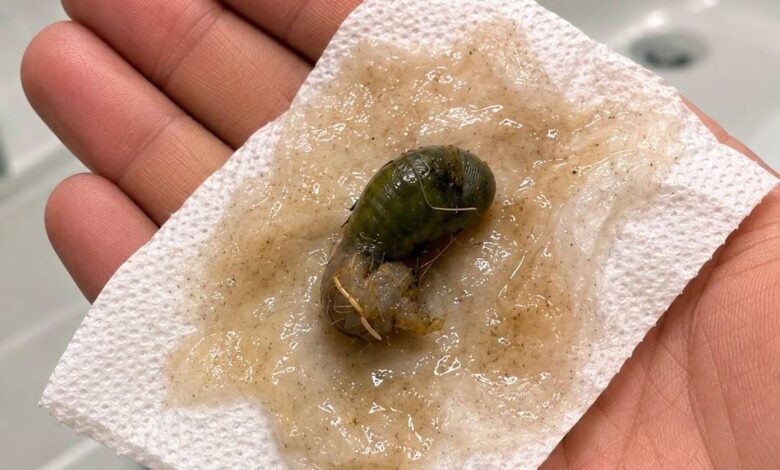
A Mysterious Discovery on Our Bathroom Floor Left Us Searching for Answers
A routine round of bathroom cleaning produced a discovery that neither of us expected. Resting on the floor was a small green object with a segmented body and an unfamiliar shape. It was easy to miss among the ordinary details of the room, yet once we noticed it, we could not stop wondering what it was or how it had arrived there.
At first, the object looked unsettling. Its ridged surface suggested something biological, but it did not resemble an insect we recognized. It was not moving, and there were no obvious wings, legs, or features that offered an immediate answer. Because it appeared in a bathroom, we considered everything from a piece of plant material to some kind of household pest.
We chose not to touch it with bare hands. Unfamiliar insects and discarded insect parts are usually harmless, but caution seemed sensible until we understood what we were seeing. We observed it from a short distance, compared impressions, and tried to remember whether anything similar had entered the house before. Neither of us could identify it with confidence.
After several minutes, my husband used a tissue to pick it up carefully. He placed it inside a small container so we could examine it without damaging it or allowing it to disappear into a crack. Under better light, the details became easier to see. The green surface had distinct sections, and the overall form appeared organized rather than broken or random.
That closer look shifted our concern into curiosity. The object seemed less like debris and more like a stage in an animal’s development. It had the compact, protected appearance of something undergoing a transformation. We began searching reliable insect images and descriptions, paying attention to color, body segmentation, size, and the shapes associated with different life-cycle stages.
The closest match was a beetle pupa. Beetles undergo complete metamorphosis, moving through egg, larval, pupal, and adult stages. The larva looks very different from the winged adult it will eventually become. During the pupal stage, the insect’s body is reorganizing inside a relatively still form. Features that will belong to the adult begin developing even though the pupa may appear inactive.
The answer explained why the object had been so difficult to recognize. Most people are familiar with adult beetles, and many have seen beetle larvae or grubs, but the stage between them is encountered less often. A pupa can look fragile, oddly shaped, and almost unfinished because it represents a temporary point in a much larger biological process.
Finding it on a bathroom floor did not necessarily mean that the room was infested. It may have been carried indoors on clothing, a towel, a pet, a plant, or an item stored elsewhere. It could also have developed in a sheltered spot and become dislodged. A single discovery offers limited evidence, so we resisted turning one mysterious object into a dramatic conclusion.
Still, the experience encouraged us to inspect the room and nearby areas. We checked for moisture problems, gaps around windows, and other signs of insects. Bathrooms can attract small creatures because they offer water and protected corners, but keeping surfaces dry, repairing cracks, and cleaning regularly can reduce opportunities for pests to remain unnoticed.
Anyone who finds an unfamiliar insect stage should avoid handling it directly if they are uncertain about it. A clear photograph beside an object for scale can help with identification. Local extension services, natural-history groups, pest professionals, and well-moderated identification communities may provide better answers than a rushed image comparison. Location and season can also be important clues.
What began as a mildly alarming discovery became a lesson in the quiet complexity of nature. The segmented green object was not the threatening mystery we first imagined. It was likely a beetle passing through one of the most remarkable stages of its life. The encounter reminded us that unfamiliar things often seem frightening because we lack context, and that patient observation can turn unease into fascination.