A Man Wants a Divorce!
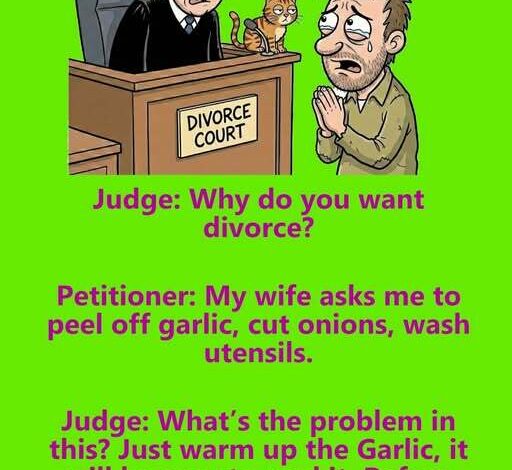
The courtroom was quiet in the way only courtrooms ever are—heavy with expectation, polished with formality, and faintly tense, as if everyone present knew that something personal was about to be exposed under fluorescent lights. At the center of it all stood a man in his early forties, shoulders slumped, eyes tired, clutching a folder that contained his formal request for divorce.
He looked like someone who had rehearsed his grievances many times. Like someone who had finally reached the end of his patience.
The judge, an older man with a calm face and a voice practiced in defusing conflict, glanced down at the paperwork and then back up at the husband.
“So,” the judge said evenly, “you’re asking to dissolve your marriage. Tell me why.”
The man cleared his throat. He spoke carefully at first, but the words soon tumbled out faster, fueled by months—maybe years—of frustration. His wife, he said, constantly asked him to do things. Small things. Endless things. Peel garlic. Chop onions. Soak dishes. Separate laundry. Clean up messes that never seemed to end. Nothing was ever enough. The demands were relentless. He felt trapped, exhausted, unappreciated.
“I can’t take it anymore,” he concluded. “I want out.”
The judge listened without interruption, nodding slowly, as if he’d heard variations of this story hundreds of times before. When the man finished, the courtroom waited for judgment, advice, perhaps even validation.
Instead, the judge leaned back slightly and smiled.
“You know,” he said, “there are ways to make those things easier.”
The husband blinked.
“For garlic,” the judge continued casually, “you can crush it lightly with the side of a knife and the peel comes right off. Onions? Chill them first—less sting, faster chopping. Dishes soak better with hot water and a bit of vinegar. Laundry lasts longer if you separate colors properly. Saves arguments.”
A few quiet chuckles rippled through the courtroom.
The husband stared at the judge, confused. This wasn’t what he expected. The judge kept going, listing household tricks with the confidence of someone who had learned them the hard way. He spoke about efficiency, routines, compromise. About how marriages were often less about grand betrayals and more about the slow grind of everyday life.
“If you’re willing,” the judge said finally, “you can withdraw your petition. Sometimes the problem isn’t the work itself, but how we look at it.”
There was a pause.
Then, slowly, the husband exhaled. His shoulders dropped even further, but this time not from defeat—more from clarity. He nodded.
“I’d like to withdraw the petition,” he said.
The courtroom relaxed. Pens stopped scribbling. People assumed the matter was settled.
But just as the judge began to move on, the husband spoke again.
“Your Honor,” he said, with a faint, wry smile, “if this is what you deal with every day… I think your condition is worse than mine.”
For a split second, there was silence.
Then laughter broke out—real laughter, not polite or forced. Even the judge smiled, shaking his head. The line landed because it was funny, yes—but also because it carried an uncomfortable truth. No one, not even the man in the robe, was spared from the exhausting mechanics of daily life.
Marriage hadn’t been exposed as a prison. It had been revealed as a shared burden—one that followed people regardless of title or authority.
The man walked out of the courtroom still married, but lighter. Not because his problems had vanished, but because he had seen them in perspective.
Thousands of miles away, under an entirely different sky, another man was facing a problem of his own.
Chuck was young, broke, and trying to survive on a struggling farm in rural Montana. One morning, he woke to find one of his horses dead in the field. For a farmer, that wasn’t just a loss—it was a financial blow. The horse had been strong, valuable, and insured only by hope.
Most people would have accepted the loss, buried the animal, and moved on poorer than before.
Chuck didn’t.
Instead, he stared at the horse for a long time and thought.
A week later, flyers appeared around town announcing a raffle. First prize: a horse. Tickets were cheap—just two dollars. People bought them eagerly. A horse for two dollars? It sounded like a steal. Chuck sold ticket after ticket until five hundred were gone.
When the raffle day came, a winner was announced.
The next morning, Chuck received a furious phone call.
“The horse is dead!” the winner shouted. “This is a scam!”
Chuck listened patiently.
“I’m sorry,” he said calmly. “Here’s your two dollars back.”
And that was the only refund he issued.
Everyone else had willingly paid for a chance. They didn’t lose anything more than they risked. Chuck walked away with nearly a thousand dollars and a story no one could quite argue against.
Two men. Two problems. Two radically different solutions.
One chose perspective over escape. The other chose ingenuity over despair.
Neither erased hardship. Neither pretended life was fair. They simply adapted.
The courtroom husband realized that exhaustion isn’t proof of failure—it’s proof of participation. The farmer realized that loss doesn’t have to be the final chapter if you’re willing to rethink the rules.
Both stories land because they share a quiet truth: survival often has less to do with strength or luck and more to do with reframing the situation in front of you.
Some people change their circumstances.
Others change how they play the game.
And sometimes, that makes all the difference.