I Raised My Grandson After His Family Died in a Snowstorm but Twenty Years Later He Revealed a Shocking Secret
“Grandma, there’s something I need to tell you about the night my parents died.”
My grandson stood in the front hallway of my little adobe house in Alamosa, Colorado, still in his winter coat, with snow melting on his shoulders. He was holding a folded piece of paper in both hands.
“It wasn’t an accident,” he said.
His voice was very calm. Calmer than I’d ever heard it.
But his hands were shaking.
Mateo is twenty-five years old. Tall and lean, with his mother’s dark eyes and his father’s serious mouth. I raised him from the time he was five. And in twenty years, I had never once seen his hands shake like that.
For twenty years, I’d believed a winter storm took my daughter. And her husband. And their oldest boy.
Mateo was the only one who lived.
He was five years old when I carried him out of the hospital in Walsenburg wrapped in my coat. I had spent two decades protecting him from what he might remember about that night.
And now he was standing in my hallway, with snow on his shoulders, about to tell me something I had never imagined.
My name is Elvira Montoya. I’m seventy years old.
I was born in Alamosa, in the San Luis Valley, in the high flat country of southern Colorado, where the Sangre de Cristo Mountains rise up on the east like a wall and the wind blows all winter long. I taught third grade at Polston Elementary for thirty-four years. My husband, Rubén, drove a potato truck. He died of a stroke when I was forty-four.
We had one child. A daughter. Lucía.
Twenty years ago, Lucía came home for Christmas.
She came with her husband, Andrés Vigil, and their two boys. Tomás, who was eight. And Mateo, who was five. They lived in Pueblo, two and a half hours east, over La Veta Pass. Andrés was a mechanic at a Ford dealership. Lucía was a dental hygienist.
They stayed five days.
I can still close my eyes and see them. The house full of noise. The little tree in the corner with the lights Rubén bought in 1978 that still worked, mostly. Tomás and Mateo tearing paper off their presents on the living room rug. A remote-control truck. A Lego set. A pair of red mittens I’d knitted for each of them.
Lucía and Andrés sitting by the tree with mugs of my hot chocolate. Laughing at something. Her head on his shoulder.
The biscochitos I made from my mother’s recipe. Tomás ate eleven of them.
Those ordinary moments are the ones I keep. Not the big ones. The small ones. Mateo asleep on the couch with a candy cane stuck to his cheek. Tomás showing me a card trick he’d learned from a book. Lucía standing at my kitchen sink, drying dishes, humming.
On the twenty-eighth of December, they packed up the car to go home.
It was a silver Honda Odyssey minivan. Andrés had bought it used the year before. The back was full of presents and suitcases and a cooler of my leftover tamales.
The weather was turning. The radio said a storm was coming over the mountains from the west. Snow was already starting, and the wind was picking up, blowing it sideways across the valley.
“Mija, stay one more night,” I said to Lucía, standing in the driveway in my coat. “Leave in the morning. When it’s cleared.”
“Mamá, Andrés has to work tomorrow,” she said. “We’ll be fine. It’s two and a half hours. We’ll go slow.”
She hugged me. She smelled like my hot chocolate and her shampoo.
“I’ll call you when we get to Pueblo,” she said.
I stood in the driveway and watched them pull away. Mateo was in his car seat in the back, waving his new red mittens at me through the window. Tomás was beside him, with his face pressed to the glass, making a fish face.
I worried about them. I remember that. Standing in the snow, watching the taillights go down the street toward Highway 160.
But I never imagined it was the last goodbye.
She didn’t call when they got to Pueblo.
At nine o’clock, I called her cell phone. It went to voicemail. At nine-thirty. Ten. Ten-thirty.
At eleven-fifteen, my phone rang.
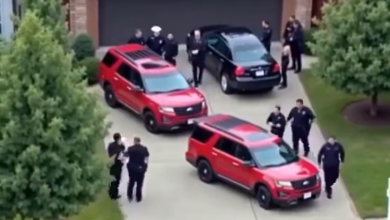
It was a deputy from the Huerfano County Sheriff’s Office. In Walsenburg. On the other side of La Veta Pass.
There had been an accident. On Highway 160. Coming down the east side of the pass, about four miles above the town of La Veta. In the snowstorm.
The minivan had skidded on the ice on a curve. It had gone off the road and down an embankment and into a stand of ponderosa pines.
Lucía was gone. Andrés was gone. Tomás was gone.
Mateo was alive. He was at the hospital in Walsenburg. In serious condition. Could I come.
I don’t remember the drive. Two hours through the storm, over the pass, past the place where it happened. A neighbor drove me. Señora Gallegos from across the street. She held the wheel with both hands and didn’t say a word the whole way.
When I got to Spanish Peaks Regional Medical Center in Walsenburg, at one-thirty in the morning, they took me to a room on the second floor.
I barely recognized the little boy in the bed.
His face was swollen and purple on one side. There was a bandage around his head. A long, dark bruise across his chest and shoulder in the shape of a seat belt. He had a severe concussion, the doctor said. Four broken ribs. A collapsed lung that they’d reinflated with a tube.
He was asleep. Or unconscious. I couldn’t tell.
I sat down beside his bed and took his tiny hand. It was so cold.
The doctor called it a miracle. That he survived.
The deputies said the same thing.
The priest said it too. At the funeral at Sacred Heart Church in Alamosa, a week later, while I stood in front of three closed coffins. Two big ones and one small one.
A miracle.
I didn’t feel like anybody had been given a miracle. I felt like God had reached into my house and taken everything but one small boy and a pair of red mittens.
The doctors warned me that Mateo’s memories of the crash would be broken. Fragmented. A concussion that severe, at that age, they said, scrambles things.
He might remember pieces. Sounds. Lights. Feelings. But not a story. Not in order.
They told me not to push him. Not to ask him to remember. To let his mind heal on its own.
So I didn’t.
Except once.
About two weeks after the funeral, Mateo woke up screaming in the middle of the night. In the little bedroom at the end of my hall that had been Lucía’s room when she was a girl.
I ran in. He was sitting up in bed, sweating, shaking.
“The man walked away,” he said. “Grandma. The man walked away.”
“What man, mijo?” I said. I held him. “There’s no man. It was a dream.”
“The man with the light,” Mateo said. “He came down the hill. He looked in the window. At me. And then he walked away.”
I rocked him. I told him it was a dream. That his brain was hurt and making up scary pictures. That nobody walked away. That it was the snow and the ice. That nobody meant for it to happen.
He fell asleep against my shoulder.
He never said it again.
And I never asked.
I buried my daughter. My son-in-law. My grandson Tomás.
Then I brought Mateo home.
I was nearly fifty. A widow. A schoolteacher. Suddenly raising a five-year-old boy again.
There were school mornings and packed lunches. Doctor’s appointments in Alamosa and specialists in Pueblo. Homework at the kitchen table. Birthday parties. Soccer games. Science fairs. Parent-teacher conferences where I was the oldest one in the room by twenty years.
And there were the nights.
For years, Mateo woke up crying in the dark. Looking for his parents. Calling for Tomás. Standing in my bedroom doorway in his pajamas with his red mittens on his hands, because he slept with them every night until he was nine.
“Grandma,” he’d ask. “Why aren’t Mommy and Daddy coming back?”
Every single time, my heart broke in half.
I’d pull him into my bed. I’d hold him.
“There was a terrible accident, mijo,” I’d say. “The snowstorm made the road very dangerous. The car slid on the ice. Nobody meant for it to happen.”
He’d listen quietly. Then he’d put his head on my shoulder.
Nobody meant for it to happen.
I said it so many times. I believed it.
We didn’t talk about that night much after he got older.
I thought leaving it alone was the kindest thing. I thought that’s what the doctors meant. Don’t push. Let him heal.
Mateo grew into a thoughtful, quiet young man. Smart. Careful. Kind. He watched people. He listened more than he talked. His teachers always said he was an old soul.
He went to Adams State University, right there in Alamosa, and studied criminal justice. He graduated with honors. I sat in the front row at his graduation and cried so hard the lady next to me gave me her whole package of tissues.
After college, he moved back into my house to save money. He got a job at a small private investigation firm in Alamosa. Archuleta Investigations. Mostly insurance fraud and background checks and finding people who’d skipped out on child support. He said he liked it. He said he liked finding out what really happened.
At twenty-five, he was independent. Responsible. A good man.
But every winter, when a storm came over the mountains and the wind rattled my windows, I still remembered the little boy who used to fall asleep on my shoulder. Frightened of the wind. Holding his red mittens.
I thought we’d finally found peace.
A few weeks before the twentieth anniversary, Mateo started acting differently.
He got quiet. Quieter than usual. I’d find him at the kitchen table late at night with his laptop and a stack of papers, staring at the screen with a troubled look. When I came in, he’d close the laptop.
At dinner, he started asking questions. About the past. About that night.
“Grandma,” he said one night, over green chile stew. “Do you remember what time they left your house? That day?”
I frowned. “Not exactly, mijo. Around three? Three-thirty? Why?”
He shook his head. “Just wondering.”
A few nights later: “Did the sheriff’s office ever call you more than once? About the accident? Or come to see you?”
“Once,” I said. “That first night. A deputy called. And then the sheriff came to the funeral. He gave me his card.” I looked at Mateo. “Why do you ask?”
“No reason,” he said.
“Mijo,” I said. “Is something bothering you?”
“No, Grandma,” he said. “I’m just trying to understand some things.”
I thought he was becoming curious about the family he’d lost. He was twenty-five. Old enough to want to know about his childhood. About his mother and father and the brother he barely remembered.
I didn’t know he’d already started looking for answers on his own.
Then, last Sunday, he came home early.
It was snowing. The first real snow of December. I was in the living room in my chair by the window, knitting a scarf for Mateo’s girlfriend, Daniela, for Christmas.
I heard the front door open. I heard him stamp the snow off his boots.
But he didn’t come in. He didn’t hang up his coat.
I looked up. He was standing in the front hallway. Not moving. In his coat, with snow on his shoulders.
In his hand was a folded piece of paper.
His face was pale.
“Grandma,” he said. “Can we sit down for a minute?”
Something in his voice made my stomach go tight.
“Of course, mijo,” I said. I put down my knitting. “What’s wrong?”
He walked toward me slowly. He held out the paper.
“Please,” he said. “Read this.”
“Mateo,” I said. “You’re scaring me.”
His eyes filled with tears.
“I’ve been trying to figure out how to tell you,” he said. “For three weeks.”
“Tell me what?”
He swallowed.
“I found out something,” he said. “About the night Mom and Dad and Tomás died.”
My heart started pounding.
For twenty years, I’d believed I knew exactly what happened. A winter storm. An icy curve on La Veta Pass. A minivan that slid off the road. Three lives gone in an instant.
But Mateo was shaking his head.
“Grandma,” he said. “What they told us wasn’t the whole story.”
I looked down at the folded paper in my hands. My fingers were trembling.
“Where did you get this?” I asked.
He hesitated.
“From my investigation,” he said.
I stared at him. “Your investigation?”
He nodded.
“I’ve been looking into the accident,” he said. “For a few months. Since the summer. I didn’t want to tell you. Not until I knew for sure.”
“Mateo,” I said. “What did you find?”
He took a shaky breath.
“Grandma,” he said. “It wasn’t just an accident.”
I unfolded the paper.
It was a letter. Handwritten. In shaky blue ink on a sheet of lined paper torn from a spiral notebook. An old man’s handwriting. Unsteady. Pressing hard.
I started to read.
And with every word, the room around me got quieter. The wind outside. The clock on the wall. The snow ticking against the window.
*To the family of Lucía and Andrés Vigil, and their son Tomás.*
*My name is Thomas Hargis. I was a deputy with the Huerfano County Sheriff’s Office from 1994 to 2009. I was the first officer on scene at the accident on Highway 160 on the night of December 28th, twenty years ago.*
*I am eighty-one years old. I have congestive heart failure. My doctors say I have a few months. I can’t die without telling you what I saw.*
*When I got to the scene at 9:52 p.m., there were two sets of tire tracks in the fresh snow on the road above the curve. Your family’s minivan. And a second vehicle. A pickup truck, from the width and the tread. The second set of tracks came across the center line. Into your family’s lane. Right at the curve.*
*Your family’s minivan swerved to avoid it. That’s why it went off the road.*
*There was red paint on the driver’s side mirror of the minivan. Fresh. Bright red. The mirror was cracked where something had hit it.*
*And there were boot prints in the snow. Going down the embankment to the minivan. And coming back up again. To where the pickup had stopped on the shoulder. Then the pickup’s tracks went on toward La Veta.*
*Somebody stopped. Somebody went down that hill and looked. And somebody drove away.*
*I wrote all of this in my report that night. I photographed the tracks and the boot prints and the mirror.*
*The next morning, Sheriff Raymond Brandt called me into his office. He took my report and my film. He told me I’d made a mistake. He told me it was a single-vehicle accident caused by weather. He told me to rewrite it. He said if I didn’t, I’d be working nights at the county jail for the rest of my career.*
*I rewrote it.*
*Two days later, I saw Sheriff Brandt’s son, Kyle, driving his father’s red Chevrolet pickup through La Veta. With a new driver’s side mirror. The paint around it was a slightly different red.*
*Kyle was nineteen years old. Everybody in town knew he drank.*
*I kept my copy of the original report. And one roll of film the sheriff didn’t know about. They are in a safe deposit box at the First National Bank of Walsenburg. Box 114. The key is enclosed with this letter.*
*I was a coward. I had a wife and three children and a mortgage. I told myself it wouldn’t bring anybody back. For twenty years I have told myself that.*
*It is not true. I am sorry. God forgive me. I hope you can.*
*— Thomas Hargis*
I read it twice.
Then a third time.
I put the letter down in my lap. I looked up at my grandson.
He was sitting in the chair beside mine now. He’d pulled it close. His eyes were full of tears.
“The man walked away,” I said.
My voice didn’t sound like mine.
Mateo looked at me.
“When you were five,” I said. “Two weeks after the funeral. You woke up screaming. In your mother’s old room. You said, *The man walked away, Grandma. The man with the light. He came down the hill and looked in the window at me. And then he walked away.*”
Mateo put his hand over his mouth.
“I said it was a dream,” I said. “I told you nobody walked away. I told you nobody meant for it to happen.” My voice broke. “And I never asked you again. Not once. For twenty years.”
“Grandma,” Mateo said.
“You told me,” I said. “You told me, mijo. You were five years old, and you told me the truth. And I told you it was a dream.”
Outside, the wind rattled the windows. The same wind. The same December storm, coming over the same mountains.
Mateo reached over and took my hand.
“I remembered him too, Grandma,” he said. “That’s why I started looking.”
He told me everything.
Last summer, he’d been working a case for an insurance company. A hit-and-run in Pueblo. He’d been reading the accident report, looking at the photographs of tire tracks on the road. And something happened. In his head.
“I looked at a picture of headlights,” Mateo said. “On a road at night. And I remembered. Not everything. Just pieces. But clear.” He swallowed. “Red. Something red, coming at us around a curve. Really bright headlights. Dad yelling. Mom screaming Tomás’s name. And then everything turning over.”
He looked down at our hands.
“And then I remembered the light,” he said. “A flashlight. Coming down through the trees in the snow. A man. He shined it in the window. On me. I was upside down in my car seat. I couldn’t breathe. My chest hurt so much.” He wiped his eyes. “And I tried to say help. And he looked at me. And then he turned around and walked back up the hill.”
“I thought maybe I was making it up,” Mateo said. “Like you said. A dream. My brain filling in blanks.” He shook his head. “So I pulled the accident report. From the Huerfano County Sheriff’s Office. It’s public record. Anybody can request it.”
“What did it say?” I asked.
“Single-vehicle accident,” Mateo said. “Weather-related. Driver lost control on ice. No other vehicles involved. Signed by Deputy Thomas Hargis. Approved by Sheriff Raymond Brandt.” He paused. “It was two paragraphs long, Grandma. Two paragraphs. For three people.”
“So I looked for Deputy Hargis,” Mateo said. “It took me two months. He’d retired. Moved away. His wife died. He was living in an assisted living home in Trinidad.”
Trinidad is an hour south of Walsenburg. Near the New Mexico border.
“I drove down there in October,” Mateo said. “On a Saturday. I didn’t tell you. I said I was going fishing.”
I remembered. He’d come home without any fish. He’d gone straight to his room and closed the door.
“He was in a wheelchair,” Mateo said. “On oxygen. In a little room with a window that looked at the mountains. I told him who I was. Mateo Vigil. The little boy from the minivan on La Veta Pass.” His voice broke. “Grandma, he started to cry. He was eighty-one years old, and he sat in his wheelchair and cried like a little kid.”
“What did he say?” I whispered.
“He said, *I’ve been waiting twenty years for somebody to knock on that door,*” Mateo said. “*I thought it’d be the Lord. I didn’t think it’d be you.*”
“He didn’t tell me anything that day,” Mateo said. “He said he needed time. He said he needed to think about how to say it. He asked me to come back.” He looked at the letter in my lap. “Yesterday, he called me. He asked me to come down. He gave me this. And the key.”
Mateo reached into his coat pocket. He took out a small brass key. On a ring with a paper tag. *FNBW — 114.*
“He said, *Give it to her first,*” Mateo said. “*To your grandmother. She deserves to read it first. Before the lawyers. Before anybody.*”
We drove to Walsenburg on Monday morning. In Mateo’s pickup. Over La Veta Pass.
The road was plowed. The sky was clear and hard and blue. The snow was bright on the mountains.
Coming down the east side of the pass, about four miles above La Veta, Mateo slowed down. He pulled over onto the shoulder. Across from a curve. Where the road bends hard to the left and the land drops away down a steep embankment into a stand of tall ponderosa pines.
He didn’t say anything. He didn’t have to.
I’d driven past that curve a hundred times in twenty years. On the way to Pueblo. To doctors. To Mateo’s soccer tournaments. Every time, I looked straight ahead.
This time, I looked.
There’s a little white cross there. In the snow. At the top of the embankment. Three names painted on it. Lucía. Andrés. Tomás. I’d had it put there the spring after. I’d never once stopped to visit it.
Mateo turned off the engine. We sat there in his truck on the shoulder of Highway 160 and looked at the cross for a long time.
“He stood right there,” Mateo said finally. Very quietly. “Kyle Brandt. On the shoulder. Where we’re parked. After he went down the hill and looked at me.” He swallowed. “And then he got back in his truck and called his father.”
At the First National Bank of Walsenburg, a young woman named Marisol brought out safe deposit box 114. She set it in a little private room. She left us alone.
Mateo opened it with Thomas Hargis’s key.
Inside was a manila folder, yellowed with age. And a small yellow canister of film. Kodak. 35 millimeter.
Mateo opened the folder.
It was a carbon copy of an accident report. Typed on an old typewriter, with handwritten notes in the margins. Four pages long. Not two paragraphs. Four pages.
*Second vehicle tracks observed crossing center line into eastbound lane at apex of curve. Tread pattern consistent with full-size pickup. Fresh red paint transfer on driver’s side mirror of V1. Boot prints observed descending embankment to V1 and returning to shoulder at point where V2 stopped. V2 tracks continue east toward La Veta. Probable hit-and-run. Recommend immediate investigation.*
*— Dep. T. Hargis, #47. 12/28. 23:40 hrs.*
Kyle Brandt is thirty-nine years old now.
He still lives in Huerfano County. In a big house outside La Veta, with a view of the Spanish Peaks. He owns the biggest car dealership in Walsenburg. Brandt Motors. Chevrolet. His face is on a billboard on Interstate 25.
He’s married. He has three kids. He coaches Little League. He’s on the board of the hospital where Mateo was taken that night.
His father, Sheriff Raymond Brandt, retired in 2011. He’s eighty-four. He lives in a nursing home in Pueblo. He has dementia. He doesn’t remember anything.
Mateo took the film to a lab in Colorado Springs that still develops old film. It took a week.
There were twenty-four pictures. Black and white. Taken with a flash in the dark and the snow.
Tire tracks on Highway 160. Two sets. One crossing the yellow line.
The driver’s side mirror of my daughter’s silver minivan. Cracked. With a bright streak on it.
Boot prints in the snow. Going down the embankment. Through the pine trees. To the overturned minivan.
And coming back up.
Mateo’s boss at Archuleta Investigations, an old man named Gilbert Archuleta who’s been a private investigator in the San Luis Valley for forty years, looked at everything. The letter. The carbon copy of the report. The photographs.
He took off his reading glasses.
“Elvira,” he said. “I’ve known you since you taught my granddaughter to read. So I’m going to tell you the truth.”
I waited.
“The statute of limitations,” Gilbert said. “For leaving the scene of a fatal accident in Colorado. For vehicular homicide. For a wrongful death lawsuit. For the sheriff’s tampering with a report.” He shook his head. “Most of it ran out a long time ago. Fifteen, eighteen years ago.”
I stared at him.
“There’s no crime here that a district attorney can charge anymore,” Gilbert said. “Not against Kyle. Not against his father. Not legally.” He put the photographs back in the folder. “I’m so sorry.”
I sat in Gilbert Archuleta’s little office in Alamosa with my hands in my lap.
“Then what was it for?” I said. “Twenty years. Thomas Hargis carrying this. Mateo finding it. What was it for, if nothing happens?”
Gilbert looked at me for a long moment.
“The law can’t do anything, Elvira,” he said. “That doesn’t mean nothing happens.” He tapped the folder. “The truth is still the truth. Whether a court says so or not.”
That night, Mateo and I sat at my kitchen table with the folder between us.
“What do you want to do, Grandma?” he asked.
I looked at him. My grandson. Twenty-five years old. With his mother’s eyes……………….CONTINUED ON NEXT PAGE