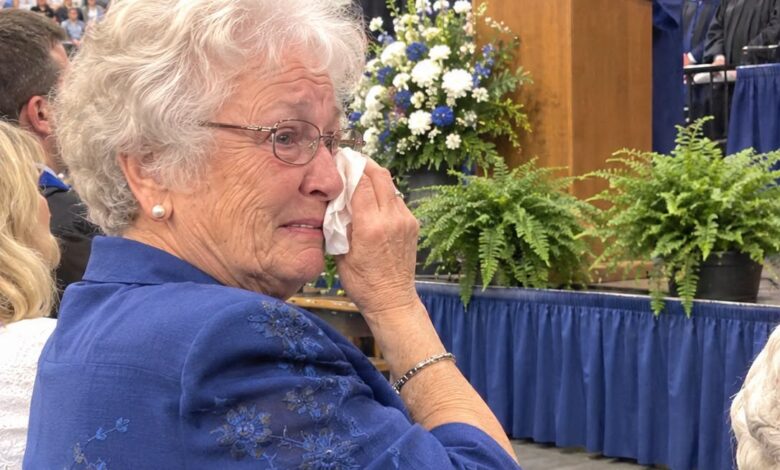
I Thought My Grandson Had Forgotten About Me, but His Graduation Speech Left Me Crying in Front of Everyone
**I Thought My Grandson Had Forgotten About Me, but His Graduation Speech Left Me Crying in Front of Everyone**
*The Warm Spot*
### Part One: Four Years Old
I raised my grandson, Kevin, after his parents died in a car accident.
He was only four.
It was a Tuesday in February. Ice on the roads outside Dayton, Ohio. My son, Michael, and his wife, Rachel, were driving home from a church potluck on Route 35. Kevin was at my house because I’d offered to keep him for the evening so they could have a little time to themselves.
A tractor-trailer jackknifed on a bridge near Xenia.
The state trooper who came to my door at eleven-thirty that night had a little girl of his own. I could tell by the way he looked past me into the living room, where Kevin was asleep on the couch under my afghan with a coloring book on his chest.
“Mrs. Haley,” the trooper said. “I’m so sorry.”
I was fifty-eight years old.
My husband, Harold, had died three years earlier—a heart attack while shoveling the driveway.
I was a widow with a modest little house in Kettering, a job in the cafeteria at Fairmont High School, and a sore hip the doctor said would need replacing someday.
And I had a four-year-old boy asleep on my couch who didn’t yet know that his whole world had just ended.
### Part Two: Too Old
Some people said I was too old.
They said it at the funeral, in whispers they thought I couldn’t hear. They said it at church. My own sister, Doris, said it to my face in my kitchen two weeks later while she was washing casserole dishes.
“Jo,” she said. “Be realistic. You’ll be seventy-two when he graduates high school. Seventy-two. What if something happens to you?”
“Then something happens to me,” I said.
“Rachel’s sister in Phoenix offered to take him,” Doris said. “She’s thirty-four. She’s got a husband and a big house and two kids already.”
I knew about Rachel’s sister. I’d met her once, at the wedding. She’d spent the whole reception on her phone.
“Doris,” I said. “He’s Michael’s boy.”
I dried my hands on a dish towel.
“He’s staying with me.”
Kevin was my whole world.
My name is Josephine Haley. Everybody calls me Jo.
I’m seventy-six now.
### Part Three: Two Jobs
I worked two jobs to keep us afloat.
Days, I worked in the cafeteria at Fairmont High—six a.m. to two p.m.—serving pizza and tater tots and chicken nuggets to teenagers who never once said thank you. Twenty-two years I’d been there.
Nights, I cleaned offices.
A company called Midwest Building Services had a contract with three office buildings in downtown Dayton: insurance companies, a law firm, a dentist’s office on the ground floor. I worked six to eleven, Monday through Friday—emptying trash cans, vacuuming carpet, scrubbing toilets in men’s rooms on floors full of lawyers who’d gone home to houses I’d never see.
My neighbor, Mrs. Ortiz, watched Kevin in the evenings. She was a widow too. She didn’t charge me. She said it gave her somebody to cook for.
I’d get home at eleven-forty. Every night.
And every night, Kevin would be waiting up for me.
He wasn’t supposed to. Mrs. Ortiz put him to bed at eight-thirty—bath, pajamas, prayers, lights out. But every night when I came through the front door, he’d be on the couch, wrapped in my old green afghan (the one my mother crocheted in 1962), eyes half-closed, hair sticking up.
“Grandma,” he’d whisper. “I saved you the warm spot.”
He’d scoot over. And there it would be: the spot on the couch where he’d been lying, warm from his little body.
I’d sit down in it, still in my work clothes, smelling like Pine-Sol and floor wax. He’d climb into my lap. I’d wrap the afghan around both of us.
And we’d sit there for five minutes in the dark, not saying anything.
Then I’d carry him to bed.
He did it every night for six years, until he was ten and too big to carry. Then he’d just walk himself to bed. But he still saved me the warm spot.
### Part Four: We Never Had Much
We never had much.
We ate a lot of spaghetti, a lot of grilled cheese, a lot of the leftovers I brought home from the cafeteria in Tupperware (which I wasn’t supposed to do).
His clothes came from Goodwill. His toys came from garage sales. His bike was Michael’s old bike from 1990, which Harold had kept in the garage.
We never went on vacations. We never went to Disney World or the beach or Kings Island.
On his tenth birthday he asked for a PlayStation. All his friends had one.
I looked at the price at the Walmart on Wilmington Pike: two hundred and ninety-nine dollars.
I went home, sat at the kitchen table, and did the math. I couldn’t do it.
I gave him a used Game Boy from a pawn shop—forty dollars, with three games.
He opened it at the kitchen table. He looked at it. Then he looked at me.
“It’s great, Grandma,” he said.
He didn’t cry. He didn’t complain. He just played that Game Boy until the buttons wore smooth.
But we had each other.
We had Sunday afternoons at the library. We had Friday-night pizza from the little place on Far Hills Avenue—a large pepperoni split two ways. We had Dayton Dragons minor-league baseball games in the summer, in the cheap seats, with a bag of peanuts I brought from home.
We had the warm spot.
### Part Five: Smart
Kevin was smart. Not just a little smart—really smart. The kind of smart teachers notice.
He read Harry Potter when he was seven. All of them. He did long division in second grade. In fifth grade his teacher, Mrs. Lindqvist, called me in for a conference.
“Mrs. Haley,” she said. “Kevin’s testing at a high-school level in math. I think he should be in the gifted program.”
He was in the gifted program.
He was on the honor roll every semester. He was in the National Honor Society. He was captain of the academic team.
He worked at the Kroger on weekends—bagging groceries, then stocking shelves. He gave me half his paycheck every week. I put it in a coffee can in the kitchen cabinet. I never spent a dime of it.
When he was a junior he started talking about college.
“Ohio State,” he said. “For engineering. Mechanical engineering.”
He was sitting at the kitchen table with a stack of brochures. I was at the stove making grilled cheese.
“Ohio State’s expensive, honey,” I said.
“I know,” he said. “I’ll get scholarships. And loans. And I’ll work.”
I didn’t say anything. I flipped the grilled cheese.
I’d been thinking about college since he was four—since the night the state trooper came to my door.
### Part Six: The Acceptance
He got into Ohio State.
The letter came on a Saturday in December of his senior year—a big envelope, scarlet and gray.
He opened it at the kitchen table, hands shaking. He read the first line. He looked up at me. He didn’t say anything. He just held it up.
*Congratulations! On behalf of The Ohio State University, I am delighted to offer you admission to the College of Engineering—*
I cried harder than he did.
I sat down at the kitchen table, put my face in my hands, and cried until I couldn’t breathe.
Kevin came around the table, knelt beside my chair, and put his arms around me.
“Grandma,” he said. “Grandma, it’s okay. It’s good news.”
“I know,” I sobbed. “I know it is.”
I couldn’t tell him why I was crying. I couldn’t tell him I was thinking about Michael. About Rachel. About a tractor-trailer on an icy bridge. About how they should have been sitting at this table.
Kevin held me for a long time. Then he said something.
“One day, Grandma,” he said, “you’ll sit in the front row and watch me graduate.”
He pulled back and looked at me. “Promise?”
I wiped my eyes with a dish towel.
“Wouldn’t miss it for the world, sweetheart,” I said.
### Part Seven: The Scholarship
In March another letter came—a thick white envelope, not from Ohio State but from a law firm in Dayton: Brennan, Walsh & Associates.
Kevin opened it at the kitchen table. He read it. His face went white.
“Grandma,” he said. “Grandma, look.”
He handed it to me.
*Dear Mr. Haley,
We are pleased to inform you that you have been selected as this year’s recipient of the Michael and Rachel Haley Memorial Scholarship.
This scholarship, established through a private endowment, will cover full tuition, fees, room, and board at The Ohio State University for four years, contingent upon maintenance of a 3.0 GPA.
The selection committee was particularly moved by your essay.*
Kevin stared at the letter.
“The Michael and Rachel Haley Memorial Scholarship,” he said slowly. “Grandma. That’s Mom and Dad.”
“I know, honey,” I said.
“I applied for twenty scholarships,” Kevin said. “I wrote an essay. About you. About the warm spot.”
He looked at the letter. “But I don’t remember applying for this one. I didn’t know there was a scholarship in their name.”
“Maybe the guidance counselor sent it in,” I said. “Mrs. Patterson. She sent your essay to a lot of places.”
Kevin looked at me for a long moment, then back at the letter.
“Full tuition,” he whispered. “Room and board. Four years.”
He put his hand over his mouth.
“Grandma,” he said. “I don’t have to take loans.”
I smiled.
“No, honey,” I said. “You don’t.”
### Part Eight: Four Years
For four years he called me almost every evening—from his dorm room in Columbus, from the engineering library, from the bus on the way to his internship.
Seven-thirty. Every night. Right after I got home from my office job. I’d quit the cafeteria by then; my hip was too bad to stand on all day. But I still cleaned offices three nights a week—Tuesday, Wednesday, Thursday.
Sometimes he’d call just to say good night.
Sometimes he’d call to tell me about a test he aced, a professor he liked, a girl named Priya he met in thermodynamics.
Sometimes it was just to ask how to get a stain out of his shirt.
“Grandma,” he said once in his sophomore year, “I got spaghetti sauce on my good white shirt. The one for my interview tomorrow.”
“Cold water,” I said. “Not hot. Hot sets it. And dish soap. Blue Dawn. Scrub it with an old toothbrush.”
“I don’t have Blue Dawn.”
“Ask the girl down the hall,” I said.
“Which girl?”
“Priya,” I said.
He was quiet for a second.
“How do you know about Priya?” he asked.
“You talk about her every night,” I said.
He came home for Christmas every year, and Thanksgiving, and a week every summer.
When he came home he’d sit on the couch in the evenings under my mother’s green afghan. And when I came in from cleaning offices at eleven-forty, he’d scoot over.
“Saved you the warm spot,” he’d say.
He was twenty years old. Six-foot-one.
He still did it.
### Part Nine: The Silence
Then, a month before graduation, everything changed.
It was April, the end of spring break. Kevin had come home for a week. He’d been fine all week—happy. He helped me clean out the gutters. He fixed the leaky faucet in the bathroom. He took me to Friday-night pizza on Far Hills Avenue—large pepperoni, split two ways, same as always.
On Saturday he said he needed his birth certificate.
“For my job,” he said. “The background check. At Honda.”
He’d gotten a job—mechanical engineer at the Honda plant in Marysville, starting in July.
“It’s in the closet in my bedroom,” I said. “In the cedar box. On the top shelf.”
He went to look for it. I was in the kitchen making pot roast for Sunday.
He was in my bedroom for a long time.
When he came out, his face was different. He didn’t say anything. He walked past me into the kitchen, got a glass of water, and drank it standing at the sink. He didn’t look at me.
“Did you find it?” I asked.
“Yeah,” he said.
He left the next morning, a day early. He said he had a project due.
He hugged me at the front door—quickly, not like usual. He didn’t look at me.
### Part Ten: He Stopped Answering
He stopped answering my calls.
At first I figured he was busy with finals—senior year, his last month, projects and exams and presentations.
I called at seven-thirty on Monday. Voicemail.
Tuesday. Voicemail.
Wednesday. Voicemail.
I texted: *Hope finals are going well, sweetheart. Love you.*
No answer.
By the end of the first week I was worried.
By the end of the second week I couldn’t sleep.
I’d lie in bed at night staring at the ceiling, going over everything—the pot roast, the gutters, the faucet, Friday-night pizza. What did I say? What did I do?
I called one more time, on a Sunday night at seven-thirty.
He answered.
“Kevin,” I said. “Honey. Thank God. Are you okay? I’ve been so worried.”
There was a long silence on the line.
“Kevin, honey,” I said. “Did I do something wrong?”
Another long silence. I could hear him breathing. I could hear voices in the background—people laughing, music.
“Grandma,” he said finally. His voice was flat. Cold. Nothing like his voice.
“I don’t want to talk to you anymore,” he said.
I gripped the kitchen counter. My knees went weak. I had to hold on to keep from falling.
“What?” I said. “Sweetheart, why?”
“Please,” he said. “Just leave me alone.”
He hung up.
### Part Eleven: The Package
I sat at the kitchen table for hours, staring at my phone.
The kitchen clock ticked. The refrigerator hummed. Outside, a car drove by on Stroop Road with its radio playing.
I didn’t move.
*I don’t want to talk to you anymore.
Just leave me alone.*
I called again at nine o’clock. Voicemail.
At ten. Voicemail.
At eleven. Voicemail.
At midnight I went to the couch. I wrapped my mother’s green afghan around me. I sat there in the dark.
There was no warm spot.
The next week I baked cookies—oatmeal raisin, his favorite, the recipe from the back of the Quaker Oats canister that I’ve made a thousand times. I made four dozen. I packed them in a shoebox with wax paper between the layers, the way I did every month when he was in his dorm.
I wrote a note:
*Kevin — I don’t know what I did. But whatever it is, I’m sorry. I love you more than anything in this world. — Grandma*
I mailed it on a Tuesday.
It came back the next Monday. Unopened.
RETURN TO SENDER. REFUSED.
I sat on my front porch with that shoebox in my lap and cried until Mrs. Ortiz came over from next door to see what was wrong.
### Part Twelve: Graduation Morning
Still, on graduation morning, I put on my best dress—a navy blue dress with little white flowers, knee-length, with a white collar.
Kevin had helped me choose it four years earlier, for his high-school graduation. We went to the Kohl’s on Wilmington Pike. I tried on six dresses. He sat in a chair outside the fitting room and gave each one a score from one to ten.
This one got a ten.
“You look like a grandma in a movie, Grandma,” he said.
“Is that good?” I asked.
“That’s really good,” he said.
I hadn’t worn it since.
I put it on in my bedroom. I did my hair. I put on lipstick—coral, the one I only wear to church. I put on my good shoes, flat ones, because of my hip.
Mrs. Ortiz drove me to Columbus. I can’t drive on the interstate anymore; my eyes aren’t good enough.
She didn’t ask any questions. She just packed a thermos of coffee and two egg-salad sandwiches and drove me seventy miles up I-70 with the radio playing Frank Sinatra.
The College of Engineering graduation was at Mershon Auditorium on the Ohio State campus—a big modern building on High Street with glass doors and scarlet banners hanging outside.
I stood in the parking lot for a long time, holding a little bouquet I’d bought at the Kroger on the way: daisies and baby’s breath, wrapped in green tissue paper. Nine ninety-nine.
“Jo,” Mrs. Ortiz said gently. “Are you going in?”
“He told me to leave him alone,” I said.
Mrs. Ortiz looked at me for a long time.
“Josephine,” she said. “You raised that boy. You worked two jobs for eighteen years. You promised him you’d be there.”
She took my hand.
“You go in there. And if he doesn’t want you there, he can tell you to your face.”
### Part Thirteen: The Back Row
I went in.
Mershon Auditorium holds about three thousand people. It was almost full—parents and grandparents and siblings, balloons and flowers and cameras.
The graduates sat in the front sections, hundreds of them in scarlet gowns and black caps.
I didn’t go to the front. I didn’t sit in the front row.
I’d promised I would.
*One day, Grandma, you’ll sit in the front row and watch me graduate.
Wouldn’t miss it for the world, sweetheart.*
But he’d told me to leave him alone.
So I sat near the back—Row Z, the second-to-last row, in the corner by the exit, where he wouldn’t see me.
Mrs. Ortiz sat beside me.
I held my little Kroger bouquet in my lap.
The ceremony started at ten.
The dean of the College of Engineering gave a speech. Then the president of the university. Then a famous engineer from NASA who’d graduated from Ohio State in 1985.
I didn’t hear a word.
I was looking for Kevin.
I found him in the third row of graduates, on the aisle—scarlet gown, black cap.
Even from the back row I could see him: the way he holds his shoulders, the way he tilts his head when he’s listening.
Just like his father.
Then the dean said something.
“And now,” the dean said, “it is my pleasure to introduce this year’s student speaker. Selected by his classmates and faculty. Graduating summa cum laude with a degree in mechanical engineering.”
He looked at his notes.
“Kevin Haley,” he said.
### Part Fourteen: On Stage
I hadn’t known.
He never told me. Not once in all those phone calls.
Student speaker. Summa cum laude.
Kevin stood up from the third row. He walked up the steps to the stage.
When he walked onto the stage my heart nearly burst.
He looked so grown up—twenty-two years old, six-foot-one, in his scarlet gown with the gold honor cords around his neck, his black cap with the tassel.
He looked just like Michael.
He walked to the podium. He set down a folded piece of paper—his speech, I guessed.
He looked out at the audience, at three thousand people.
Then he looked at the front row of the family section—reserved seats for the graduates’ families.
There was one empty seat on the aisle, right in the middle, right in front of the stage.
I could see it from the back. It had something on it: a piece of paper, and something draped over the back of the chair. I couldn’t tell what.
Kevin looked at that empty seat for a long time.
Then he folded his speech and put it in his pocket.
Then he took the microphone.
### Part Fifteen: My Grandma Is Here Today
“My grandma is here today,” he said.
My hands started shaking. The little bouquet of daisies rattled in my lap. Mrs. Ortiz grabbed my arm.
“I don’t know where she’s sitting,” Kevin said. “But I know she’s here. Because she promised. And my grandma has never broken a promise in her life.”
The auditorium was quiet.
“A month ago,” Kevin said, “I told her I didn’t want to speak to her anymore.”
The room went completely silent—three thousand people, not a sound.
“I told her to leave me alone,” Kevin said. “I hung up on her. I sent back a box of oatmeal cookies without opening it.”
His voice cracked.
“She baked those cookies for me every month for four years,” he said. “And I sent them back.”
People in the audience shifted in their seats. Somebody coughed.
“She still doesn’t know why,” Kevin said.
He looked out at the audience.
“And Grandma,” he said, “if you’re listening, you deserve the truth.”
He swallowed.
“So does everyone in this room,” he said.
I had no idea where he was going with this.
Tears were streaming down Kevin’s face. On the giant screen above the stage I could see them in close-up, running down his cheeks.
“I found something you hid from me,” Kevin said. “For twenty years.”
### Part Sixteen: The Envelope
“And when I found out,” Kevin said, “I was so angry.”
Then he reached into his graduation gown, into the inside pocket, and pulled out a small envelope.
I recognized it immediately.
It was a plain white envelope, business size, yellowed with age, with a law firm’s return address in the corner: Brennan, Walsh & Associates. Attorneys at Law. Dayton, Ohio.
And on the front, in my handwriting, in blue ink:
*For Kevin. Open when you’re 25.*
My stomach dropped.
I’d put that envelope in the cedar box on the top shelf of my bedroom closet in 2008—under my wedding photos, under Harold’s Navy discharge papers, under Michael’s baby book, under Kevin’s birth certificate.
I’d told him the birth certificate was in the cedar box.
I’d forgotten the envelope was there too.
Kevin stepped off the stage. He came down the steps at the side of the stage in his scarlet gown, the envelope in his hand.
He walked up the center aisle of the auditorium. People moved aside to let him through.
He walked past the graduates, past the front rows of families, past the empty seat on the aisle with the paper on it.
He kept walking—Row M, Row P, Row T.
He was looking, scanning the rows, searching faces.
Row X.
Row Y.
He saw me.