A Sheriff Arrested a Federal Judge Without Knowing Who She Was
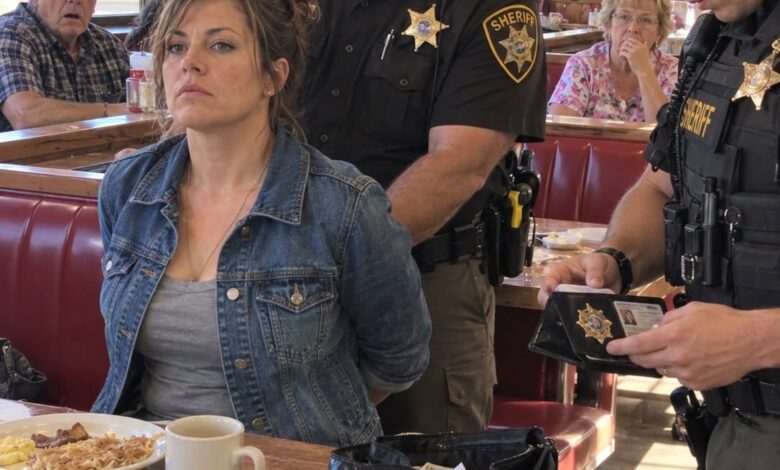
The heavy metal cuff snapped shut on my left wrist before I’d even had time to put down my fork.
“Hands behind your back, right now!”
Sheriff Dalton Voss’s voice boomed across the little diner like a thunderclap.
The whole restaurant went silent. Forks clattered onto plates. People froze with food halfway to their mouths and stared as this big, thick-necked lawman pinned my shoulder against the red vinyl booth.
I didn’t flinch, and I didn’t scream. I sat perfectly still with the cold steel biting into my skin and calmly finished chewing my bite of fried catfish.
My name is Amara Whitlock. I’m forty-four years old, born and raised in Georgia, and for the past six years I’ve served as a United States District Judge. But in my denim jacket and braided hair, Sheriff Voss saw a Black woman he thought was powerless, alone, and completely at his mercy.
He didn’t know my judicial credentials were zipped into the inside pocket of my purse. He didn’t know why I was in his county. And he didn’t know that for the past four months, a stack of letters from his own residents had been sitting in a locked drawer in my chambers in Atlanta.
“You’re making a serious mistake, Sheriff,” I said softly. I kept my voice steady and even.
“I don’t make mistakes in my county, lady.”
He leaned down so close I could smell stale coffee and cigar smoke on his breath. He twisted my right arm behind my back and snapped the second cuff closed with a vicious click.
“You match the description of a suspect in an armed theft,” he said. “And right now, you’re resisting arrest.”
I hadn’t moved an inch or raised my voice.
He yanked me out of the booth so hard the table jumped and my water glass tipped over. Ice and water ran across the Formica and dripped onto the floor. Somebody gasped. An old man at the counter half rose from his stool, saw the sheriff’s face, and sat back down.
Nobody said anything. In Pell County, Georgia, nobody had said anything to Dalton Voss in twelve years.
Voss bent to my ear and spoke low, with cruel satisfaction.
“You think you’re clever? In my town, nobody hears you scream. And nobody’s coming to save you.”
He shoved me through the glass front doors toward his idling cruiser. Behind us, a young deputy carried my purse on his shoulder like he didn’t know what to do with it.
Inside that purse, my government-issued phone began to buzz with an urgent message.
It was from the Chief Judge of my district.
Sheriff Voss thought he’d just humiliated another powerless outsider. He had no idea who he was putting in the back of his car, and the nightmare at his station house was only starting.
I need to tell you why I was sitting in a diner in Pell County that Tuesday afternoon, because it matters, and because a federal judge doesn’t just wander into a small Georgia town looking for trouble.
I’m not a detective. That isn’t my job, and it would be wrong for me to make it my job. Judges decide cases other people bring. We don’t go hunting for them.
But I’m also a granddaughter of Pell County.
My mother’s sister, Aunt Lorraine Bishop, still lives on eleven acres off Old Mill Road, three miles outside the town of Halvorsen Springs. She’s seventy-six. She taught third grade at Pell County Elementary for thirty-four years, and she’s been sending me clippings from the county newspaper since I was in law school. Every one comes with a sticky note in her looping cursive: “Thought you’d want to see this, baby.”
Last spring, the clippings changed. They were about arrests: a mechanic picked up for “loitering” outside his own garage, a church deacon charged with “obstruction” for asking a deputy why his son was being searched, a widow who lost her house at a tax sale three months after spending nineteen days in the county jail on a charge that was later dropped.
Then, in June, Aunt Lorraine sent me something that wasn’t a clipping. It was a manila envelope holding thirty-one handwritten letters from people in Pell County. Some were on lined notebook paper, and some were on church stationery. One was written on the back of a feed store receipt.
All of them were about Sheriff Dalton Voss.
“These folks wrote to the GBI,” Aunt Lorraine said on the phone. “To the governor. To the county commission. Nothing happened. Some of them got visits from deputies the next week asking why they were making trouble.” Her voice shook. “Amara, I know you can’t do anything. You’re a judge. But somebody in Atlanta needs to read these. Somebody who’ll know where to send them.”
She was right that I couldn’t do anything as a judge. But I could do what any citizen can do, and what the law expects a judge to do when credible allegations of federal crimes land on her desk.
The next morning, I walked the letters down the hall to Chief Judge Harold Brennan’s office. We made copies, logged everything, and he forwarded the originals to the United States Attorney’s Office for the Northern District of Georgia and to the public corruption squad at the FBI’s Atlanta field office. I wrote a memo stating that I had a family connection to Pell County, and that I would recuse myself from any case that came out of it.
I thought that would be the end of my part.
Then, three weeks ago, Aunt Lorraine fell and broke her hip.
I took a week of leave to drive down and stay with her during her recovery. I told Chief Judge Brennan where I’d be. He asked me, half joking, to keep my head down.
“Pell County isn’t Atlanta, Amara,” he said. “Be careful.”
I’d been there four days. That Tuesday, I left Aunt Lorraine napping with her physical therapist on the porch, drove into Halvorsen Springs to pick up her prescriptions at Pruitt’s Pharmacy, and stopped at the Magnolia Diner for lunch because I was hungry and they make good catfish.
I wasn’t wearing anything that would tell anyone I was a judge. I didn’t introduce myself. I didn’t flash my credentials. I sat down in a booth and ordered lunch, like the woman I was raised to be.
And twenty-two minutes later, Dalton Voss put me in handcuffs.
The ride to the station took six minutes. Voss drove with one wrist draped over the steering wheel, humming along to a country station. Every so often he glanced at me in the rearview mirror and smiled.
The young deputy sat in the passenger seat holding my purse in his lap. His name tag said MILLER. He couldn’t have been more than twenty-five. He kept stealing looks at me over his shoulder. He looked like he wanted to say something and didn’t dare.
“Run her name when we get in,” Voss told him. “And find out what she was doing in my county.”
“Yes, sir.”
“Probably casing the pharmacy,” Voss said to nobody in particular. “Pruitt’s got opioids in there. I’ve seen her type.”
My type.
I looked out the window at the dry fields and the kudzu-covered pines, and I counted my breaths. Four seconds in, four seconds out. My grandmother taught me that in a church pew when I was six, when a white man at a Waffle House called my granddaddy a word I’m not going to write down.
“You keep your breath,” she told me, “and you keep your mind. They can’t take either one unless you hand it to them.”
The Pell County Sheriff’s Office was a low tan brick building next to the courthouse square, with a flagpole out front and a faded sign: “Serving Pell County with Pride Since 1871.” Voss pulled around back to the sally port and hauled me out of the car by the arm.
Inside, the air smelled like burnt coffee and floor wax. Fluorescent lights buzzed overhead. A clerk with reading glasses on a beaded chain sat behind the booking desk. Two deputies stood near the holding cells. A third sat at a computer.
All of them looked at me, then quickly looked away.
“Put her in the chair,” Voss said. “I’ll be in my office.”
As Miller walked me to the booking chair, one of the other deputies leaned toward him and whispered something I wasn’t supposed to hear.
“He’s picked up people for a lot less than this.”
Miller didn’t answer.
Voss swaggered into his office and slammed the door. Through the glass, I watched him drop into his leather chair, put his boots up on the desk, and pick up his phone.
Then my government phone buzzed again inside the purse in Miller’s hands.
Miller looked down at the purse. He hesitated. Then, following procedure, he unzipped it to inventory the contents and find my ID.
He took out my wallet and opened it.
Then he took out the black leather credential case tucked behind it.
I watched his fingers stop moving.
It was a gold seal with an eagle, and beneath it the words United States District Court, Northern District of Georgia, with my photograph and name: The Honorable Amara J. Whitlock, United States District Judge.
The color drained from his face. He read it once, then again.
“Judge Amara Whitlock?” he whispered. “United States District Court?”
The room went silent.
The clerk slowly took off her glasses and stood up from her chair. The deputy at the computer pushed back from the screen like it had suddenly gotten hot.
Miller turned toward the sheriff’s office. His voice shook.
“Sir,” he called. “Sir, you need to come out here. Right now.”
Voss came out of his office with an irritated scowl, ready to chew somebody out.
Then he saw the credential case in Miller’s trembling hand.
His face changed so fast that even the deputies standing next to him noticed. The swagger went out of his shoulders.
“That’s impossible,” he muttered. He snatched the credentials out of Miller’s hand and held them up to the fluorescent light, turning them over like he expected to find a price sticker on the back.
Before he could say another word, my phone lit up again on the booking desk. The screen showed a preview of the message from Chief Judge Brennan’s secure line, and Miller was close enough to read it.
“Amara, where are you? Call immediately. The FBI has advised that the Pell County investigation is moving today. Agents may be on the ground in Halvorsen Springs this afternoon. Please confirm you are safe and away from the sheriff’s office.”
Miller went completely white.
I finally raised my eyes to Voss.
“Sheriff,” I said, “you told me nobody was coming to save me.”
In the distance, very faint at first, sirens were approaching.
“You were right about one thing,” I said. “Someone is coming. But they aren’t coming for me.”
Voss stood frozen behind the booking desk, gripping my credentials as if he could make them disappear by staring at them long enough. Around him, the deputies traded frightened glances. The confidence was gone from their faces, and panic had taken its place.
I stayed seated with my hands still cuffed behind me and watched the man who’d threatened me a few minutes earlier fumble for something to say.
“This has to be a mistake,” he finally muttered. “Nobody told me a federal judge was in my county.”
Miller swallowed hard and glanced at the front entrance.
“Sir, those credentials are official. And that message came straight from the Chief Judge’s office.”
Voss snapped at him to shut up, but his voice didn’t carry the way it had in the diner. He turned toward me and tried to smile. It came out as a grimace.
“Judge Whitlock,” he said, “if that’s really who you are, maybe we can clear up this unfortunate misunderstanding privately.”
I tilted my head.
“You arrested me without probable cause,” I said. “You accused me of resisting when I never resisted. You told me no one would hear me scream.” My voice stayed calm, but every officer in that room heard every word. “And now that you know who I am, you’d like to resolve things privately?”
Voss opened his mouth, then shut it when he saw his deputies listening.
“Deputy Miller,” I said. “Please remove these handcuffs.”
Miller looked at his sheriff for permission. Voss couldn’t bring himself to give another order.
With shaking hands, the young deputy unlocked the cuffs and stepped back. Deep red marks ringed both my wrists. The left one had started to swell where Voss had twisted it against the booth.
The clerk behind the desk, a gray-haired woman whose nameplate read DORIS KEELER, quietly picked up a pen and began writing on a legal pad. Later I learned she wrote down the exact time the cuffs came off: 1:47 p.m.
“Thank you, Deputy,” I said to Miller. I said it without any anger, because something told me this young man was standing at the most important fork in the road of his life, and I wanted to see which way he’d turn.
The sirens got louder. Then the station’s front doors swung open.
Three federal agents walked in, two women and a man, in dark windbreakers with FBI in yellow letters across the back. Behind them came a tall, silver-haired man in a gray suit carrying a thick accordion file with PELL COUNTY written on the tab in black marker. Behind him was a sharp-eyed woman in a navy pantsuit with a leather portfolio under her arm.
Voss straightened his uniform and stepped forward with his hand out, like a man welcoming guests to a barbecue.
“Afternoon, folks. Sheriff Dalton Voss. What can I do for the FBI today?”
The lead agent, a tall Black woman in her forties with close-cropped hair, walked right past his hand without looking at it and came straight to me.
“Judge Whitlock,” she said. “Special Agent Renee Calloway, FBI Atlanta. Are you injured?”
She looked at my wrists, and her jaw tightened.
“I’ll be fine,” I said. “But I’d like every detail of what happened to me today preserved. All of it.”
“Yes, ma’am.” Agent Calloway turned to her colleague, a younger agent with red hair named Kessler. “Secure the booking logs, the dispatch recordings, the body camera footage from every officer involved, and the surveillance video from this building. Then go to the Magnolia Diner and get their security footage and the name of every witness.”
“On it,” Kessler said.
The woman in the navy suit stepped forward. “Monica Delgado, Assistant United States Attorney, Public Corruption Section.” She nodded at me. “Judge. We were on our way here today for a different reason. I’m sorry you got caught up in it.”
“What reason?” Voss asked. His voice had gone up half an octave.
The silver-haired man set his accordion file on the booking desk and unwound the string.
“Special Agent Thomas Greer,” he said. “I’ve been leading an investigation into this department since July.” He pulled out a stack of documents and spread them across the desk. “These are complaints from residents of Pell County. People who say they were threatened, wrongfully arrested, or pressured to drop complaints against your department. Some of these complaints were filed with your office and then disappeared. Others were marked ‘resolved’ with no investigation at all.”
For the first time since I’d come into his county, nobody was asking Sheriff Voss what he wanted.
Voss stared at the papers, and I watched his jaw tighten as he recognized names.
“Those are unverified accusations,” he said, trying to pull himself together. “Every sheriff in Georgia gets complaints. People don’t like getting arrested.”
“You’re right,” Agent Greer said calmly. “Complaints are where an investigation starts, not where it ends. That’s why we’re here. Your department’s records will now be examined independently.”
“Every allegation deserves to be tested against the evidence,” I said, and everyone turned to look at me. “Nobody should be treated as guilty because of a letter. That includes you, Sheriff. But nobody in this building is going to destroy records or intimidate witnesses while that review happens. Not today, and not any other day.”
AUSA Delgado opened her portfolio and pulled out a single sheet of paper with a raised seal.
“Sheriff Voss, this is a federal search warrant signed this morning by a United States Magistrate Judge in Macon,” she said. “Not Judge Whitlock’s court. She’s recused from all of this. The warrant authorizes the seizure of all records, computers, phones, and financial documents in this building relating to arrests, bail, evidence handling, and property seizures for the past eight years.”
Voss’s face went gray.
“You can’t take my records.”
“We can, and we are,” Delgado said.
Then Deputy Miller stepped forward. He was holding a small spiral notebook against his chest, the kind you can buy at any Dollar General for a dollar and twenty-five cents. It had a blue cover, bent at one corner.
“There’s something else you need to know,” he said to Agent Greer. His voice was shaking. “I’ve seen Sheriff Voss order arrests with no legal reason before. More than once. I wrote down the dates.”
Voss spun toward him, his face burning red.
“Caleb, you shut your mouth. You understand me? You shut your mouth right now.”
The FBI agents moved between them so fast that I barely saw them do it. Agent Calloway put a hand on Voss’s chest.
“Sheriff, step back,” she said. “That’s a witness speaking to a federal agent. You don’t get to tell him to be quiet.”
Voss looked at her hand on his chest like nobody had ever touched him without permission before. Maybe nobody had.
Miller’s hands shook as he opened the notebook to the first page.
The room went so quiet that the clock behind the booking desk sounded loud.
Miller set the notebook on the desk. It held names, dates, and short descriptions of incidents in careful block letters, none of which had ever appeared in an official report.
“March 14. Traffic stop, Highway 41. Driver Terrence Holloway, age 52. No violation. Sheriff searched truck. Took envelope with $8,400 cash from glove box. Driver said it was for his daughter’s tuition. No receipt. Not logged in evidence.”
“May 2. Arrested Deacon Earl Simmons for obstruction. He asked why his son was being searched. Charge dropped 11 days later. Sheriff said, ‘That’ll teach him to run his mouth.’”
“June 19. Sheriff told me to write that Mr. Rufus Tate resisted. He didn’t. He was 71 and using a cane.”
Agent Greer read the pages slowly. His face got more serious with every one.
I realized my arrest might have uncovered something much bigger than one sheriff’s abuse of his badge.
Then Miller pointed to the last entry, and his voice dropped to a whisper.
“This is the incident they told me never to mention.”
The last entry was dated fourteen months earlier, in August of the previous year.
Agent Greer read it out loud.
“August 9. Sheriff arrested Mrs. Hattie Greene, age 81, at her property on Cypress Creek Road. Charge: obstruction and disorderly conduct. She was standing on her porch telling surveyors from Pinecrest Holdings to get off her land. She was not disorderly. She was crying.
At booking she said she needed her heart pills. They were in her purse. Sheriff said no medication until she saw the jail nurse. Jail nurse doesn’t come on weekends.
August 10. Mrs. Greene asked for her pills four times. I asked the sheriff twice. He said, ‘She’ll live.’
August 11, 3:15 a.m. Mrs. Greene found unresponsive in cell 3. Taken to Pell County Memorial.
August 13. Mrs. Greene died.
Sheriff told everybody on shift never to mention the pills. He said the report would say she was found unresponsive with no prior complaint. He said if anybody said different, they’d be done in law enforcement in this state.”
Nobody in the room breathed.
I knew that name. I’d read it in one of the thirty-one letters Aunt Lorraine sent me. It had been written on yellow legal paper in a teenage boy’s handwriting.
“My great-grandmother Hattie Greene died in the Pell County Jail. They say it was her heart. But she called my mama from jail and said they took her pills. Nobody will listen. They sold her land three months after she died. Please, somebody, listen. — Jaylen Greene, age 17.”
Agent Greer looked up from the notebook at Voss.
“Sheriff, what is Pinecrest Holdings?”
Voss didn’t answer.
But AUSA Delgado did. She pulled a document from her portfolio and laid it beside Miller’s notebook.
“Pinecrest Holdings LLC,” she said, “was registered with the Georgia Secretary of State two years ago. Its registered agent is a man named Wade Purcell.” She looked at Voss. “Your brother-in-law.”
The deputy who’d been at the computer, a heavyset man named Briggs, made a small sound like he’d been punched.
“In the last two years,” Delgado went on, reading from her notes, “Pinecrest Holdings has acquired eleven parcels of land in Pell County, all through tax deed sales or estate sales. Total acreage: roughly six hundred and forty acres of timberland and river frontage. Every single one of those parcels belonged to someone who was arrested by this department within the twelve months before they lost the property.”
She turned the page.
“And every one of those parcels sits along the route of the proposed Georgia Power transmission corridor and the new state highway bypass, which were announced publicly eighteen months ago.” She looked up. “Land along that corridor is now appraised at three to four times what Pinecrest paid for it.”
I felt sick.
So this was how it worked. Arrest a landowner on a charge that wouldn’t stick. Set the bail high enough that they couldn’t pay it. Hold them for weeks while they lost their jobs, missed their property tax payments, and fell behind on bills. When the county put the land up for a tax sale, or when an old widow died and her family couldn’t afford to fight the estate, Pinecrest Holdings was waiting with a check.
“Mrs. Greene’s forty-two acres on Cypress Creek,” Delgado said. “Pinecrest bought them at an estate sale four months after her death for $61,000. Georgia Power has since offered $238,000 for an easement across a fifteen-acre strip of that parcel alone.”
Voss finally found his voice.
“That’s my brother-in-law’s business. It’s got nothing to do with me.”
“Then you won’t mind,” Agent Greer said, “explaining why the Pell County Sheriff’s Office bank records show three wire transfers from Pinecrest Holdings to an account in your wife’s name. Totaling $187,500.”
Voss’s face went from gray to white.
They didn’t arrest Dalton Voss that afternoon………………READ MORE NEXT PAGE