A Wealthy Woman Refused to Leave a Single Turkey for a Grandmas Sick Grandson but Minutes Later She Regretted It
I was reaching for a gallon of milk when I heard an elderly woman say, “Please. I only need one.”
It was the Tuesday before Thanksgiving. Six-forty in the evening. The Shop-Rite on Commerce Street in Millbrook, Pennsylvania, was packed the way grocery stores only get packed the week of a holiday. Carts jammed in every aisle. Kids crying. Somebody’s toddler screaming about Lucky Charms. A teenage cashier on register four calling for a price check on cranberry sauce for the third time.
I’d come straight from work. Twelve hours at the hospital. I’m a respiratory therapist at Millbrook General. I was still in my scrubs. Navy blue. My feet hurt. My back hurt. I wanted milk, eggs, and a bag of frozen pierogies for dinner, and then I wanted my couch.
I had my hand on the refrigerator door.
*Please. I only need one.*
I turned around.
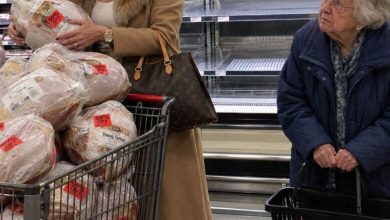
At the end of the refrigerated aisle, by the meat case, a woman was loading turkeys into her shopping cart.
Fast. One after another. Like she was racing somebody.
She was maybe fifty. Tall. Thin. Expensive blonde highlights. Heels. Real heels, the kind with a red sole. A camel-colored wool coat that probably cost more than my car payment. Bright makeup. Pearl earrings. A black leather purse hanging from her elbow with a gold clasp shaped like two interlocking letters.
She was pulling turkeys out of the open case.
The discount case.
Every year, the week before Thanksgiving, Shop-Rite puts out a case of discounted turkeys. Frozen. Twelve to fourteen pounds. Store brand. Red clearance stickers slapped on the plastic.
$9.99.
Regular price is thirty-eight dollars. Sometimes forty.
People line up for them. Every year. Families who can’t afford the forty-dollar turkey. Older folks on Social Security. Single moms. The guys from the VFW who buy them for the veterans’ dinner.
There are usually about fifteen of them in the case.
They’re usually gone by noon.
That year, there were thirteen.
And the woman in the camel coat was taking all of them.
Not two or three.
Every single one.
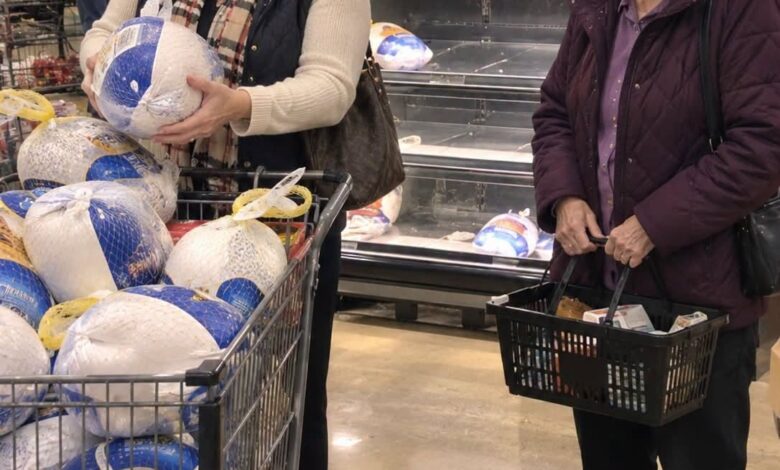
Her cart was already full. Turkeys stacked three deep. Red stickers everywhere. $9.99. $9.99. $9.99. The cart was so heavy one of the front wheels was wobbling.
She reached into the case.
She pulled out another one.
Number twelve.
I recognized her immediately.
Everybody in Millbrook would have.
Her name was Beatrice Pemberton.
The Pembertons are Millbrook. That’s the only way to say it. Pemberton Motors, the Ford and Chevy dealerships out on Route 422. Pemberton Properties, which owns half the apartment buildings downtown, including mine. The Pemberton Building on Main Street with its name carved in limestone over the door. The Pemberton Wing at Millbrook General. The Pemberton Family Foundation, which hosts a charity gala every December at the country club that gets a full page in the *Millbrook Ledger*.
And the house. On the hill above Lincoln Park. Nine bedrooms. A circular drive. A fountain. You can see it from the interstate.
Beatrice was the daughter. The only child of Elias Pemberton, who started it all. She ran the foundation now. And the property management side. She was on the hospital board.
I’d seen her twice at work. At ribbon cuttings. Smiling for photographers. Holding giant scissors.
She never looked at any of the nurses.
Beside her stood a tiny woman in a worn blue coat.
Seventies, maybe. Barely five feet tall. Gray hair pulled back in a bun. A wool coat that had been navy once and was now faded to the color of old denim. The elbows were shiny. One button was missing. A knit scarf. Sensible black shoes with Velcro straps.
She was gripping a red plastic shopping basket.
It was almost empty.
A box of saltine crackers. A can of chicken broth. Two carrots. An onion. A bag of egg noodles. A box of Theraflu.
That was all.
“My grandson has the flu,” she said.
Her voice was soft. A little shaky. Southern, maybe, a long time ago.
“I raise him by myself,” she said. “He’s nine. He’s been sick since Saturday. He won’t eat anything. I wanted to make him soup. My mama’s turkey soup. It’s the only thing he’ll eat when he’s sick.”
She looked at the case. At the regular turkeys in the next section. The forty-dollar ones.
“But the regular turkeys are almost forty dollars,” she said. “I can’t—I don’t have forty dollars until the first.”
Beatrice lifted another turkey out of the case.
She didn’t look at the old woman.
“Then buy chicken,” she said.
“The chicken isn’t on sale either,” the old woman said quietly. “I looked. It’s eleven dollars for a whole one. And it’s not the same. Micah won’t eat it. He says it tastes wrong.”
There was one turkey left in the case.
One.
In the back corner. Under the light.
$9.99.
The old woman reached for it.
Slowly. Her hand shaking a little. Arthritis. Her knuckles were swollen.
Beatrice grabbed it first.
She didn’t even look at the old woman. She just reached past her and took it. Fast. Smooth. Like she’d done it before.
She dropped it on the pile in her cart.
Thirteen.
The old woman stood there with her hand still out over the empty case.
“Ma’am,” she said. “Please. You already have twelve.”
“Thirteen,” Beatrice said.
“Could you leave me just one?”
Beatrice adjusted the turkey on top of the pile so it wouldn’t slide off.
“I got here first,” she said.
I couldn’t stay quiet.
I’m not a person who makes scenes. I’m not. I’m the person who lets other people go ahead in line. Who apologizes when somebody bumps into me. Who says *no problem* when the cashier messes up my order.
But I’d just spent twelve hours on the pediatric floor at Millbrook General.
With kids who had the flu.
Kids who couldn’t breathe. Kids with oxygen tubes. Kids whose grandmothers sat next to their beds and held their hands and asked me, over and over, *Is he going to be okay?*
“You’re seriously taking all of them?” I said.
Beatrice turned and looked at me.
She looked at my scrubs. My hospital badge clipped to my pocket. KARA LINDELL, RRT. My sneakers with the coffee stain on the toe.
She smiled.
“Absolutely,” she said.
She turned back to her cart.
“And no,” she said, “I’m not giving one up.”
The old woman’s cheeks went red.
She took a step toward Beatrice.
She opened her little black purse. The clasp was broken. She held it closed with a rubber band.
She took out a ten-dollar bill. Folded small. Soft from being folded and unfolded.
She held it out.
“I can give you the ten dollars,” she said. “Cash. Right now. You don’t even have to go back through the line. Please.”
Beatrice laughed.
Not a big laugh. Not a mean, cackling, cartoon-villain laugh.
A small one. Light. Amused. The kind of laugh you give when a waiter brings you the wrong wine.
“If ten dollars is this difficult for you,” Beatrice said, “maybe turkey soup isn’t what you should be spending money on.”
The aisle went silent.
There were other people there. I realized it then. A young dad with a baby in a carrier on his chest. A teenage boy in a Millbrook High football jacket. Two older women with matching carts. A man in a Carhartt jacket reaching for eggs.
Everybody had stopped.
Everybody was watching.
The old woman lowered her hand.
The ten-dollar bill was still in it.
“My grandson hasn’t eaten properly in two days,” she whispered.
Beatrice pushed her cart past her.
The front wheel wobbled. A turkey slid. She caught it.
She didn’t look at the old woman.
“That’s not my problem,” she said.
Then she stopped.
She glanced back over her shoulder.
At me. At the young dad. At the teenage boy. At the two older women. At everybody in aisle six.
“And before anyone makes a scene,” Beatrice said, “remember who my family is.”
She turned around.
She started pushing.
The cart was too heavy.
Thirteen frozen turkeys. Twelve to fourteen pounds each. Over a hundred and sixty pounds of frozen poultry. The wobbly wheel kept catching. The cart kept pulling to the left.
She had to lean her whole body into it. In her red-soled heels. Her camel coat. Her expensive purse sliding down her arm.
She was struggling.
She’d barely made it to the end of the aisle, past the yogurt and the string cheese, when the store speakers crackled.
*Ding-dong.*
The two-note chime. The one before every announcement. Price check on register four. Cleanup in aisle nine.
“Attention, shoppers.”
A man’s voice.
Old. Deep. Gravelly. Slow.
Not the usual voice. Not the teenage cashier or the night manager.
Beatrice kept walking.
Then the voice said one more word.
“Beatrice.”
She stopped.
So suddenly the cart slammed into an end-cap display of Stove Top stuffing. Boxes went everywhere. Red and yellow. Bouncing across the floor.
She didn’t look at them.
She was standing absolutely still.
Every head in aisle six turned.
Then every head in aisle five. And aisle seven. People were leaning around the ends of the aisles. Looking up at the speakers in the ceiling.
“You just told everyone in aisle six,” the voice said, “to remember who your family is.”
Beatrice’s fingers tightened around the handle of the cart.
Her knuckles went white.
“Oh, no,” she whispered.
There was a pause.
A long one. Five seconds. Ten.
The whole store was silent. Two hundred people. The checkout lanes stopped beeping. The baby in the carrier stopped fussing. Even the toddler screaming about Lucky Charms went quiet.
Then the man said:
“That’s actually a very good idea.”
Beatrice went white.
Not pale. White. Like the blood had drained out of her face all at once. Even under the bright makeup, you could see it.
People nearby began turning toward her.
The two older women with matching carts. The man in the Carhartt jacket. The teenage boy. Staring at her.
The voice came again.
One final sentence.
“Stay exactly where you are, Beatrice.”
“Why?” she shouted.
Her voice cracked on it. It came out high and thin. It echoed off the freezer cases.
The man’s voice answered through the entire store.
Calm. Slow. Patient.
“Because I’d hate for you to miss what’s coming.”
Beatrice slowly turned her head.
She looked toward the front of the store.
Toward the registers. The automatic doors. The customer service desk.
Her mouth fell open.
“No,” she whispered.
I followed her eyes.
A man was walking down the main aisle from the front of the store.
Slowly. With a cane. A wooden one. Dark. Carved.
He was old. Eighty, at least. Tall, even though he was stooped. A gray wool overcoat. A tweed flat cap. Thick white eyebrows. A long, lined face like an old map.
Beside him walked the store manager. A heavyset man in his fifties with a red Shop-Rite vest and a name tag. RON — STORE MANAGER. He was holding a portable microphone. The kind connected to the PA system.
People moved out of the way.
Nobody told them to. They just did. They pressed back against the shelves as the old man walked past. Like water parting around a stone.
I knew who he was.
Everybody in Millbrook would have.
I’d seen his face in the *Ledger* a hundred times. On the wall of the Pemberton Wing at the hospital. In a bronze plaque in the lobby.
ELIAS J. PEMBERTON. FOUNDER. “WE ARE WHAT WE GIVE.”
Beatrice’s father.
He walked all the way down the main aisle.
He turned into aisle six.
He stopped at the end. Next to the scattered boxes of Stove Top. Next to his daughter. Next to her cart full of thirteen discounted turkeys.
He didn’t look at her.
He looked at the cart.
He looked at it for a long time.
At the turkeys. Stacked three deep. At the red stickers. $9.99. $9.99. $9.99.
Then he looked down the aisle.
Past his daughter.
At the old woman in the worn blue coat.
Standing next to the empty case. Holding her red plastic basket. Saltines. Broth. Two carrots. An onion. Egg noodles. Theraflu.
Still holding the ten-dollar bill.
His face changed.
I’ll never forget it.
He’d been walking like a man who was angry. Stiff. Tight. Jaw set.
When he saw the old woman, all of that went away.
His face just opened.
Like a door.
He said something.
Too quiet for most people to hear.
I was close enough.
“Hattie?”
The old woman looked up.
She saw him.
She stared at him for a long moment.
Her eyes went wide.
Her free hand went to her mouth.
“Eli?” she said.
Ron the manager told me later how it happened.
He told me in the parking lot. An hour after. While we were loading Hattie’s groceries into my car.
Elias Pemberton came into the Shop-Rite every Tuesday evening. Every single Tuesday. For eleven years. Since his wife died.
He always came at six-thirty. He always parked in the same spot. He always bought the same things. A rotisserie chicken. A loaf of rye bread. A pint of chocolate milk. A bag of Werther’s Originals.
And he always stopped by the manager’s office first. To say hello to Ron.
Ron’s father had worked for Elias at the Ford dealership for thirty-one years. Elias paid for Ron’s mother’s funeral. Elias wrote Ron a letter of recommendation when he applied for the manager job.
They’d sit in Ron’s little office for ten minutes. Drinking bad coffee. Talking about the Steelers.
That Tuesday, Elias came in at six-thirty-two.
He went to Ron’s office.
Ron had the security monitors on. Eight screens. Every aisle. The registers. The parking lot.
They were talking about the Steelers’ offensive line.
And Elias looked at the monitor for aisle six.
He saw his daughter.
He saw the turkeys.
He saw the old woman with the red basket.
“He went quiet,” Ron told me. “Just stared at the screen. Didn’t say anything. Then he asked me to turn up the audio.”
Shop-Rite’s cameras have audio. Ron turned it up.
They heard everything.
*Please. I only need one.*
*Then buy chicken.*
*My grandson has the flu.*
*I got here first.*
*If ten dollars is this difficult for you, maybe turkey soup isn’t what you should be spending money on.*
*That’s not my problem.*
*Remember who my family is.*
“He just stood there,” Ron said. “In my office. Holding his coffee. He didn’t move. And then he put down the coffee and said, *Ron. Where’s your microphone?*”
Elias Pemberton walked down aisle six.
Past his daughter.
Past her cart.
Past the scattered Stove Top.
He walked straight to the old woman in the worn blue coat.
He stopped in front of her.
He took off his cap.
He held it against his chest.
“Hattie Gaines,” he said.
His voice was rough. Shaking.
“Eli Pemberton,” the old woman said. Barely a whisper. “Lord have mercy.”
He looked at her for a long time.
At her face. Her gray hair. Her worn blue coat with the missing button.
At the ten-dollar bill in her hand.
“How long has it been?” he said.
She thought about it.
“Fifty-four years,” she said. “Since Lula’s closed.”
“Fifty-four years,” Elias said.
He looked down at her red basket.
At the saltines. The broth. The carrots. The onion. The egg noodles.
He looked at it for a long time.
“You’re making the soup,” he said.
Hattie’s eyes filled.
“For my grandson,” she said. “Micah. He’s got the flu. He’s nine.”
Elias nodded slowly.
“Your mama’s soup,” he said.
“Mama’s soup,” Hattie said.
Elias closed his eyes.
Then he turned around.
He looked at his daughter.
At the end of the aisle. Standing by her cart full of turkeys. White as a sheet.
“Beatrice,” he said. “Come here.”
Beatrice didn’t move.
“Daddy,” she said. “Please. Not here. Not in front of—”
“Come here,” Elias said.
He didn’t raise his voice.
He didn’t have to.
Beatrice let go of the cart.
She walked down the aisle. In her red-soled heels. Click. Click. Click. On the linoleum.
Past me. Past the young dad. Past the teenage boy. Past everybody.
She stopped next to her father.
She didn’t look at Hattie.
“Beatrice,” Elias said. “This is Hattie Gaines.”
Beatrice looked at the floor.
“Look at her,” Elias said.
Beatrice looked up.
She looked at Hattie. At the worn blue coat. At the red basket.
Her face was red.
“Do you know who this is?” Elias said.
“No, Daddy.”
“No,” Elias said. “You don’t.”
He turned to the aisle.
To everybody standing there. Watching.
To the two hundred people in the Shop-Rite on Commerce Street who had stopped shopping and were standing at the ends of the aisles, holding their carts, holding their phones, holding their breath.
“My daughter,” he said, “just told all of you to remember who her family is.”
He put his cap back on.
“So I’m going to tell you,” he said.
“In 1970,” Elias said, “I was twenty-six years old. I’d just come home from Vietnam. Two tours. I came home to Millbrook with a duffel bag and four hundred dollars and nothing else.”
His voice was steady now. Slow. Like he was telling a story he’d told himself a thousand times but never out loud.
“My father was dead,” he said. “My mother was dead. The house I grew up in on Locust Street had been sold for back taxes.”
“I had one idea,” he said. “Used cars. I’d been a mechanic in the Army. I knew engines. I thought I could buy junk cars cheap, fix them up, and sell them.”
He shook his head.
“I rented a lot,” he said. “Out on 422. A gravel lot with a chain-link fence and a trailer for an office. A hundred dollars a month. I bought three cars at an auction in Reading. A ’62 Falcon. A ’64 Bel Air. A ’59 Rambler that didn’t run.”
Somebody in the crowd laughed softly.
“I spent every dollar I had,” Elias said. “On the lot and the three cars. I didn’t have money left for an apartment. So I slept in the trailer. On a cot. With a space heater.”
“That winter,” he said, “was the coldest winter in Millbrook in forty years. January of 1971. Twelve below zero. The pipes in the trailer froze. The space heater broke.”
He looked at Hattie.
“And I got sick,” he said.
“Pneumonia,” he said. “I didn’t know it at the time. I just knew I couldn’t stop coughing. And I had a fever. And I couldn’t get warm. And I couldn’t afford a doctor.”
He was quiet for a moment.
“I hadn’t sold a single car,” he said. “Not one. In three months. I had eleven dollars left. I was eating one meal a day. A bowl of soup. At Lula’s Diner. On Second Street.”
“Lula’s,” somebody said. An old man in the back. “I remember Lula’s.”
“Best pie in Millbrook,” somebody else said.
“Lula’s had a waitress,” Elias said. “A young girl. Nineteen. Twenty, maybe. Skinny. Quiet. She worked the counter at night. She’d only been in Millbrook a year. She came up from Georgia.”
He looked at Hattie.
Hattie had tears running down her face.
“Every night,” Elias said, “I’d come in. At nine o’clock. When it was empty. I’d sit at the counter. I’d order a cup of coffee and a bowl of the cheapest soup on the menu. Split pea. Thirty-five cents.”
He shook his head.
“And every night,” he said, “she’d bring me a bowl of turkey soup instead.”
The store was completely silent.
“I told her the first night,” Elias said, “that I’d ordered split pea. She said, *We’re out.* I said, *I can’t afford turkey soup.* She said, *It’s the same price tonight.*”
He almost smiled.
“It wasn’t on the menu,” he said. “Lula’s didn’t have turkey soup. Never did.”
He looked at Hattie.
“She was making it herself,” he said. “At home. In her apartment over the laundromat on Third Street. Her mama’s recipe. From Georgia. She’d bring it to work in a mason jar. And heat it up in the back. And bring it to me.”
“Every night,” Elias said. “For six weeks. January and February. She never charged me more than thirty-five cents.”
“And when I got so sick I couldn’t come in,” he said. “When I was lying on the cot in the trailer with a fever of a hundred and four and couldn’t get up. She noticed.”
He looked at Hattie.
“She noticed I didn’t come in,” he said. “Two nights in a row. And on the third night, after her shift, at eleven o’clock, she walked two miles. In the snow. Twelve below zero. Out Route 422. To my lot.”
Hattie was crying.
Beatrice was staring at her father.
“She knocked on the trailer door,” Elias said. “I couldn’t answer. She came in anyway. She found me on the cot.”
He swallowed.
“She had a mason jar of turkey soup in her coat,” he said. “Inside her coat. Against her body. To keep it warm. For two miles.”
“She sat on the floor of that trailer,” Elias said, “and fed me that soup with a spoon. Like I was a baby. Because I couldn’t hold the spoon.”
He looked at his daughter.
“Then she went to the pay phone at the Esso station a quarter mile away,” he said. “And called her pastor. Reverend Marcus Bell. At midnight. And he came in his car and took me to Millbrook General.”
“The doctor said if I’d stayed another night in that trailer,” Elias said, “I’d have died.”
The silence in the Shop-Rite was so complete I could hear the freezer cases humming.
“I was in the hospital for two weeks,” Elias said. “And every single day, she came. After her shift. With a mason jar.”
He looked at Hattie.
“When I got out,” he said, “I went back to the lot. And I sold the Bel Air the next week. For four hundred dollars. And the Falcon the week after. And I bought two more.”
He shook his head.
“By the end of 1971,” he said, “I had eight cars on the lot. By 1975, I had the Ford franchise. By 1980, the Chevy.”
He looked around.
At the Shop-Rite. At the two hundred people.
“Everything my family has,” he said, “everything with the name Pemberton on it. The dealerships. The buildings. The hospital wing. The house on the hill.”
He looked at Hattie.
“It started with a mason jar of turkey soup,” he said. “From a nineteen-year-old waitress who walked two miles in the snow. And never once asked me for anything.”
He turned to Beatrice.
“Remember who your family is,” he said.
His voice was very quiet now.
“That’s who your family is, Beatrice,” he said. “That’s where it came from.”
He pointed at Hattie.
“From her.”
Beatrice was crying.
Mascara running down her face. Her pearl earrings trembling.
“Daddy,” she said. “I didn’t know. You never told me.”
“I told you,” Elias said.
He took a breath.
“I told you when you were six,” he said. “At bedtime. I told you about the trailer. And the soup. And the waitress who walked two miles.”
Beatrice stared at him.
“I told you when you were twelve,” he said. “And sixteen. And at your wedding. In my toast. Three hundred people at the country club. I told the whole story.”
He shook his head.
“You were on your phone,” he said.
Beatrice put her hand over her mouth.
“I told you a hundred times,” Elias said. “You never listened. You thought it was an old man’s story. A war story. Something boring from before you were born.”
He looked at the cart. At the thirteen turkeys.
“You thought the name Pemberton meant money,” he said. “It never meant money. It meant a mason jar.”
“I never found her,” Elias said.
He looked at Hattie.
“Lula’s closed in 1972,” he said. “Lula died. The building got sold. I went back to find the waitress. To thank her. To pay her back. Nobody knew where she went.”
He looked at her.
“I didn’t even know your last name,” he said. “Just Hattie. That’s all it said on your name tag.”
“I got married,” Hattie said quietly. “In 1972. To Leroy Gaines. We moved to Scranton. For his job at the mill. We came back in 1998. After he passed.”
She wiped her eyes.
“I saw your name everywhere,” she said. “On the buildings. On the dealerships. On the hospital. I knew it was you.”
“Why didn’t you come find me?”
Hattie looked at him.
“Eli,” she said. “What would I have said? *Remember me? I’m the girl who made you soup fifty years ago?*”
She shook her head.
“You were Elias Pemberton,” she said. “And I was a widow cleaning offices at night. I didn’t want you to think I wanted something.”
Elias looked at her for a long time.
“Hattie,” he said. “I’ve been looking for you for fifty-four years.”
Then Elias turned around.
He looked at his daughter’s cart.
At the thirteen turkeys.
“Beatrice,” he said. “Why do you have thirteen turkeys?”
Beatrice didn’t answer.
“Beatrice.”
She looked at the floor.
“For the foundation,” she said. “For the Thanksgiving drive.”
Elias stared at her.
“The Thanksgiving drive,” he said.
“The Pemberton Family Foundation Thanksgiving Turkey Drive,” Beatrice said. Very quietly. “We give turkeys to families in need. At the community center. Thursday morning. The *Ledger*’s coming to take pictures.”
The store went silent.
“We give turkeys,” Elias said slowly, “to families in need.”
“Yes, Daddy.”
“And you came to the Shop-Rite,” Elias said, “and bought every discounted turkey in the case. At nine-ninety-nine. To give away at the community center. For the newspaper.”
Beatrice’s face went bright red.
“The budget was tight this year,” she said. “The gala cost more than we expected. I thought if I bought the discounted ones—”
“You’d save money,” Elias said.
“Yes.”
“On turkeys for families in need,” Elias said……………………..READ MORE NEXT PAGE 2