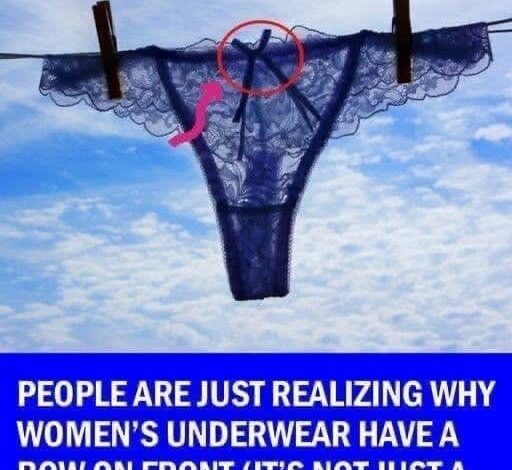
Why Womens Underwear Have A Bow On Front
Why Do Women’s Underwear Have That Tiny Bow on the Front? That little bow isn’t just decoration! One practical explanation is that it helps women identify the front of their underwear by touch, especially when getting dressed in a dark room. Historically, ribbons were used to secure underwear before elastic waistbands became common, and tying them at the front was convenient. Although modern underwear no longer needs those ribbons, the bow has remained as a charming design detail and a small reminder of the past…
The front bow is a small feature that can attract attention precisely because it appears so familiar. Many people have seen it repeatedly without stopping to ask why it is there. Unlike a seam or a waistband, it does not immediately announce a structural purpose. Its placement makes it look intentional, yet modern underwear generally stays in position without needing the ribbon to be tied. That contrast is what makes the detail interesting.
The practical explanation given in the account concerns orientation. A small raised feature at the front can offer a tactile clue when someone picks up a garment. It is an example of how a decorative detail might also be useful. That does not mean every wearer relies on the bow or that every style requires one. Different cuts and constructions can provide other ways to recognize the front, and many garments have no bow at all.
The historical explanation should also be understood with some care. The account connects the modern decoration with earlier garments secured by ribbons before elastic became common. That is a proposed connection between an older fastening practice and a detail that remains in modern design. It does not establish a single documented origin for every bow found on underwear today. A recurring design element can survive for several reasons, including familiarity, appearance, and the preferences of the people making and buying it.
In a modern garment, the ribbon may simply soften the appearance of the front or provide a small point of contrast. Its usefulness does not have to be mechanical to explain why someone enjoys it. Clothing frequently retains decorative touches even after changes in construction remove the need for an earlier practical function. The bow can be appreciated as a visual choice without requiring it to perform an essential task.
Its position is part of that choice. A centered detail gives the eye a clear focal point and distinguishes one side of the garment from the other. The effect can remain subtle, especially when the ribbon is small or matches the surrounding fabric. In other designs, a contrasting color makes it more conspicuous. Both approaches use the same basic shape in different ways.
The most useful answer therefore leaves room for more than one purpose. The bow can be decorative, it can help some people orient a garment by touch, and it can recall the ribbon fastenings described in the account. None of those explanations requires every design to have exactly the same history. The little detail endures because it remains recognizable and adaptable, even when the garment itself no longer depends on a tied ribbon to function.