After Three Decades of Hosting Christmas, One Phone Call From My Son Changed Our Family Tradition
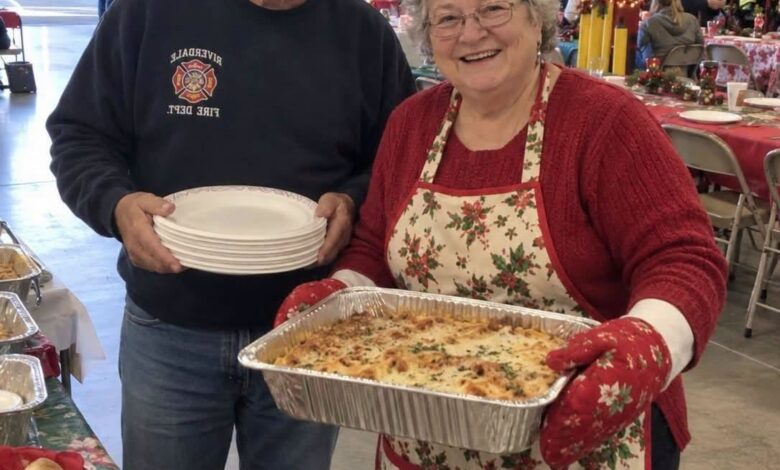
I held the spare blue apron toward my daughter-in-law, Amber. For a moment, she simply stared at it while the Christmas dinner continued around us at the fire hall. Children laughed, volunteers carried plates, and the smell of turkey and fresh pie filled the room.
“You’re family,” I told her. “We could use another pair of hands.”
Amber hesitated before accepting the apron. “I don’t really know what to do.”
“Neither did I when I first came here with Leonard,” I replied. “Start with the dishes.”
She managed a small smile, tied the apron around her waist, and joined me in the kitchen.
Earlier that afternoon, I had left my son Greg’s house feeling hurt. Amber had prepared a list of Christmas rules: guests could stay for only two hours, nobody was to bring food, and gifts had to remain inexpensive. After years of hosting family celebrations, I felt as though my traditions had suddenly become a problem.
Instead of arguing, I had taken a container of homemade pie to the community fire hall, where volunteers served Christmas dinner to anyone who needed a warm meal or a welcoming place to sit.
I never expected Greg, Amber, and their children to arrive later that evening.
As the hall filled with guests, Amber worked beside me. She washed dishes, carried trays, and even laughed with the older volunteers. Watching her relax made me realize that perhaps the evening could become a fresh beginning for our family.
Later, Greg approached me near the serving counter.
“Mom, I need to explain something,” he said.
He admitted that the Christmas rules had partly been his idea. He had watched me spend days preparing meals, buying presents, and cleaning while everyone else enjoyed the celebration. He worried that I was carrying too much responsibility after losing my husband.
“I told Amber I wanted Christmas to be different,” he explained. “Instead of talking to you, we made a list. I thought it would prevent an argument.”
“You could have spoken to me honestly,” I replied.
“I know. I’m sorry.”
His words softened my frustration, although they did not erase it. I understood that he had been worried about me, but I also wished he had trusted me enough to discuss his concerns.
That night, I discovered something else about myself. I had become so accustomed to helping everyone that I sometimes forgot to let other people make their own decisions.
Amber and I eventually spoke privately in the kitchen. She admitted that her childhood Christmas celebrations had often been unpredictable. Her mother had changed plans without warning, and family gatherings sometimes ended in arguments. Amber had created rules because she wanted to make sure nothing went wrong.
“I thought you would take over,” she confessed.
“Have I done that before?” I asked.
She reminded me of her daughter’s birthday, when I had brought extra cakes, rearranged the food, and organized the presents without asking.
“I thought I was helping,” I said.
“You were,” she answered. “But sometimes I wanted to do things my own way.”
I understood then that kindness could unintentionally become control. I apologized, and she did the same. Before leaving the fire hall, I gave her the blue apron to keep.
For the first time in years, we hugged without either of us feeling obligated to do so.
I returned home that evening believing the most important part of Christmas had been learning to understand one another.
Then I noticed the envelope on my kitchen table.
Inside was an old photograph of my late husband, Leonard, standing outside the fire hall with Chief Dale and a woman holding a little girl. I did not recognize either of them.
On the back, someone had written: “Ask Dale what Leonard promised us.”
I called Greg, who told me that a similar envelope had arrived at his home. It contained a birth certificate belonging to a woman named Rebecca Mercer and a note referring to a fire on Cedar Street many years earlier.
The name meant nothing to me, but the fire did.
Decades before, Leonard had returned home after responding to a serious incident at a property on Cedar Street. He had seemed troubled, and shortly afterward, a woman had called our house. Leonard told her she could not call again, then explained that she had reached the wrong number.
I had believed him.
Now I wondered what he had kept from me.
The following morning, I contacted Chief Dale. When I showed him the photograph, he recognized the woman immediately.
“Her name was Evelyn Mercer,” he explained.
He told me that Evelyn had once lived in an apartment above a garage that had burned under circumstances that were never fully explained. She had been frightened and had asked Leonard and Dale for help. They had assisted her in finding a safe place to stay, and she eventually disappeared from the area.
Evelyn had a complicated family history, including a husband named Thomas Mercer, whose connection to the incident had raised serious concerns.
“Leonard promised her he would help protect her daughter,” Dale said. “He also promised that if anything happened to Evelyn, he would try to find the girl.”
I felt hurt that my husband had carried such a significant responsibility without telling me. Yet I also recognized that he might have believed silence was necessary to protect someone who had asked for privacy.
Before I could ask more questions, the local news reported that Rebecca Mercer had been reported missing near Lake Benton.
I stared at her photograph on the television. She was now a grown woman, but her face resembled the little girl in the old picture.
Then Amber arrived at my house, carrying the blue apron from the fire hall.
When she saw Rebecca’s photograph, she began to cry.
“Rebecca is my sister,” she admitted.
I could hardly believe what I was hearing.
Amber explained that her mother had told her Rebecca had died when Amber was young. Three months earlier, Amber had discovered an old box in a storage unit containing photographs, letters from Leonard, and documents relating to the Cedar Street fire. She had not understood the full story, and she had been afraid to discuss it until she knew more.
Now the box had disappeared from her home.
Dale immediately contacted the authorities and asked Greg to keep the children inside while the situation was checked. We did not know who had taken the documents or why Rebecca had vanished, so we agreed not to make assumptions.
A short time later, Greg called to say that a woman was standing outside his house.
Amber listened carefully to his description, then shook her head.
“My mother cannot be there,” she whispered. “She died six weeks ago.”
The woman outside had called Greg by name and mentioned Leonard’s promise to keep Rebecca safe. Before Greg could ask further questions, the visitor left.
Dale finally admitted that Leonard had asked him to keep one last confidence. Shortly before his death, Leonard had said that he had tried to fulfill his promise to Evelyn but had never managed to learn everything about Rebecca’s whereabouts.
Dale had also discovered that Thomas Mercer, long believed to have died years earlier, might still be alive. He could not confirm whether the man had any connection to Rebecca’s disappearance, and he cautioned us against treating the old suspicions as established facts.
I looked at the photograph again and realized that the mystery was larger than a single family secret. Someone was trying to reconnect people who had been separated for years, but we did not yet know whether that person wanted to help or simply wanted answers.
Instead of following the anonymous instructions, I contacted the sheriff’s office and handed over the photograph, the envelope, and the information we had received. Amber provided the details of the missing storage box, while Dale explained what he remembered about the old fire.
We waited for the authorities to investigate.
Later that afternoon, an officer called with encouraging news. Rebecca had contacted a relative from a temporary place of safety. She was unharmed and had chosen to stay somewhere private while she worked through the information that had recently come to light.
The authorities were still examining the documents, and no one could yet explain who had delivered the envelopes. But Rebecca was safe, and she agreed to speak with Amber when she felt ready.
When Amber heard the news, she covered her face and let out a long breath.
“I thought I had lost her before I even knew she was alive,” she said.
I placed a hand over hers.
“You haven’t lost her now.”
A few days later, Rebecca agreed to meet us in a quiet room at the community center. She brought copies of the letters she had found among her mother’s belongings. They showed that Leonard had helped Evelyn during a difficult period and had continued trying to locate Rebecca after the family separated.
One letter included a simple message: Leonard hoped Rebecca would someday have the freedom to learn her own history and decide what kind of relationship she wanted with her family.
There was no dramatic confession or easy explanation for every missing year. Some questions remained unanswered, and the authorities continued reviewing the circumstances surrounding the old fire and the recent disappearance.
But Rebecca was able to speak with Amber, and the sisters began rebuilding a relationship they had both been told was impossible.
As I listened to them, I thought about Leonard. I wished he had trusted me with more of the truth, but I could finally understand why he had tried to help a frightened family. His silence had caused pain, yet his actions had also kept a promise that mattered deeply to him.
The following Christmas, our family gathered at the fire hall again.
This time, there were no complicated lists. We agreed on a simple plan, shared the cooking, and allowed everyone to contribute in their own way. Amber wore the blue apron, Greg prepared the vegetables, and the children helped arrange the tables.
Rebecca joined us when she felt comfortable, sitting beside her sister as they exchanged stories about the years they had missed.
Before dinner, Amber approached me.
“I used to think rules were the only way to prevent a family from falling apart,” she said.
“And now?”
She glanced at the crowded room.
“Now I think people need to listen to one another before they decide what everyone else needs.”
I smiled and handed her a stack of clean plates.
“That sounds like a good place to start.”
That Christmas did not erase every secret or repair every old wound. Instead, it taught us that trust grows through honest conversations, patience, and the willingness to admit when we have misunderstood someone.
And as I watched my family serve dinner together, I finally understood something Leonard had tried to teach me long ago: love is not about carrying every burden alone. Sometimes, the greatest gift we can give one another is the chance to help, the freedom to choose, and the reassurance that there will always be a place at the table.