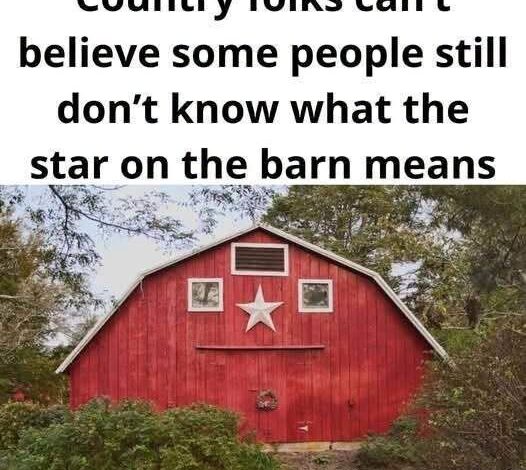
Why You See Stars on Barns History and Symbolism
Long before barn stars became mass-produced décor in home catalogs, they were personal prayers written in color and geometry. Pennsylvania Dutch farmers believed each shade held a purpose: red to draw fortune and love, blue to calm storms in the mind and sky, green to coax life from the soil, black to guard against unseen harm. Carefully painted hex signs were not casual art; they were intimate contracts with fate, layered with symbols that blended faith, superstition, and identity.
As farming changed and beliefs softened, the stars stayed. They shifted from talisman to testimony, quietly marking who built, who toiled, who hoped on that land. When you see one now on a barn, a shed, or a porch in the suburbs, you’re looking at more than rustic charm. You’re seeing someone’s insistence that their story, however small, will not vanish unnoticed.
The article treats the barn star as an object with a life beyond its shape. Seen from a passing car, it may look like a familiar piece of rural decoration. Seen through the account of the families who painted and displayed such symbols, it becomes a way of expressing hopes that were closely connected with home, work, and the land around them.
Color gives that expression another dimension. The meanings described here connect red with love and fortune, blue with calm, green with growth, and black with protection. These are presented as the beliefs attached to the symbols, rather than promises that a painted object could control weather or determine a harvest. Their importance lies in what people hoped for and the language they used to make those hopes visible.
A farming household could face uncertainty that was difficult to control. The account’s description of protective symbols reflects that tension between sustained labor and outcomes that remained uncertain. A carefully painted design offered a place for intention and identity. It could say something about the people who lived and worked there even when no written explanation accompanied it.
The later movement from talisman to decoration does not erase the earlier meanings. Objects can continue to matter after the beliefs surrounding them change. A star may remain on a building because it belongs to the place, because a family remembers who put it there, or because its form has become part of a familiar view. The article invites the observer to consider that continuity.
That is why the star’s endurance matters as much as its original purpose. The building may weather, farming practices may change, and a design may be reproduced far from the setting in which it once carried personal meaning. Yet the older association between a household and the symbol can still give the object depth. Looking again at an ordinary barn star becomes a way of noticing the people and hopes that a landscape can hold.
The next time that familiar shape appears on a building, its apparent simplicity may therefore be worth another glance. A small ornament can preserve a sense of belonging that is larger than the surface on which it hangs.