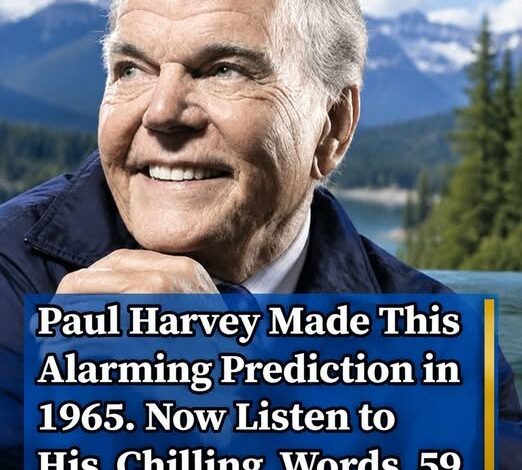
Paul Harvey Warned Us in 1965—And His Words Still Echo Today
There are moments in history when an old voice seems to speak directly to the present.
Paul Harvey was one of those voices.
For decades, millions of Americans listened to Harvey’s distinctive broadcasts, where he mixed news, commentary, history, and observations about American life. His ability to turn complicated social issues into memorable stories made him one of the most recognizable voices on radio.
Today, an alleged warning attributed to Harvey and dated to 1965 is circulating widely online. The message is presented as a prediction of where society could eventually end up—and many readers say that parts of it sound surprisingly familiar.
But there is an important reason to pause before accepting the viral version at face value: the exact wording, date, and original broadcast should be verified before treating the quotation as an authentic 1965 prediction.
That doesn’t necessarily make the underlying discussion irrelevant.
A Warning About Where Society Could Be Heading
The appeal of the story comes from a familiar question: Could someone decades ago have recognized social changes that would become much more visible in the future?
Harvey frequently discussed changes in American culture, family life, education, politics, morality, and the influence of mass media. His broadcasts often encouraged listeners to think beyond the day’s headlines and consider where larger trends might lead.
That style of commentary is precisely why old Harvey quotations continue to circulate.
A statement written decades ago can sound remarkably modern when it touches on enduring subjects such as family relationships, political polarization, technology, changing cultural values, or the growing influence of media.
Why Old Predictions Can Feel So Accurate
There is something powerful about reading a decades-old prediction after history has unfolded.
When we already know what happened, certain statements can appear almost prophetic. But hindsight can also be misleading.
A broad warning about social change can apply to many different periods. And internet posts frequently remove the original context, shorten quotations, combine passages from different broadcasts, or attach an incorrect date.
That is why the most interesting question isn’t simply:
“Was Paul Harvey right?”
A better question is:
“What did Paul Harvey actually say, when did he say it, and what did he mean in the context of his time?”
The Part That Still Deserves Our Attention
Even when a viral quotation turns out to have been altered or misdated, the larger ideas behind it can still prompt a worthwhile conversation.
Every generation worries about the direction of society. Previous generations worried about television, declining community life, political division, changing family structures, and the influence of popular culture. Today, those concerns have expanded to include social media, artificial intelligence, misinformation, and an unprecedented flow of information.
The technology has changed.
The fundamental question has not:
What kind of society are we creating for the next generation?
That is what gives old commentary its staying power.
Look Beyond the Viral Caption
The internet rewards dramatic claims.
“Paul Harvey predicted the future in 1965” is far more likely to attract attention than a careful explanation of what a particular broadcast actually contained.
So before sharing a sensational quotation, it is worth checking the original recording, transcript, broadcast date, and historical context.
If Harvey really made the statement, the original source makes it more meaningful—not less.
And if the quotation has been edited or incorrectly attributed, discovering that is equally valuable.
Either way, the conversation can continue.
Because the enduring appeal of Paul Harvey isn’t simply that people believe he could predict the future.
It is that his broadcasts often asked listeners to stop, think, and consider where the choices of one generation might lead the next.
Decades later, that question remains remarkably relevant.
The past cannot tell us exactly what the future will be. But sometimes, it can give us a reason to pay closer attention to the present.