Massive Python With Swollen Belly Found Under Family’s Shed — X-Ray Reveals Its Last Meal
The sound coming from beneath the backyard shed didn’t seem real.
It was the kind of noise that makes you stop what you’re doing and listen again.
For Leslie and Ed Daley, it began as an ordinary day at their home in Freehold, New Jersey. Nothing about the quiet backyard suggested that a dangerous exotic animal was hiding just a few feet away.
Then they noticed something beneath the shed.
At first, it was difficult to make out in the darkness.
Then the body moved.
A thick, patterned snake slowly emerged from underneath the structure, revealing itself to be far larger than anyone expected. Coiled in the cool dirt was an approximately 8-foot Burmese python, its enormous body stretched beneath the shed and its belly noticeably swollen.
The sight was enough to bring the peaceful backyard to an immediate standstill.
This wasn’t a harmless garden snake.
It was a powerful constrictor native to Southeast Asia, an exotic species that should not have been roaming freely through a New Jersey neighborhood.
And the strangest part was the enormous bulge running through the middle of its body.
Something was inside.
A Shocking Discovery Under the Shed
Animal Control officers were called to investigate.
Removing a large python from underneath a structure isn’t something that can be done casually. The animal is powerful, the space is confined, and frightened wildlife can react unpredictably.
Officers worked alongside a contractor, carefully opening portions of the shed and creating enough space to reach the snake.
The python had wedged itself underneath the structure, making the rescue even more difficult.
Slowly and carefully, the rescuers began working the snake out.
Its thick body seemed almost impossible to believe.
As more of the python emerged, the enormous swelling in its abdomen became even more obvious.
Everyone wanted to know the same thing:
What had the snake eaten?
The answer would eventually come from an X-ray.
The X-Ray Reveals the Truth
After the python was safely removed, it was taken to the Monmouth County SPCA for examination.
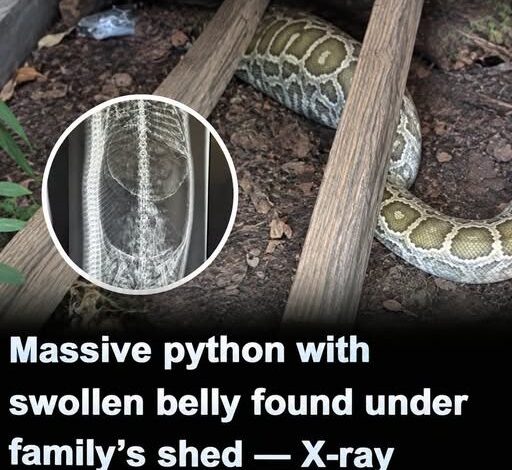
Veterinary staff used imaging to determine what was inside the snake’s distended abdomen.
The result was startling.
The X-ray revealed the unmistakable shape of a large opossum inside the python.
The snake had swallowed the animal whole.
For a python, that behavior is not unusual. Burmese pythons are ambush predators capable of consuming prey much larger than people might expect. They don’t chew their food; instead, they use their jaws and flexible bodies to swallow prey whole.
That explains the bizarre appearance of the snake.
The enormous bulge wasn’t a tumor or some mysterious growth.
It was its most recent meal.
From Backyard Predator to Animal-Control Case
Once the mystery was solved, the situation became more complicated.
The python wasn’t native wildlife.
Burmese pythons are native to parts of South and Southeast Asia, not suburban New Jersey.
That raised an obvious question:
How did an eight-foot exotic snake end up living beneath a family’s shed?
Authorities began looking into whether the animal had an owner and how it had escaped or been released.
Cases involving exotic animals can create difficult situations for both residents and wildlife officials. A large snake that escapes into a neighborhood can pose a potential danger to pets and native wildlife, while the animal itself can also be vulnerable to cold weather, starvation, traffic, or other hazards.
In this case, the python had apparently managed to survive long enough to find shelter beneath the shed and successfully hunt local wildlife.
Why the Discovery Was So Alarming
The most disturbing part for the family wasn’t simply the snake’s size.
It was where the snake had been living.
The animal was underneath a structure in a residential backyard.
That meant it wasn’t discovered in some remote wilderness area. It was close to where people lived, walked, gardened, and spent time outdoors.
The fact that the snake had already captured a sizable wild animal demonstrated that it was capable of surviving outside captivity.
And that is one of the concerns surrounding exotic animals that are released or escape into environments where they don’t naturally belong.
An animal doesn’t have to be intentionally released to become a problem.
A door can be left open.
A cage can fail.
A snake can escape during transportation.
And once a large predator gets outside, it may find shelter and food surprisingly quickly.
Burmese Pythons Are Built for This
Burmese pythons are among the largest snakes in the world.
They are powerful constrictors, meaning they capture prey with their bodies rather than relying on venom.
They are also remarkably capable hunters.
A python can wait quietly for an opportunity before striking, wrapping its body around prey and eventually swallowing the animal whole.
Their flexible jaws and expandable bodies allow them to consume meals that look impossibly large compared with the snake’s head.
That’s why the swollen belly seen on the New Jersey python was such an important clue.
The snake had recently eaten—and the X-ray provided the evidence.
The Animal Was Eventually Moved to Safety
After being examined and cared for, the python was placed in a secure enclosure and transferred to a licensed reptile expert.
That outcome was important for both the snake and the surrounding community.
A large exotic animal shouldn’t be left to fend for itself in a suburban neighborhood, especially in a climate very different from its native range.
At the same time, the animal itself wasn’t responsible for being there.
If a pet escapes or is abandoned, the consequences can affect everyone involved—including the animal.
The python could have been injured, killed by a vehicle, exposed to freezing temperatures, or eventually encountered someone who didn’t know how to safely respond.
A Warning About Exotic Pets
The bizarre discovery beneath the shed ultimately highlighted a much larger issue.
Exotic animals can look fascinating when they’re young and manageable.
But some species grow dramatically larger and stronger as they mature.
A snake that seems easy to keep in a small enclosure as a juvenile can eventually become an animal requiring specialized housing, food, handling, and legal permits.
And when owners can no longer care for them, releasing them outdoors isn’t a solution.
It can endanger native wildlife and create serious problems for the animal itself.
That’s why responsible ownership, secure enclosures, and compliance with local laws are so important.
One Backyard, One Giant Snake, One Unforgettable Discovery
For Leslie and Ed Daley, it was the kind of backyard discovery that is almost impossible to forget.
What started as an ordinary day suddenly became a wildlife emergency.
Beneath their shed was an approximately eight-foot python.
Its enormous belly suggested that it had recently consumed something substantial.
And the X-ray revealed exactly what that something was: a large opossum swallowed whole.
The discovery was shocking, but it also told rescuers something important.
The python wasn’t simply hiding.
It had adapted.
It had found shelter.
It had found food.
And it had managed to survive in a place where it never should have been in the first place.
That is what made the discovery beneath the shed so unsettling.
The strangest part wasn’t that an eight-foot python could swallow an animal whole.
It was that the python had been living quietly beneath an ordinary family’s backyard shed—and nobody knew it was there.