My Neighbor Sealed My Driveway With Concrete Until I Wiped the Smile Off His Face
The little plastic card felt heavier than it should have.
I was sitting in the front seat of my old Chevrolet in the DMV parking lot, holding it in my palm like a passport to somewhere I’d never been.
There was my picture. Not a great one. I’d blinked right as the flash went off, and the woman behind the counter said, “It’s fine, honey, nobody looks good in these,” and I believed her. My name. My address. My date of birth.
And across the top, in blue letters: DRIVER LICENSE.
Sixty years old.
And I finally had my driver’s license.
I adjusted my rearview mirror. Then I adjusted it again. Then a third time, even though it hadn’t moved. And I let out a laugh that surprised me. It just burst out of me, right there in the parking lot, all by myself.
Paul would have teased me. He’d have said, Carrie, the mirror’s fine. The mirror’s been fine for ten minutes. You’re allowed to go now.
My husband had been gone for two years.
Forty-one years of marriage. And he’d driven every single mile of it.
“You planning to sit there all afternoon? Or are we getting coffee?”
Stella’s voice came through my open window.
She was leaning against her own car, two spaces over, with her arms crossed and that big grin on her face. The same grin she’d been wearing since the day I met her. Thirty-four years ago, in the file room of the insurance office where we both worked, when she dropped an entire drawer of claim forms on my foot and said, “Well, now we have to be friends. That’s the rule.”
We’d been friends ever since.
“I’m savoring the moment,” I told her.
“You’re stalling.”
“I’m sa-vor-ing.”
“Carol, honey. The car has to actually move for it to count.”
I checked my side mirrors. Both of them. Twice each.
Stella walked over and tapped the roof of my car with her knuckles. She was laughing.
“Oh, Lord,” she said. “You’re going to be one of those grandmas who goes forty in a forty-five, aren’t you?”
“Fifty in a fifty-five,” I said. “Thank you very much.”
“That’s still under, Carol.”
“It’s responsible, Stella.”
I should explain why I never learned to drive.
People always ask. And for a long time, I didn’t have a good answer. Or I had one, but I didn’t like saying it out loud.
When I was sixteen, my father tried to teach me. In his big brown Buick, in the parking lot of the Methodist church on a Sunday afternoon. He sat in the passenger seat with his arms crossed and yelled every time I did something wrong. And I did everything wrong. I was so nervous my hands were sweating on the wheel. I stalled it four times. On the fifth time, I stepped on the gas instead of the brake and drove over a flower bed.
My father got out of the car. He walked around to the driver’s side. He opened my door.
“Get out,” he said. “Some people just aren’t built for it. Your mother never drove either. You’ll find a man who drives.”
I got out.
And I found a man who drove.
I met Paul when I was nineteen. He had a green pickup truck with a bench seat, and on our third date he drove me all the way to the lake with the windows down and his arm across the back of the seat. I sat there with my hair blowing everywhere and thought, I never want to drive anywhere. I want to be driven like this forever.
And for forty-one years, I was.
Paul drove me to work every morning. He drove me to the grocery store on Saturdays. He drove me to the hospital when our daughter, Lisa, was born, running three red lights, and he drove us home again two days later at exactly twenty-five miles an hour the whole way, with his hands at ten and two, sweating, terrified he’d hit a bump and wake the baby.
He drove me to every doctor’s appointment. Every church supper. Every funeral. Every wedding. Every Christmas at his mother’s house. He never once complained.
“You’re my favorite passenger,” he used to say. “Why would I want you driving? Then who would I talk to?”
I never learned. I never had to.
And then Paul had a heart attack in the garden one Tuesday morning in April, while he was planting tomatoes.
And he was gone.
And I was sixty years old, standing in my kitchen with a set of car keys I didn’t know how to use.
That first year without him, I got rides.
Stella drove me places. My daughter drove me when she visited, but she lives four hours away in Columbus, with two kids and a job. The ladies from church took turns taking me to the grocery store. I took cabs to the doctor. I took the bus when I could figure out the schedule.
And every single time, I felt like a burden.
I’d sit in the passenger seat of somebody else’s car, saying thank you, thank you, I’m so sorry, thank you, over and over. Like I was apologizing for existing.
The last straw was in March. My granddaughter, Emma, had a piano recital in Columbus. She was eight. It was her first one. She’d been practicing a song called “Spring Morning” for three months. She’d called me every week to play it for me over the phone.
“Are you coming, Grandma? Are you coming to the recital?”
“I’ll be there, sweetheart. I promise.”
Stella was supposed to drive me. The morning of the recital, her car wouldn’t start. Dead battery. We tried to get a cab. There weren’t any available that would go that far. We tried the bus. The next one to Columbus left too late.
I missed it.
I sat at my kitchen table and listened to Emma play “Spring Morning” on my daughter’s cell phone, through a speaker, with the sound going in and out. Emma kept looking at the camera. Looking for me.
After, she got on the phone.
“Grandma,” she said. Her little voice was wobbly. “Why didn’t you come? You promised.”
I didn’t have an answer.
The next morning, I called the driving school.
My instructor’s name was Gordon.
He was about seventy, with a gray crew cut and a voice like a gravel road. He’d been teaching people to drive for thirty-eight years. He wore the same blue windbreaker every single day, no matter the weather.
On our first lesson, he sat in the passenger seat of the driving school’s little white car and looked at me.
“You nervous?” he asked.
“Terrified.”
“Good,” Gordon said. “The people who aren’t nervous are the ones who scare me.”
We started in the parking lot of the community college. On a Sunday afternoon. Just like with my father.
I stalled it twice. Well, you can’t really stall an automatic. But I stepped on the brake so hard both times that we both jerked forward against our seatbelts.
Gordon didn’t yell. He didn’t cross his arms. He didn’t sigh.
“That’s okay,” he said. “Brakes work. That’s good to know. Try it again. Gentler this time. Pretend there’s an egg under your foot.”
I pretended there was an egg under my foot.
It took me eleven lessons before I drove on a real road.
It took me eighteen before I drove on the highway. The first time I merged, I was gripping the wheel so hard my knuckles were white, and I was saying Paul’s name under my breath, over and over, like a prayer.
“Who’s Paul?” Gordon asked, after we’d merged. I was going fifty-two in a sixty-five.
“My husband,” I said. “He passed.”
“He drive?”
“Everywhere. For forty-one years.”
Gordon was quiet for a moment.
“Well,” he said. “He’d be pretty proud of that merge. That was textbook.”
It took me six months of lessons.
On the day of my test, Gordon drove me to the DMV. He sat in the waiting room while a young man with a clipboard rode with me. We went around the block. We parallel parked. I did a three-point turn. I signaled every single time. I came to a complete stop at every stop sign and counted one, two, three in my head, like Gordon taught me.
When we got back to the parking lot, the young man looked at his clipboard for a long time.
“You passed,” he said. “First try.”
I stared at him.
“Really?”
“Really.” He tapped the clipboard. “You know why? Because you actually follow the rules. You signaled at every turn. You stopped all the way. You checked your mirrors. Most people don’t do any of that. Most people think the rules are just suggestions.”
I thanked him. I thanked him probably six times.
Then I went into the waiting room and found Gordon and hugged him. He stood there stiffly in his blue windbreaker and patted me on the back twice.
“Knew you’d do it,” he said gruffly. “Don’t speed.”
“I would never.”
“I know,” he said. “That’s why I’m not worried about you.”
Fifteen minutes after I finally pulled out of the DMV parking lot, Stella and I were sitting in a booth at Dot’s Diner.
It’s our diner. We’ve been going there every Thursday for twenty years. The same booth by the window. The same waitress, Maxine, who’s been working there since before either of us started.
Stella raised her coffee mug like it was a glass of champagne.
“To Carol!” she announced. Loud enough for the whole diner to hear. “Licensed, dangerous, and long overdue!”
A man at the counter turned around and clapped. I turned red.
“I’m not dangerous.”
“You’re a menace,” Stella said. “A slow, careful, blinker-signaling menace to society.”
I couldn’t stop smiling. My face actually hurt from it.
I hadn’t smiled like that since before Paul’s funeral. Two years. I’d smiled at things. At Emma on the phone. At Stella’s jokes. At the kids at church. But not like this. Not the kind of smile that starts somewhere down in your stomach.
“You know what the man at the DMV said?” I asked.
“That you drive like you’re transporting a wedding cake?”
“He said I passed on the first try because I actually respect the rules. He said most people don’t.”
“Well, most people didn’t have somebody driving them around for forty years,” Stella said. “Most people had to figure it out when they were sixteen. With their dads yelling at them.”
That touched a nerve. My father in the Buick. Some people just aren’t built for it.
Stella saw it on my face. She always does. She reached across the table and squeezed my hand.
“He’d be proud of you, Carol,” she said. “Paul.”
I looked out the window at my old Chevy in the parking lot. Parked perfectly between the lines.
“He’d be terrified,” I said. “He’d never let me merge!”
We laughed so hard that Maxine came over to refill our cups just to find out what was so funny.
By the time I turned onto my street that afternoon, the sun was going down.
My little house looked like it was waiting for me. The white siding. The blue shutters Paul painted the summer before he died. The rosebushes by the front steps. The empty space in the garden where the tomatoes used to be. I hadn’t been able to plant tomatoes since.
I pulled into my driveway. Slowly. So slowly. I put my blinker on even though there wasn’t a single car behind me.
That’s when I noticed him.
Ryan. The new neighbor. From the house directly across the street.
He was standing on his front porch with a beer in his hand. He was in his late thirties. Tall, a little soft around the middle, with a baseball cap on backwards and a T-shirt that said GRIND NEVER STOPS across the front.
He’d moved in about four months before. The house had belonged to the Kowalskis for thirty years, a sweet old couple who moved to Florida to be near their grandkids. Then one day there was a moving truck, and then there was Ryan.
He’d barely said two words to anybody on the street since. He didn’t come to the block party. He didn’t wave back when Mr. Henderson waved. He parked his big black pickup truck crooked on the street every night and played loud music in his garage on Sunday mornings.
I waved at him.
He lifted his hand. Slowly. But he didn’t smile.
“Afternoon!” I called across the street.
Ryan didn’t answer.
He just stood there on his porch, holding his beer. Watching me. I got my purse out of the car. I locked the doors. I checked the handle twice. I walked up my front steps.
The whole time, I could feel his eyes on my back.
Probably nothing, I told myself. Probably just me being sensitive. It’s been a big day.
I turned my key in the front door.
And I told myself the road ahead was wide open.
On Wednesday morning, the pickup was there again.
Ryan’s big black truck. Parked on the street in front of my house. And its back tire was sitting on the edge of my driveway. Not all the way in. Just enough. Just enough so that I couldn’t back my Chevy out without hitting it.
It looked like he’d measured it with a ruler.
I had a doctor’s appointment in forty-five minutes. My annual checkup. My blood pressure. I’d had to reschedule it twice last year because I couldn’t get a ride.
My purse was already on my shoulder. My keys were already in my hand.
I stood in my driveway and looked at that tire for a long moment.
Then I walked across the street in my sensible shoes and knocked on Ryan’s door.
He opened it after the third knock. He was wearing sweatpants and holding a coffee mug. The mug said WORLD’S OKAYEST BOSS on the front.
Honestly, it felt like the most honest thing about him.
“Ryan,” I said. “I’m so sorry to bother you this early. But could you please move your truck? I have a doctor’s appointment. And please, if you don’t mind, try not to block me in.”
He looked past me. At my Chevy, sitting in my driveway.
Then he looked at me.
And he laughed.
“Maybe take an Uber, Carol,” he said. “Women your age have no business driving anyway.”
I just stood there for a second.
I was holding the strap of my purse so tight it was digging into my palm. Like it was the only thing keeping my hand from doing something my mother would not have approved of.
“That’s a rude thing to say to a neighbor,” I said.
“It’s a true thing to say to a neighbor,” Ryan said.
And he shut the door in my face.
I called a cab.
It cost me twenty-eight dollars that I didn’t really have to spare. Paul’s pension isn’t much. And the whole ride to the clinic, I sat in the back seat with my purse on my lap and forced myself not to cry.
Because the day Paul died, standing in that hospital hallway, I made myself a promise.
I promised I wouldn’t waste a single tear on men who weren’t worth the salt.
Ryan was not worth the salt.
At the clinic, the nurse took my blood pressure. She frowned at the little screen.
“It’s a little high today, Carol,” she said. “Anything stressful going on?”
“New neighbor,” I said.
She nodded like she understood. “Say no more.”
On Thursday, I told Stella about it.
We were sitting at her dining room table. She has these placemats with little yellow tulips on them. She’s had them since 1987. She refuses to replace them.
Stella listened to the whole story with her mouth getting tighter and tighter.
“Carol, honey,” she said when I was done. “You call the police.”
“For a truck?”
“For a jackass!”
I laughed. I couldn’t help it.
“I don’t want to be that neighbor, Stella,” I said. “You know. The one who calls the police about everything. The one everybody talks about.”
Stella pointed her finger at me across the tulip placemats.
“Carol,” she said. “You are already that neighbor. He made you that neighbor. You just haven’t accepted it yet.”
On Saturday, I had to parallel park.
It was the farmers’ market downtown. Every Saturday morning in the summer. Paul and I used to go every week. He’d buy tomatoes and complain that they weren’t as good as his, and I’d buy fresh bread and honey from the bee lady.
I hadn’t gone since he died.
I drove myself downtown. I found a spot on the street, right in front of the market. Between a minivan and a mailbox.
I was easing into it. Carefully. One inch at a time. Checking my mirrors. Turning the wheel exactly the way Gordon taught me. Back, back, cut the wheel, back, straighten.
And then I heard him.
“Careful, Carol! That mailbox didn’t do anything to you!”
I looked up.
Ryan was standing across the street. Leaning against his big black pickup truck. Laughing.
What was he even doing there? He didn’t strike me as a farmers’ market kind of man. Maybe he’d followed me. Maybe it was a coincidence. I never found out.
Two teenage boys on the sidewalk started laughing with him. Because teenage boys will laugh at anything, as long as it isn’t them.
My face went hot.
I finished parking.
My spacing was perfect. Eighteen inches from the curb, exactly. Equal distance front and back. Gordon would’ve given me a gold star.
I did not look at Ryan once.
I got out. I locked my car. I checked the handle. And I walked into the farmers’ market with my head up.
I bought tomatoes. They weren’t as good as Paul’s.
I bought bread and honey from the bee lady. She hugged me and said she’d missed seeing me.
When I came back out, Ryan was gone.
The tires happened on a Tuesday.
I walked out the front door at seven o’clock in the morning with my travel mug full of coffee. I was going to drive to Stella’s. We were going to go to the craft store together. She wanted to start a quilt.
And my car was sitting lower than it should have been.
All four tires were flat.
Not a little flat. Not a slow leak. Flat all the way down to the rims. Flat in a way that tires don’t just go flat by themselves.
I walked around the car in my slippers.
There was a slash in each one. On the side. Clean. Deliberate.
Four slashes.
Like a signature.
I stood there in my driveway in my robe and slippers, holding my coffee mug, and I said a word out loud. A word Paul would’ve pretended to be shocked by. He’d have put his hand over his heart and said, Carrie! Language! And then laughed.
Then I put my coffee mug down on the hood of my car.
And I marched across the street.
Ryan opened his door on the first knock this time.
He was wearing a T-shirt with a big yellow mustard stain on the front. He looked like he’d been expecting me.
“I’m sorry,” I said. My voice was shaking, but I kept going. “But this is my driveway. That is my car. Why are you doing this to me?”
He rolled his eyes. So hard that I honestly worried about his optic nerve.
“I don’t care, Carol,” he said. “Okay? I don’t care about your car. I’ve just been trying to show you something. Women can’t drive. Especially old ones like you.” He took a sip from his WORLD’S OKAYEST BOSS mug. “Driving is a man’s job.”
I stared at him.
“A man’s job?”
“That’s what I said.”
I thought about it for a second.
“Ryan,” I said. “You work from home. Selling protein powder. On Instagram.”
I’d heard that at the Hendersons’ barbecue a few weeks before. He’d been telling anyone who would listen about his “business.”
His face did something very interesting. It went red, then white, then red again.
“Get off my porch, Carol!”
I got off his porch.
I walked back across the street. I called the tire shop.
The man at the tire shop came out with a flatbed truck. He looked at my tires and whistled.
“Somebody really doesn’t like you, ma’am.”
“Apparently not.”
It cost me four hundred and sixty-two dollars.
Four hundred and sixty-two dollars. That was almost my whole grocery budget for two months. I put it on my credit card. I’d figure it out later.
And then, when the tire man was done, I got in my car, with its four brand new tires, and I drove to Stella’s.
Because I refused. I absolutely refused to let that man decide where my car went.
“You should have called the cops,” Stella said.
We were at the craft store. Standing in the fabric aisle. She was holding a bolt of blue flowered cotton against her chest.
“I don’t have any proof, Stella.”
“Carol.”
“I know.”
“He slashed your tires!”
“I know he did. But I didn’t see him do it. Nobody saw him do it. There’s no camera. It’s my word against his. And he’ll just say I ran over something.”
Stella put down the fabric. She reached out and pressed her hand against my shoulder. She looked worried. Stella almost never looks worried.
“Please be careful, honey,” she said.
I laughed. It wasn’t a very happy laugh.
“I’m always careful, Stella,” I said. “That’s my whole problem.”
That night, I sat on the edge of my bed and talked to Paul.
I still did that sometimes. Even though I knew I was really just talking to the wallpaper. It’s yellow, with little blue flowers. Paul picked it out in 1994. I always thought it was too busy. Now I couldn’t imagine changing it.
“I handled it, honey,” I told the wallpaper. “New tires. Four of them. I didn’t give him the satisfaction of seeing me cry.”
The wallpaper didn’t answer.
But I could almost hear Paul. The way he used to talk when I was being too stubborn. Slow and gentle. Carrie. You don’t have to handle everything by yourself. That’s what people are for.
“Yes, I do,” I told the wallpaper. “That was the whole point of the license, Paul. So I wouldn’t need anybody anymore. So I wouldn’t be a burden. So I could do it all myself.”
I turned off the lamp.
I pulled the quilt up to my chin. The one Stella made me the Christmas after Paul died. It’s made of his old flannel shirts.
And I told myself that I’d won.
I told myself that. Lying there in the dark.
I almost believed it.
A horrible grinding roar dragged me out of sleep at 6:47 a.m. on Monday.
I sat straight up in bed. My heart was pounding. For one crazy second, I thought a garbage truck had driven straight through my living room.
Then I remembered garbage day was Friday.
I threw on my robe. I shoved my feet into my slippers. The pink fuzzy ones. Paul bought them for me our last Christmas together. They were too big. He always got my size wrong. I wore them every single day anyway.
The noise was coming from outside. From my driveway.
I rushed to the front door. I opened it.
And I froze on the top step.
Ryan was standing in the middle of my driveway.
He was wearing a bathrobe. A plaid one. Over pajama pants. He was pointing at something, like a construction foreman.
Two workers in bright orange vests were standing next to a small crane truck, parked at the end of my driveway. They were guiding a thick metal chain.
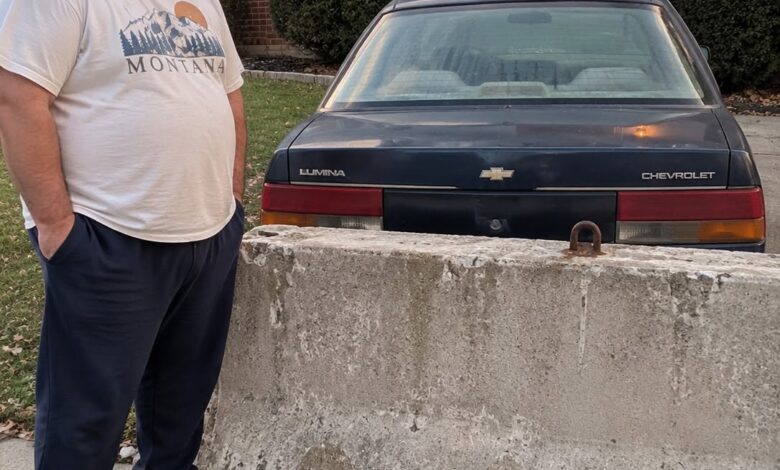
And hanging from that chain was a concrete block.
A huge concrete block. Gray. Rough. The size of a loveseat.
They were lowering it. Slowly. Right down onto my driveway. Right behind my Chevy.
Sealing me in completely.
“What,” I said. My voice came out as a squeak. I tried again. “What in God’s name are you doing?!“
Ryan turned around slowly. Like he’d been waiting for me. Like he’d been waiting for his audience to arrive.
“Morning, Carol,” he said. “Nice robe.”
“Get that thing off my property! Right now! Right this second!”
“See,” Ryan said. “That’s the funny part.”
He wandered toward me across the driveway. Behind him, the two workers glanced at each other. They looked like they wished they were anywhere else on earth.
“It’s not your property,” Ryan said. “The property line runs right through where that block’s landing. My surveyor came out yesterday. Measured the whole thing.”
“You don’t have a surveyor.”
“I have a guy who owns a tape measure.” He shrugged. “Close enough.”
The concrete block touched down.
THUD.
I felt it in my chest. In my bones. The whole driveway shook.
My Chevy was completely boxed in. The block was right behind the back bumper. There was no way to back out. No way around. My beautiful, stubborn old Chevy was trapped like an exhibit in a museum.
“I’m calling the police,” I said. My hands were shaking. “I’m calling them right now.”
“Go ahead.”
Ryan shrugged. He actually shrugged. Like I’d just offered him a mint.
“They’ll come out,” he said. “They’ll look at it. They’ll tell you it’s a civil matter. A property dispute. Not their department. Then you’ll have to get a lawyer. He’ll cost you eight hundred bucks, minimum. You’ll go to court. Six months from now, maybe, a judge might order me to move it.” He smiled. “Might.“
He folded his arms across his bathrobe. He smirked.
“And in the meantime, Carol? We’ll finally have some peace and quiet around here.”
He leaned in a little closer.
“Take an Uber, sweetheart.”
I felt tears coming.
I felt them rising up in my throat, burning behind my eyes. And I hated them. I hated them so much.
I hated that my hands were shaking. I hated that my voice was shaking. I hated that I was standing in my own driveway in my robe and Paul’s too-big pink slippers while a smug thirty-something man in a plaid bathrobe told me my life belonged to him now.
“Why do you hate me?” I asked him.
It came out small. Much smaller than I wanted.
“I don’t hate you, Carol,” Ryan said. “I just think some people need to stay in their lane.”
He winked at me.
He actually winked.
“Driving pun,” he said. “Get it?”
One of the workers in the orange vests cleared his throat.
He was young. Early twenties. He looked absolutely miserable.
“Uh, sir,” he said to Ryan. “We’re gonna. Uh. We’re gonna head out now.”
“Yeah, yeah,” Ryan said, waving his hand. “Invoice me.”
The young worker looked at me. Just for a second. And his face said, I’m sorry, lady. I didn’t know.
Then he climbed into the crane truck.
I stood there and stared at Ryan.
And that’s when I realized there was absolutely no point in arguing with him. None. You can’t argue with somebody like that. Anything you say, they’ll just laugh at. Anything you do, they’ll just do something worse.
I didn’t say another word.
I turned around. I walked back up my front steps. I went inside.
And I closed the door with both hands. Carefully. Gently. So I wouldn’t slam it.
Then I stood in the middle of my living room and cried.
For exactly ninety seconds.
I timed it on the microwave clock. I watched the green numbers change. 6:52. 6:53.
Because Paul used to say that a good cry has a beginning, a middle, and an end. And you don’t let it run past the credits.
He said that to me the night my mother died. I cried for an hour. And then he made me a grilled cheese sandwich and said, Okay, Carrie. That was a good one. That was a real Oscar winner. Now eat something.
When the ninety seconds were up, I wiped my face with the sleeve of my robe.
I took a deep breath.
I walked to the kitchen. I was going to pick up the phone. I was going to call Stella. Or maybe the police, even though Ryan was probably right. Even though they’d probably just shrug and say civil matter.
My hand was on the phone.
And something stopped me.
A memory. Sharp as a mailbox corner.
Three weeks before. The neighborhood barbecue.
It was at the Hendersons’ house, two doors down. They do one every summer, on the Fourth of July. Mr. Henderson grills. Mrs. Henderson makes her famous seven-layer dip. The kids run through the sprinkler. Everybody brings a folding chair and a side dish.
I almost didn’t go. It was my second Fourth without Paul. He used to love that barbecue. He’d bring his tomatoes and slice them up with salt and pepper and stand next to Mr. Henderson at the grill for three hours arguing about baseball.
But Stella made me go. She picked me up and drove me. Two houses down. She said I needed to “get out and be a person.”
Ryan was there.
He was standing next to the grill. Loud. Way too loud. Holding a beer and holding court. Telling anybody who would listen about his protein powder business. About how many followers he had. About how he was going to be a millionaire by the time he was forty.
And then somebody asked him how he afforded the Kowalskis’ old house.
“Oh, my mom,” Ryan said. He laughed. “My mom is the reason I even have that house. She takes care of everything.” He took a big swig of his beer. “And she’ll handle anybody who talks back to me. Trust me.”
Everybody laughed. The uncomfortable kind of laughing. The kind where people don’t know what else to do.
Everybody except one person.
There was a small woman standing a few feet behind Ryan. She was maybe seventy. Silver hair in a neat short bob. A navy cardigan buttoned all the way up, even though it was July. She was holding a paper plate with a scoop of potato salad on it.
She wasn’t laughing.
Her mouth was pressed into a thin, flat line. The line of somebody who had completely run out of patience a very long time ago.
I remember thinking she looked like a school principal. The kind who could stop a whole cafeteria from talking just by standing in the doorway.
That was Patricia. Ryan’s mother.
Later that evening, I was standing by the drinks table. Pouring myself a glass of Mrs. Henderson’s sweet tea.
And the woman in the navy cardigan came and stood next to me.
She didn’t say anything at first. She poured herself a glass of lemonade. She took a sip.
Then she spoke without looking at me. Very quietly.
“You’re the one across the street from my son,” she said. “Carol. The widow.”
“Yes,” I said. I was surprised she knew my name.
“Patricia,” she said. She shook my hand. Her grip was firm. Much firmer than I expected from such a small woman.
She glanced over her shoulder. Back at the grill. At Ryan, who was showing everybody pictures of his abs on his phone.
Then she reached into the pocket of her cardigan. She pulled out a small folded piece of paper. And she slipped it into my palm. Quickly. Quietly. Like a spy in an old movie.
“Carol, honey,” she said in a low voice. “If he ever crosses a line with you, you call me. Not him. Me.”
I looked down at the paper. Then back at her.
“I mean it,” Patricia said.
And she walked away.
I’d put the folded paper in my address book that night when I got home. Under P. I never looked at it again. I honestly forgot all about it.
Now I walked to my kitchen drawer. The junk drawer. I pulled out my address book. The old leather one Paul gave me in 1985. I flipped to P.
There it was. The little folded paper. Tucked in between the pages.
I unfolded it.
A phone number. In neat, careful cursive handwriting. The kind they taught in schools a long time ago.
Patricia.
I picked up the phone.
I dialed the first nine digits.
My finger hovered over the last one.
And a little voice in my head, a voice that sounded suspiciously like Paul, said:
You don’t have to do this alone, Carrie.
I pressed the button.
It rang once.
“Hello, Patricia speaking?”
Her voice was crisp and awake. Like she’d been up for hours.
“Patricia,” I said. “It’s Carol. From across the street from Ryan. I’m so sorry to be calling this early, I know it’s not even seven, but—”
“Carol.”
Her voice changed. It went sharp. Alert. Like a bell.
“What did he do?”
So I told her everything.
The truck blocking my driveway. The Uber comment. Women your age have no business driving. The parallel parking at the farmers’ market. The four slashed tires. The four hundred and sixty-two dollars. Driving is a man’s job. And the concrete block. The crane. Take an Uber, sweetheart. The wink.
When I got to the part about the wink, I heard her breathe in through her nose. Hard.
When I finished, there was a long pause on the line.
Then a slow, long breath. Like a teacher setting down a red pen.
“I’ll be there in less than five minutes, sweetheart,” Patricia said. “I happen to be in the neighborhood.”
And the line went dead.
I stood at my front window in my robe and watched.
The sun was climbing up over Ryan’s roof. Birds were singing in the maple tree. The concrete block sat in my driveway like a big gray tombstone.
The crane truck was still there, parked at the curb. The two workers were sitting in the cab. They hadn’t left. I don’t know why. Maybe they were filling out their paperwork. Maybe they were waiting to see what happened.
Ryan was back on his porch. Sitting in a lawn chair. In his bathrobe. Drinking his coffee. Looking very pleased with himself.
Waiting felt like torture. Every second. I watched the clock on my microwave through the kitchen doorway. 6:59. 7:00. 7:01.
At 7:02, a silver sedan turned onto our street.
It pulled up to the curb in front of my house. Very neatly. Exactly eighteen inches from the curb.
The door opened.
Patricia stepped out.
She was wearing a navy cardigan again. Or maybe the same one. Buttoned all the way up. Pressed gray slacks. Sensible shoes, a lot like mine. She had a thick folder tucked under her arm like a schoolteacher on the first day back.
And she had her phone pressed to her ear.
I opened my front door and stepped out onto the porch.
“That’s right, Mike,” Patricia was saying into the phone. “The whole slab. Concrete. About the size of a loveseat. I need it gone within the hour.” A pause. “Yes. Bill it to my son. You have his address.” Another pause. “No, Mike, the other son. The one who doesn’t call me.”
She lowered the phone and slipped it into her purse.
Across the street, Ryan saw his mother’s car.
I watched him see it.
I watched his coffee mug stop halfway to his mouth.
I watched his face go absolutely, completely white. The color drained out of it so fast that, for one second, I almost felt sorry for him.
Almost.
Patricia didn’t look at him. She didn’t look at his house. She walked right past me, up my driveway, straight to the concrete block.
She looked at it for a long moment. She walked all the way around it. She looked at my Chevy, trapped behind it. Then she walked down to the curb. To the crane truck. To the two workers sitting inside it.
They both suddenly found their boots very interesting.
“Gentlemen,” Patricia said. Pleasantly. “Good morning.”
“Morning, ma’am,” said the young one.
“My contractor is on his way to remove this,” she said. “His name is Mike. He’ll be here in about twenty minutes. You can go now. You won’t be needed. And any bill for this job goes straight to my son.” She paused. “Not to this lady. To my son. Is that clear?”
“Yes, ma’am,” said the young one. “Very clear, ma’am.”
“Thank you.”
Ryan was already off his porch.
He came running across the street toward us. Sprinting. In his bathrobe. In his slippers. The bathrobe was flapping open. One of his slippers flew off in the middle of the street. He didn’t stop to get it.
I folded my arms across my chest and stood on my porch.
“Mom!” Ryan said. He was out of breath. “Mom, come on! What are you doing here? It was a joke! It was just a joke!”
He turned to me. Wild-eyed.
“Carol knows it was a joke. Right, Carol? Tell her. Tell her it was a joke.”
I looked at him.
“Funny,” I said. “I forgot to laugh.”
Patricia didn’t even glance at her son.
She opened the folder she’d been carrying. She took out a crisp white piece of paper. Printed. Signed. And she held it out to him.
“Ryan,” she said. Calmly. “The house is in my name. Not yours. You pay me rent. Or, I should say, you’re supposed to pay me rent. You’re three months behind.”
She tapped the paper.
“And your lease, which you signed, forbids harassing the neighbors. And it forbids any construction or alteration without my written permission.” She looked at the concrete block. “I’d say this counts as both.”
Ryan stared at the paper.
“You have thirty days to move out,” Patricia said.
“Mom,” Ryan said. His voice cracked. “Mom, no. Anything but this. Please. Stop it.”
“You heard me.”
“Thirty days?” His voice went up about an octave. “Where am I supposed to go?”
Patricia finally looked at her son.
It was a long, steady look. A look I recognized. It was the same look she’d had at the barbecue. The look of a woman who had completely run out of patience a long, long time ago.
“Anywhere,” Patricia said, “that teaches you some manners.”
Ryan turned to me. His face was desperate now. Red and blotchy.
“Carol,” he said. “Carol, please. Tell her. Tell her I’ll apologize. I’ll say sorry. I’ll—I’ll wash your car! Every week! Every single week! For free!”
I took a deep breath.
And for the first time in weeks, my hands weren’t shaking.
Not even a little.
“Ryan,” I said. “The world doesn’t belong to you just because you want it to. Or because you’re a man.”
I paused.
“Maybe try sleeping in an Uber,” I said. “I hear the backseats are very roomy. Great for men your age.”
Patricia’s mouth twitched.
Just at the corner. Just a tiny bit.
It was the closest thing to a smile I’d ever seen on her face.
Mike the contractor showed up at 7:24.
He was a big, quiet man with a gray beard and a flatbed truck with a crane on the back. He looked at the concrete block. He looked at Ryan, standing in his bathrobe in the middle of the driveway with one slipper on.
He shook his head slowly.
“Ryan,” he said. “Your dad would’ve been so disappointed.”
He hooked up his chains. He lifted the block. He set it on the back of his truck.
By 7:45 a.m., the concrete block was gone.
The driveway was mine again.
There was a gray dusty rectangle on the pavement where it had been sitting. I got the hose out later that afternoon and washed it away.
After Mike drove away, Ryan walked back across the street. Slowly. Picking up his lost slipper from the middle of the road. He went inside his house and closed the door.
I didn’t see him again for three days.
Patricia stood in my driveway for a moment. Looking at my Chevy.
“That’s a good car,” she said. “Old, but good. They don’t make them like that anymore.”
“It was my husband’s,” I said.
She nodded. She was quiet for a moment.
“Carol,” she said. “Would you mind if I came in for a cup of coffee? I think I owe you an explanation. And frankly, I could use a cup of coffee.”
We sat at my kitchen table.
I made a fresh pot. I put out a plate of the lemon cookies I keep for company. Patricia took one. She didn’t eat it. She just held it.
“His father was like that,” she said finally.
I didn’t say anything. I waited.
“Richard. My husband. Well. Ex-husband.” She set the cookie down on her napkin. “Thirty-one years, we were married. And for thirty-one years, he told me I couldn’t drive. That I wasn’t smart enough. That I’d crash. That women had no business behind the wheel. He wouldn’t let me learn. He hid the car keys. He drove me everywhere. To the grocery store. To the doctor. To church. He decided where I went. And when. And for how long.”
I stared at her.
“I didn’t know how to leave him,” Patricia said. “Because I couldn’t drive. How do you leave somebody when you can’t even get to the end of the street by yourself?”
She picked up her coffee cup. Her hand was very steady.
“I finally left when I was fifty-two,” she said. “Ryan was twenty-one. My sister drove me away. With two suitcases. And the very first thing I did, the very first week, was sign up for driving lessons.” She took a sip. “I passed on the second try. I failed the first one. I was so nervous I drove over a curb.”
I laughed. I couldn’t help it.
“My father made me drive over a flower bed when I was sixteen,” I said. “And then he told me I wasn’t built for it.”
Patricia looked at me for a long moment.
“Well,” she said. “Here we are. Two old women who weren’t built for it.”
“Both driving,” I said.
“Both driving,” she agreed.
“I tried,” Patricia said after a while. “With Ryan. I tried so hard to raise him different. To show him that his father was wrong. But he spent too many years watching Richard. Listening to him. Watching the way he treated me.” She shook her head. “And when I left, Ryan took his father’s side. He was so angry with me. He said I’d broken up the family. He didn’t speak to me for four years.”
“Oh, Patricia.”
“And then, last year, his business failed. The first one. Before the protein powder. He was broke. He was going to be evicted. And he called me. For the first time in four years.” She smiled a little. Not a happy smile. “And I thought, maybe this is my chance. Maybe if I help him. Maybe if I give him a place to live, cheap, and show him I still love him, maybe he’ll finally see.”
She looked out my kitchen window. Across the street. At the house she owned. Where her son lived.
“So I bought the Kowalskis’ house,” she said. “And I let him live there. And I told myself I was helping him.” She was quiet for a moment. “But really, I was just doing what I did with his father. Letting him get away with things. Hoping he’d change on his own.”
“And then the barbecue,” I said.
“And then the barbecue,” she said. “She’ll handle anybody who talks back to me.” Her mouth went into that thin line again. “I stood there with my potato salad and I thought, No, I won’t. Not anymore. I spent thirty-one years handling things for a man like that. I’m not doing it again.“
She looked at me.
“That’s why I gave you my number,” she said. “I saw how he looked at you. When you pulled into the driveway in that car. I’d seen that look before. For thirty-one years.”
Ryan moved out twenty-eight days later.
He didn’t wait the whole thirty. I watched from my front window as a small moving truck pulled up. He loaded it himself. It took him all day. Nobody came to help him.
Late that afternoon, when the truck was full, he did something I didn’t expect.
He walked across the street.
He knocked on my door.
I opened it with the chain on.
He was standing on my porch in a regular T-shirt. No slogan. No mustard stain. He looked tired. Younger, somehow. Like a little boy who’d been sent to the principal’s office.
“I’m not here to cause trouble,” he said.
“Then why are you here?”
He looked down at his shoes.
“My mom said I had to apologize,” he said. “Before I left. Or she wouldn’t help me with the deposit on my new place.”
I waited.
He shifted from one foot to the other.
“And also,” he said. He stopped. Started again. “And also, I think I should. Apologize. I mean it. Not just because of the deposit.”
He looked up at me.
“I’m sorry about your tires, Carol,” he said. “And the truck. And the block. And the stuff I said. About women. And driving. And your age. All of it.”
He swallowed.
“My dad used to say all that stuff to my mom,” he said quietly. “Every day. When I was a kid. And I guess I just—I guess I thought that’s how you’re supposed to talk. That’s what guys do.”
“It’s not,” I said.
“Yeah,” Ryan said. “I’m kind of figuring that out.”
He reached into his back pocket. He pulled out an envelope. He held it out to me.
“It’s for the tires,” he said. “Four hundred and sixty-two. And the twenty-eight for the cab. My mom told me the numbers.”
I took the chain off the door. I took the envelope.
“Thank you, Ryan,” I said.
He nodded. He turned around and walked back down my steps.
At the bottom, he stopped.
“For what it’s worth,” he said without turning around. “You’re a really good parallel parker.”
Then he walked across the street, got into his moving truck, and drove away.
Patricia sold the house in September. To a young family with twin baby girls and a golden retriever. They wave at me every morning.
But Patricia didn’t disappear from my life.
She calls me every Tuesday. We talk about books. We talk about our gardens. We talk about being women who learned to drive late in life. We talk about the men who told us we couldn’t.
And every Thursday, she comes to Dot’s Diner with Stella and me.
The three of us, in our booth by the window. Maxine brings three coffees now instead of two.
Stella adores her. They argue about everything. Politics. Recipes. Whether it’s okay to wear white after Labor Day. I sit between them and eat my pie and laugh.
In October, I planted tomatoes again.
It was too late in the season. Everybody told me so. The man at the garden center said, “Ma’am, they won’t do anything this late. You should wait until spring.”
I planted them anyway. In the empty space in the garden. Where Paul was kneeling the morning his heart stopped.
I knelt in the same spot. I dug the holes. I put in the little green plants. I watered them.
Then I sat back on my heels in the dirt and had a good cry. With a beginning, a middle, and an end. I didn’t time it on the microwave this time. I let it run as long as it needed to.
Only three of the tomato plants lived. They each grew exactly one tomato.
They were small and a little lopsided.
They were the best tomatoes I’ve ever eaten.
In November, I drove to Columbus.
By myself. Four hours. On the highway. I merged onto the interstate going fifty-eight in a sixty-five, with my hands at ten and two, saying Paul’s name under my breath.
I stopped twice for coffee. I stopped once to use the bathroom at a rest stop. I stopped once on the shoulder for five minutes because a truck passed me too fast and I got nervous.
And then I kept going.
Emma had another piano recital. A Thanksgiving one. She was playing a song called “Autumn Leaves.”
I walked into the school auditorium at 6:52 p.m. Eight minutes early. I found a seat in the third row.
When Emma walked out on the stage in her green velvet dress, she looked out at the audience. Searching. The way she’d looked at the camera in March.
She saw me.
Her whole face lit up. She waved at me from the stage. Right there, in front of everybody, before she even sat down at the piano.
I waved back.
She played “Autumn Leaves” perfectly. She didn’t miss a single note.
Afterward, she ran down the aisle and jumped into my arms.
“You came!” she said into my neck. “Grandma! You came! How did you get here?”
“I drove,” I said.
She pulled back and looked at me with her mouth open.
“You drove? By yourself?”
“By myself,” I said. “Four whole hours.”
Emma thought about that for a long moment. With the very serious face of an eight-year-old.
“Grandma,” she said. “That’s so cool.”
A few weeks after Ryan moved out, I drove Stella and Patricia to lunch.
In the old Chevy. All three of us. Stella in the front seat, Patricia in the back.
We went to a little restaurant in the next town over. An hour’s drive, on the winding country roads, through the trees that were just starting to turn red and orange and gold.
We laughed the whole way.
About Ryan running across the street in his bathrobe with one slipper on. About the wink. About driving pun, get it? About Mike the contractor saying, Your dad would’ve been so disappointed.
“I’m going to have that picture in my head until the day I die,” Stella said, wiping her eyes. “That boy in his bathrobe. Running.”
“He’s thirty-eight,” Patricia said. “He’s not a boy.”
“He was running like a boy.”
“He was running like his father,” Patricia said. “Richard ran exactly like that. Arms flapping. Like a chicken.”
Stella laughed so hard she snorted. Patricia laughed so hard she had to take off her glasses and wipe them.
I kept my eyes on the road. Fifty in a fifty-five.
And I laughed until my stomach hurt.
I got my license at sixty.
People think it was about driving. About cars. About getting to the doctor and the grocery store without asking for a ride.
And it was, partly.
But it was also about something else. Something bigger.
I spent forty-one years in the passenger seat. And I don’t regret a single one of them. I loved Paul. I loved being his favorite passenger. I loved the way he drove with his arm across the back of the seat.
But when he was gone, I realized I’d never learned how to steer my own life. I’d been riding along for so long that I forgot my hands could hold the wheel.
And there’s one more thing I learned. The thing Paul was trying to tell me, that night I was talking to the wallpaper.
I thought getting my license meant I’d never have to ask anybody for help again. That I’d finally be able to do everything by myself. That I’d never be a burden.
I was wrong.
Because the day that concrete block landed in my driveway, I couldn’t handle it by myself. No license in the world could have gotten my car out from behind that thing.
What got me out was a folded piece of paper in an old address book. And a phone call I almost didn’t make.
Being strong doesn’t mean you never need anybody.
Knowing who to call isn’t weakness.
It’s the wisest turn I ever made.
Ethan Blake
Ethan Blake is a skilled Creative Content Specialist with a talent for crafting engaging and thought-provoking narratives. With a strong background in storytelling and digital content creation, Ethan brings a unique perspective to his role at TheArchivists, where he curates and produces captivating content for a global audience.
Ethan holds a degree in Communications from Zurich University, where he developed his expertise in storytelling, media strategy, and audience engagement. Known for his ability to blend creativity with analytical precision, he excels at creating content that not only entertains but also connects deeply with readers.
At TheArchivists, Ethan specializes in uncovering compelling stories that reflect a wide range of human experiences. His work is celebrated for its authenticity, creativity, and ability to spark meaningful conversations, earning him recognition among peers and readers alike.
Passionate about the art of storytelling, Ethan enjoys exploring themes of culture, history, and personal growth, aiming to inspire and inform with every piece he creates. Dedicated to making a lasting impact, Ethan continues to push boundaries in the ever-evolving world of digital content.