This Image Has People Perplexed Can You Solve It?
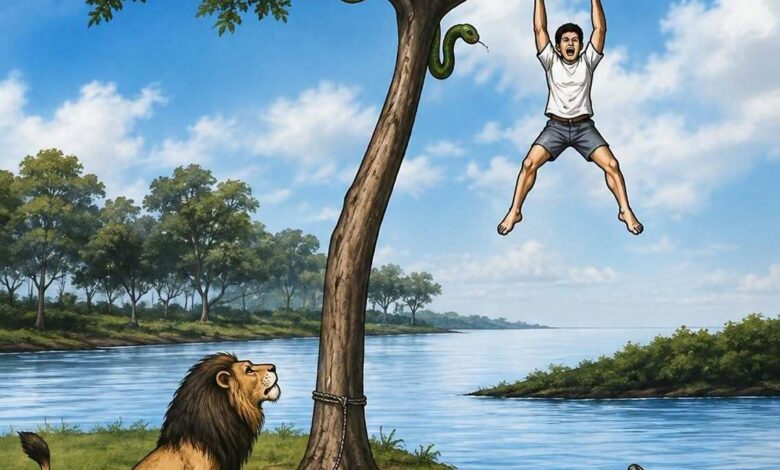
A man appears trapped in a place where every direction seems dangerous. A snake is ready to strike on one side. A tree stands near a lake occupied by crocodiles, while a hungry lion moves nearby. Looking at the scene for the first time, most people immediately search for the fastest route away. Every obvious path, however, seems to place the man within reach of another threat.
Moving toward the snake would bring him closer to its bite. Entering the lake would expose him to the crocodiles, and attempting to run across open ground could attract the lion. The puzzle therefore creates the impression that escape depends on choosing the least deadly option. That assumption is what makes the image so confusing. It encourages a quick decision when the safer answer may require no immediate movement at all.
The man’s best advantage is not strength or speed. It is his ability to observe. The animals are alive, which means they will not necessarily remain in the same positions or continue paying attention to the same thing. A still image freezes the danger for the viewer, but the situation itself can change. Once that possibility is considered, the puzzle becomes less about outrunning animals and more about waiting for their behavior to create an opening.
The lion eventually becomes thirsty and moves toward the lake to drink. Its movement changes the balance of the entire scene. The crocodiles now have a large animal near the water, giving them something else to watch. The lion is also no longer occupying exactly the same area. During that brief distraction, the man can move away from the immediate threats instead of challenging any of them directly.
Timing is essential. Leaving too early would expose him while all three dangers remain focused and predictable. Waiting too long could close the opportunity. He must remain calm enough to notice the moment when the lion’s thirst draws it toward the water and the crocodiles’ attention shifts. The escape works because he responds to a change in the environment rather than forcing his way through a fixed obstacle.
Many people struggle with the puzzle because the mind naturally treats every visible element as permanent. The snake, lion, and crocodiles seem like walls around the man. Yet animals have needs and instincts. A thirsty lion seeks water. Crocodiles react to movement near their territory. Once those instincts are treated as part of the solution, the threats no longer form a perfect barrier at the same time.
The riddle also shows why panic narrows judgment. A frightened person may select the first available path simply because standing still feels unbearable. That reaction can turn a difficult situation into a fatal one. Observation creates more information. More information reveals options, and options make a careful decision possible. The man survives by resisting the pressure to act before the circumstances are favorable.
Of course, the image is a logic exercise rather than practical wildlife advice. Its purpose is to challenge assumptions and reward attention to the relationships between the objects in the scene. The solution does not require an invisible bridge, a hidden weapon, or impossible physical ability. Everything needed is already present in the behavior of the animals.
The answer is patience. The man waits for the lion to approach the lake, allows the crocodiles to become distracted, and then uses the temporary opening to leave. What first looked like an impossible trap becomes manageable when the scene is understood as a sequence instead of a frozen picture. The safest move is not always the fastest one. Sometimes the escape route appears only after a person stops, studies the situation, and lets the danger rearrange itself.