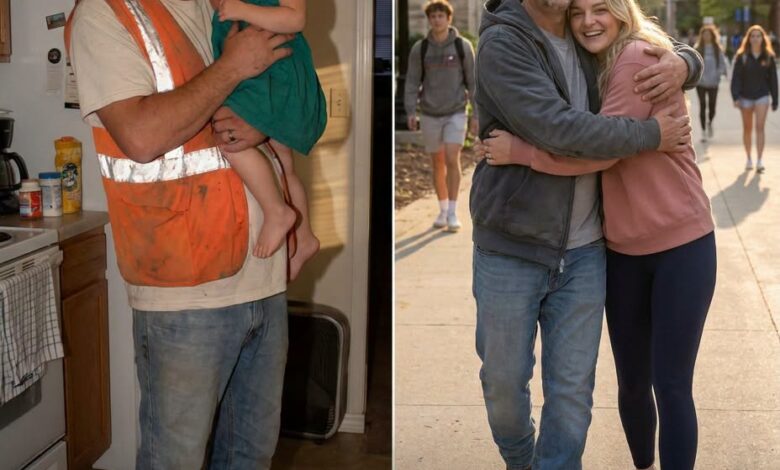
After My Father’s Funeral, One Unexpected Discovery Revealed a Family Story I Never Knew
“Daddy’s Bug, I hope you’ll forgive me after you see what’s inside.”
Those words were written on a small note tucked inside an old grocery bag my father had left for me. I found it shortly after saying goodbye to the man who had raised me almost entirely on his own.
I was still wearing his worn construction jacket over my black dress when I opened the bag. For as long as I could remember, I had believed one simple version of my childhood: my mother had left when I was young and never truly returned.
Dad rarely spoke about her. Whenever I asked questions, his answers were short and gentle. Eventually, I stopped asking.
But inside that grocery bag was a story I had never been told.
The first thing I found was a recent photograph of my mother. She was smiling beside a man and two grown children. I stared at the picture for several minutes because there was no mistaking her face. Even after all those years, I could see pieces of myself in her expression.
Then I turned the photograph over.
The date showed that it had been taken recently.
My mother had not simply vanished from the world. She had continued with her life, remarried, and raised another family.
Underneath the photograph were carefully preserved documents: old birthday cards, payment records, custody papers, letters, and a calendar filled with handwritten notes.
My father had known more than he had ever told me.
As I spread everything across the kitchen table, memories from childhood returned with an entirely different meaning.
Dad had been studying engineering when I was born. After becoming my primary caregiver, however, he left school and found construction work. For more than two decades, we lived modestly in the same apartment.
Money was often tight, although he worked hard to prevent me from worrying about it.
He repaired old work boots instead of buying new ones. He planned meals carefully and found creative ways to make difficult moments feel like adventures. When the electricity once went out, he turned the living room into an indoor campsite and told stories by flashlight.
As a child, I thought it was exciting.
Only later did I understand how much effort went into making our life feel secure.
The documents revealed another surprising detail. Months after leaving, my mother had contacted Dad and asked for financial help while completing her education.
He helped her.
For nearly two years, while working long construction shifts and raising me, Dad contributed toward her tuition. According to his notes, he believed that helping her become financially stable might eventually make it easier for her to reconnect with us.
That reunion never happened.
Eventually, my mother remarried. Formal custody arrangements confirmed that Dad would continue raising me. There were occasional cards and brief communications over the years, but no meaningful relationship developed between my mother and me.
Dad saved almost everything.
In his final letter, he explained why.
He believed that telling me every detail while I was young would only create questions he could not answer. He worried that I would spend years wondering why my mother had chosen a different path.
Whether that decision was right or wrong, I finally understood what had motivated it.
I wanted answers, so I contacted Hannah, one of the people in the photograph.
Learning about each other was strange for both of us.
Hannah eventually told me something I had never expected: she had grown up believing her mother had no children before her second marriage.
We agreed to meet at a café.
She brought family photographs showing birthdays, school events, vacations, celebrations, and ordinary moments from a childhood very different from mine.
Looking through those albums was emotional, but I also realized Hannah was not responsible for decisions made before she was born. She had been given an incomplete family history just as I had.
Eventually, I met my mother.
The conversation was uncomfortable, and there were disagreements about how the past should be remembered. I brought copies of the documents Dad had preserved because I wanted our discussion to be based on what could actually be verified.
I also told her something important.
If we were ever going to build any kind of relationship, the truth had to come first.
I could understand that people make complicated decisions when they are young. What I could not accept was continuing a story that erased part of the family’s history.
There was no dramatic instant when everything became perfect.
Real life rarely works that way.
Hannah and I began communicating slowly. We discovered similarities, exchanged stories, and allowed ourselves to build a connection without pretending that biology automatically created closeness.
My mother also began writing to me.
At first, I did not respond. I needed time to decide what kind of relationship, if any, I wanted. Forgiveness and reconciliation are deeply personal decisions, and neither can be demanded simply because someone finally explains the past.
Meanwhile, I kept returning to Dad’s final letter.
He admitted that keeping so much information from me had been a mistake. He wrote that I deserved to know my own history and hoped I would someday understand why he had waited.
I was still disappointed that he had decided what I could handle.
But disappointment did not erase gratitude.
My father had spent his life showing up.
He was there for school mornings, packed lunches, parent meetings, scraped knees, graduations, difficult exams, and countless ordinary evenings that seemed insignificant at the time.
Those ordinary moments became his greatest legacy.
Using part of what Dad left behind, I helped establish a small educational fund through a community organization. Its purpose was to assist single parents returning to programs connected with engineering, construction, and skilled trades.
It seemed like the most meaningful way to honor the future Dad once imagined for himself.
The first person supported by the program was a parent who had stepped away from school after having a child and was ready to continue her education.
That moment meant more to me than I expected.
Today, I still keep one of my mother’s old birthday cards.
Not because of what she wrote inside.
I keep it because Dad had carefully written the date on the envelope and preserved it for years. Even when he chose silence, he kept a record so that one day I could understand where I came from.
I no longer see my family story in simple categories of heroes and villains.
Both of my parents made decisions that affected me. Some came from fear, some from hope, and some created consequences that could never be completely undone.
The difference I remember most is found in the ordinary details.
One parent occasionally wrote about caring from a distance.
The other packed lunches, repaired coats, worked long shifts, attended school events, and came home every night.
That grocery bag changed what I knew about my childhood, but it did not change the person who had been beside me throughout it.
Dad may have hidden the letters.
He never hid me.