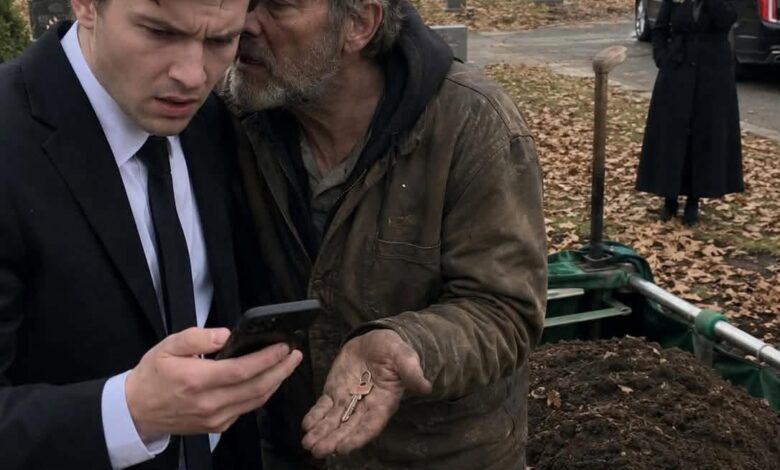
I Stood at My Mother’s Open Grave, Only for the Gravedigger to Whisper the Most Chilling Secret of My Life!
The funeral director, Earl, stood beside me as the November wind whipped through the cemetery, his face a mask of professional stoicism. I thought he was there to offer comfort, but then he leaned in close, his voice barely a tremor in the cold air. “Your mother paid me to bury an empty coffin,” he whispered. I froze, my heart slamming against my ribs as he pressed a cold brass key into my palm. My mother had been dead for six days—or so I thought. This wasn’t a funeral; it was a front, and the terrifying truth was about to destroy everything I knew.
I didn’t wait for the service to end. I slipped away, the weight of the key in my pocket feeling like a burning coal. My phone buzzed—a text from my mother’s number: Come home alone. It was impossible, yet there it was, glowing on my screen. I drove to the Safelock storage facility on the edge of town, my mind racing through every dark possibility. I reached Unit 16, the brass key turning with a heavy, final click.
Inside, there was no furniture or old junk. There was a folding chair, a lantern, water, and my mother’s navy-blue handbag—the exact one I had identified at the morgue when I saw her body. Someone hadn’t just stolen it from the scene; they had brought it here. Taped to the purse was an envelope: For Emily. If you’re reading this, they lied to you first.
Before I could process the words, a black SUV roared into the row, tires crunching on gravel. I didn’t wait to see who it was. I scrambled into the unit, pulling the door down just enough to hide. Outside, two men stepped out. Their voices were calm, practiced, and utterly predatory. “Ms. Carter? We just want to talk,” one said. “Your mother involved you in something she shouldn’t have.”
I opened the note with trembling hands. Emily, if anyone follows you here, do not trust the police, Richard Hale, or anyone from Lawson Financial. Take the red folder and leave through the back fence. I’m sorry.
Richard Hale. My mother’s employer for nineteen years. He had hugged me at the funeral just hours ago, wearing a performance of grief so perfect it was chilling. Now, I understood. The “cardiac event” that killed my mother wasn’t a tragedy; it was a cover-up. She hadn’t died; she had been forced to disappear because she had stumbled upon a massive, systemic fraud within Lawson Financial. They weren’t just moving money; they were stealing from the estates of the dead and redirecting assets through shell companies.
I found the red folder, its contents damning: wire transfer records, forged signatures, and proof that my mother had been building a case for months. I didn’t hesitate. I pushed aside the plywood backing, scrambled through a pre-cut hole in the chain-link fence, and ran.
I met Daniel Brooks, a clerk at the County Recorder’s Office, who had been my mother’s secret partner in this endeavor. He provided the final piece of the puzzle: a letter she had left behind. She had orchestrated her own death, using the funeral as a distraction to buy herself time and protect me. She had let me bury an empty box so that the vultures circling her wouldn’t look for her while she gathered the evidence to take them down.
That night, in a secure federal building, I handed everything to Audrey Marsh, a sharp-eyed agent in the financial crimes division. I didn’t cry. I was too busy calculating the cost of my mother’s deception. Forty-eight hours later, the arrests began. Richard Hale was pulled from his suburban home in handcuffs; the deputy coroner, who had been on the Lawson payroll to falsify death certificates, was dragged from his office.
My mother finally called me nine days later. Her voice sounded older, weighted by the months of hiding. She explained that she had been trapped—if she had gone to the authorities openly, they would have killed me to silence her. The funeral was her only exit strategy. I understood the logic, but that didn’t stop the cold anger from settling in my chest. She had used my grief as a weapon to protect me, and while I was alive because of it, the betrayal felt like a second death.
When she finally came home in the spring, we sat in my kitchen, the silence between us heavy with the ghosts of what had been. I didn’t forgive her immediately. I told her exactly what it felt like to stand at her grave and mourn someone who was still breathing, to look at the dirt and believe she was in it. She didn’t offer excuses. She looked me in the eye and said, “I would do it again.”
And in that moment, I realized that my mother wasn’t a victim—she was a warrior who had fought a war I didn’t even know was happening. She had taught me that survival sometimes requires the most brutal performances. I still keep the brass key to Unit 16 in a dish on my dresser. It serves as a reminder that the world is built on layers of truth and lies, and that sometimes, the people who love you most will lie to you to keep you alive. I don’t have a clean verdict on it, and I’m not sure I ever will. But we are here, we are together, and the people who thought they could destroy us found out the hard way that they had badly underestimated a woman they thought they knew.