Two months after I signed the papers to end our marriage, I found myself standing in a sterile hospital corridor
Chapter 1: The Hospital Corridor
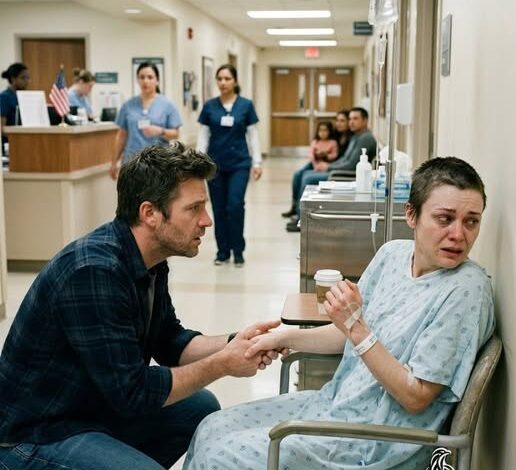
Two months after I signed the papers to end our marriage, I found myself standing in a sterile hospital corridor, my heart hammering against my ribs like a trapped bird.
The air smelled of antiseptic and lingering despair, but all I could focus on was the woman huddled against the wall.
Emma.
My ex-wife.
The woman whose laugh had once filled our kitchen before grief turned every room quiet.
She looked like a shadow of the person I once knew. Her frame was fragile beneath the loose cardigan, her hair shorn close, and her eyes hollowed out by a secret I had not been there to share.
For a moment, I couldn’t move.
I had come to the hospital to visit a coworker after surgery.
I had not come prepared to find the woman I had loved sitting alone outside the oncology ward, tethered to an IV pole.
Then she looked up.
And my name broke softly from her lips.
“Nathan?”
Chapter 2: The Woman I Left
Her voice was barely more than a breath, but it hit me harder than any accusation could have.
I stepped closer, slowly, as if sudden movement might make her disappear.
“Emma,” I said, but her name came out ruined.
She tried to stand, then winced and lowered herself back against the wall.
Instinct pulled me forward before pride could stop me.
“Don’t,” I said gently. “Please. Stay seated.”
She gave me a faint smile that did not reach her eyes.
“You always hated hospitals.”
I almost laughed because it was true, and because she remembered, and because the world had become unbearable in the space of five seconds.
“What are you doing here?” I asked.
Even as I said it, I knew it was the wrong question.
Her wrist was bruised from needles.
Her skin was pale.
The answer was already sitting between us.
Emma looked down at her hands.
“I didn’t want you to find out this way.”
Chapter 3: The Truth
And then she opened her mouth to tell me the truth about why she had been fighting this battle alone.
The words did not come out as a sob or a scream.
They came out in a whisper that seemed to evaporate into the fluorescent hum of the hospital.
“I was diagnosed with leukemia.”
Everything inside me went still.
I heard a cart rolling somewhere behind me.
A nurse speaking softly near the desk.
The distant beep of machines behind closed doors.
But all of it sounded far away.
“When?” I asked.
Emma swallowed.
“A few weeks after you left.”
The sentence landed between us with a cruelty I was not prepared for.
A few weeks.
While I was signing documents and telling myself we were both better off, she had been receiving news that would have made any person reach for the one hand they trusted most.
And I had not been there.
“Why didn’t you call me?”
Chapter 4: The Clean Slate
Emma looked away from me, toward the blank wall across the corridor.
“Because I didn’t want to burden you.”
The word burden made something sharp twist behind my ribs.
“Don’t say that.”
She gave a small, exhausted laugh.
“Nathan, you left because you couldn’t breathe in our marriage anymore. You said we had become a house full of grief.”
I closed my eyes.
I remembered saying that.
I remembered standing in our bedroom with a suitcase open on the bed, trying to sound gentle while I carved her life in half.
We had lost three pregnancies.
Three tiny futures.
Three names we never got to use.
After the last one, Emma still reached for me in the dark.
I stopped reaching back.
Not because I didn’t love her.
Because her pain reminded me of my own, and I was too cowardly to sit inside it with her.
So I called leaving survival.
And she believed me.
Chapter 5: The Weight
“I thought if I didn’t tell you, you could finally be happy,” Emma said.
Her voice cracked on the last word.
“You wanted a clean slate, Nathan. I didn’t want to be the weight that dragged you back into the dark.”
The silence that followed was deafening.
I looked at her hands.
The same hands that had folded my shirts when I worked late.
The same hands that left coffee on the counter every morning, even during the months when we barely spoke.
The same hands that once pressed against her stomach while she whispered hopes to a child we never got to hold.
I had convinced myself our divorce was mature.
Peaceful.
Necessary.
A mutual release from a life that had become too heavy for both of us.
But sitting there, watching her fingers tremble around the IV line, I finally understood.
I had not released her.
I had abandoned her.
Chapter 6: Empty Rooms
The weight of my own cowardice pressed down on me, heavy and suffocating.
I had spent months filling my apartment with clean furniture, quiet mornings, and false proof that I was healing.
No framed photographs.
No baby blankets hidden in drawers.
No soft voice asking if I wanted tea.
Just order.
Silence.
Empty rooms that never asked anything from me.
I had mistaken the absence of pain for peace.
But seeing Emma there, fragile and alone, tore the lie open.
The distance I placed between us had not healed me.
It had only hollowed me out.
“Who comes with you?” I asked quietly.
Emma’s mouth tightened.
“For treatment?”
I nodded.
She looked down.
“Mostly no one. Sometimes my neighbor drives me if I’m too weak.”
That answer broke something in me.
My wife had been walking into battle with strangers while I congratulated myself for moving on.
Chapter 7: The Architecture of My Soul
I sat beside her on the cold hospital bench.
Neither of us spoke for a while.
Doctors passed.
Nurses moved between rooms.
Life and fear carried on around us as if my world had not just collapsed.
Emma kept her eyes on the floor.
“You don’t have to do this,” she said.
“Do what?”
“Feel guilty.”
I let out a breath that almost became a laugh.
“Emma.”
“I mean it,” she whispered. “We were already over.”
That sentence should have been simple.
Legal.
True.
But it felt wrong in every place that mattered.
I had traded a life of shared burdens for a life of quiet rooms.
I had walked away from the only person who truly knew the architecture of my soul.
The cracks.
The hidden rooms.
The parts I kept locked because I was afraid even love would not survive seeing them.
And somehow, Emma had loved me anyway.
Chapter 8: Never a Weight
I reached for her hand.
For a second, she stared at my fingers like she did not know whether she was allowed to take them anymore.
That hurt more than I deserved to admit.
So I closed the distance myself.
I took her hand gently, careful of the bruises near her wrist, and held it with a grip that promised I was not going anywhere.
“You were never a weight, Emma.”
My voice was thick, nearly unrecognizable.
“You were my home. And I am so sorry I left you to face this by yourself.”
Her eyes filled slowly.
Not dramatically.
Not all at once.
Just enough for me to see how tired she was of being strong.
“Nathan,” she whispered.
“I know I don’t have the right to ask for anything,” I said. “I know papers were signed. I know I failed you when it mattered.”
I swallowed hard.
“But let me show up now.”
Chapter 9: The First Appointment
She searched my face for the truth.
I let her look.
I did not defend myself.
I did not explain my fear, my grief, or the thousand excuses I had polished during lonely nights.
Excuses would only insult what she had survived.
Finally, Emma looked down at our joined hands.
“I have chemotherapy tomorrow morning.”
It was not forgiveness.
It was not reconciliation.
It was a door opened only a crack.
But I knew enough to treat that crack like mercy.
“What time?” I asked.
“Seven.”
“I’ll be here at six-thirty.”
Her mouth trembled.
“You don’t have to—”
“I know.”
She looked at me then.
Really looked.
For the first time in months, the icy wall between us began to thaw.
Not all the way.
Maybe not even halfway.
But enough for warmth to enter the corridor.
Chapter 10: Staying
We sat there in that hallway, two broken people trying to find the pieces of a life we had discarded too soon.
I knew the road ahead was steep and uncertain.
Treatments.
Tests.
Fearful phone calls.
Long nights when neither of us would know what to say.
I also knew that staying one day would not erase the day I left.
Love was not a dramatic speech in a hospital corridor.
Love was showing up the next morning.
And the morning after that.
And the morning after that, even when guilt became uncomfortable, even when fear returned, even when Emma had every right to doubt me.
She leaned her head carefully against my shoulder.
I stopped breathing for a second.
Then I rested my cheek against her hair.
I had walked away from the fire, only to realize that in the cold, I had nothing left to live for.
Now, I was finally ready to stay.
Epilogue: Home Again
The next morning, I arrived at six-fifteen.
Emma was already there, wrapped in a blue scarf, pretending not to watch the elevator doors.
When she saw me, she did not smile right away.
She looked at the coffee in my hand.
Black, two sugars.
Her old order.
“You remembered,” she said.
“I remember everything.”
That was not entirely true.
There were things I had forgotten when it was convenient.
How brave she was.
How lonely grief can become when only one person is willing to speak its name.
How marriage is not proved in the easy seasons, but in the rooms where fear sits beside you and waits.
I did not ask her to forgive me that day.
I sat beside her.
I held her hand.
And when the nurse called her name, I stood with her.
Not as a hero.
Not as a husband restored by one apology.
But as a man finally learning what love should have meant from the beginning.