CHAOS IN THE WEST WING THE TRUTH BEHIND DONALD TRUMP BANISHMENT FROM THE SITUATION ROOM DURING A HIGH STAKES SPECIAL OPS MISSION
The sanctity of the White House Situation Room is rarely breached by internal politics, yet a staggering report has emerged detailing a moment where the Commander-in-Chief was reportedly sidelined during an active military crisis. As global tensions reached a fever pitch in early April 2026, a high-stakes search-and-rescue operation in hostile territory became the backdrop for an unprecedented breakdown in executive protocol. While the world watched the escalating conflict between the United States and Iran, a different kind of battle was supposedly being waged within the walls of the West Wing—a struggle over temperament, information flow, and the stability of leadership during a life-or-death mission.
The incident was ignited on April 3, 2026, when an F-15E Strike Eagle crashed over southwestern Iran during active military operations. In an instant, a routine mission transformed into a geopolitical nightmare. The two-person crew was ejected into rugged, contested terrain, and while one airman was quickly recovered by tactical units, the second remained missing. For over twenty-four hours, the United States military was locked in a desperate race against time. The missing pilot was a ticking clock in a region already simmering with the threat of total war. Inside the nerve center of Washington, the urgency was palpable, but according to sources familiar with the events, the atmosphere in the West Wing was characterized less by clinical precision and more by explosive volatility.
Reports from the Wall Street Journal suggest that as the gravity of the situation became clear, Donald Trump’s reaction was one of profound anger. Upon learning that an American service member was unaccounted for in Iranian territory, the President reportedly launched into a hours-long tirade, raising his voice at senior aides and expressing visceral frustration. Witnesses described a President preoccupied not just with the tactical safety of the pilot, but with the haunting specter of historical precedent. He reportedly referenced the 1979 Iran hostage crisis with alarming frequency, noting how that specific failure had decimated the presidency of Jimmy Carter. To Trump, the missing airman wasn’t just a soldier; he was a potential political catastrophe that could define his legacy.
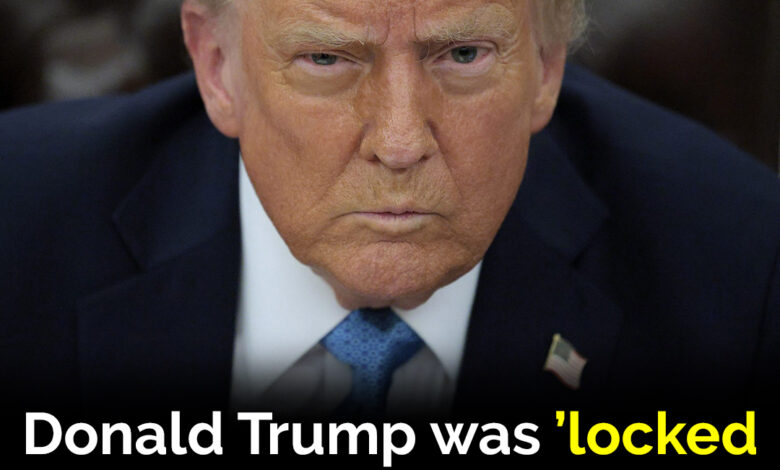
As the search-and-rescue mission moved into its most critical phase, a stark physical divide opened within the White House. Senior officials, including Vice President JD Vance and Chief of Staff Susie Wiles, were positioned where they belonged: inside the Situation Room, monitoring live feeds and intelligence streams as they funneled in from the field. However, the President of the United States was conspicuously absent from the table. Sources claim that senior aides made a calculated, quiet decision to keep Trump outside the room. The rationale provided by one senior official was as blunt as it was controversial: there were deep-seated concerns that the President’s mounting impatience and volatile temperament would disrupt the sensitive flow of information and interfere with the operational focus of the commanders on the ground.
Instead of the standard continuous briefing provided to a sitting president during a kinetic operation, Trump was reportedly kept at arm’s length. Updates were delivered to him by phone at key intervals, a method of communication that effectively filtered the raw, chaotic data of the mission before it reached the Oval Office. This insulation was a radical departure from standard presidential protocol, raising fundamental questions about who was truly at the helm during the mission’s most harrowing hours. The official White House response, delivered by Press Secretary Karoline Leavitt, attempted to paint a much more harmonious picture. She insisted that the President remained “steady” and “fully informed,” characterizing the decision-making process as a standard distribution of duties rather than a forced exclusion.
Despite the internal friction, the professionalism of the U.S. military and intelligence apparatus remained unshaken. On April 4, the operation reached its climax. After more than a day of searching what officials called a “needle in a haystack,” U.S. forces successfully located and extracted the missing airman. The rescue was made possible through a masterclass in modern espionage, with the Central Intelligence Agency providing the “advanced intelligence capabilities” necessary to pinpoint a human being hidden in some of the world’s most unforgiving and hostile terrain. The pilot was brought home safely, a victory for the Special Operations community that stood in sharp contrast to the reported dysfunction at the highest levels of government.
However, the rescue did little to cool the rhetoric emanating from the Oval Office. Even as the pilot was being debriefed, Trump continued to utilize aggressive language regarding the Iranian infrastructure. He warned that if diplomatic negotiations failed to produce a favorable deal, the United States was prepared to take action that would result in “widespread destruction.” These remarks, delivered in the wake of a successful rescue, drew immediate concern from international observers who feared that the President’s personal frustrations were clouding the strategic objectives of the United States. Iranian officials, never ones to back down from a rhetorical fight, signaled their own readiness for escalation, leaving the possibility of future peace talks in a state of precarious uncertainty.
The expiration of a fragile ceasefire is now looming, and the President has signaled that he has little interest in extending the grace period. This hardline stance, coupled with the reports of his exclusion from the Situation Room, paints a picture of a presidency at a crossroads. On one side is a Commander-in-Chief who views military operations through the lens of political survival and historical grievance. On the other is a professional staff and military leadership that, in this instance, felt the need to bypass the president to ensure operational success.
The implications of this episode extend far beyond a single downed aircraft. It challenges the traditional understanding of the American chain of command. If the people closest to the President believe his presence is a liability during a crisis, it suggests a profound level of internal distrust. While the mission was a tactical triumph—the pilot returned home, and no lives were lost during the extraction—the procedural anomalies are impossible to ignore. In the world of high-stakes geopolitics, the outcome is often the only thing that matters to the public, but for those within the halls of power, the process is everything.
As the dust settles on the rescue mission, Washington is left to grapple with the reality of an executive branch that appears to be operating in silos. The story of April 3 is no longer just about a pilot in the desert; it is a story about the mechanics of power in a modern age of volatility. It serves as a reminder that the most dangerous moments of a presidency often happen behind closed doors, in the quiet spaces where decisions are made about who gets to be in the room when the world is on the line. The airman is home, but the questions regarding Donald Trump’s leadership style and the extraordinary measures taken by his own staff to manage it are only beginning to be asked. In this unfolding narrative, the “locked door” of the Situation Room may become the most enduring image of a presidency defined by its refusal to follow the rules.