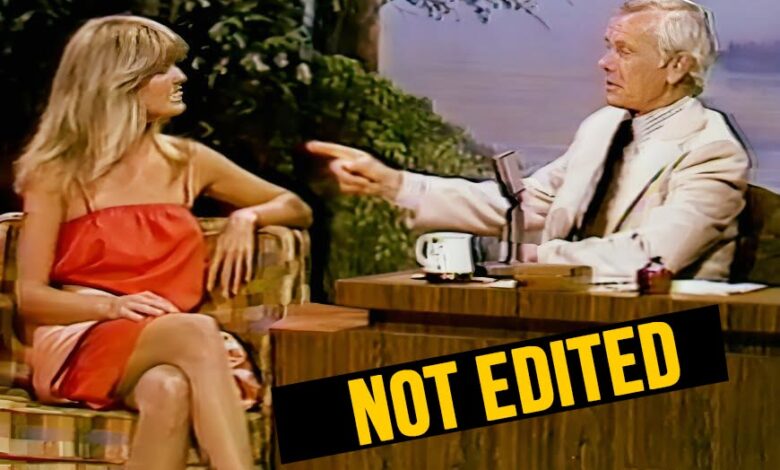
The Secret Life Of A Golden Icon Why Farrah Fawcett Almost Became A Nun And The Hidden Heartbreak Behind The Most Famous Poster In History
Farrah Fawcett did not simply inhabit the 1970s; she was the living, breathing definition of that era. Long before the modern celebrity industrial complex turned personal lives into a nonstop headline machine, she was the sun-kissed face taped to bedroom walls across the globe. As the breakout star of Charlie’s Angels, she radiated a specific kind of golden, wholesome glamour that felt both unattainable and remarkably approachable. She was the American dream in a red swimsuit, an icon whose feathered hair launched a thousand trends. Yet, beneath the shimmering surface of Hollywood stardom lay a complex woman who spent her life navigating the sharp contrast between public expectation and private conviction. When illness eventually darkened her doorstep, the world watched in heartbreak as the symbol of carefree vitality transformed into a monument of grit and visible courage.
To understand the woman behind the “Farrah Flip,” one must look back at her deeply grounded beginnings in Texas. Raised in a devout Catholic household, Farrah was shaped by a traditional upbringing that prioritized faith and family. In fact, her spiritual roots ran so deep that during her adolescence, she briefly contemplated a life of religious service. In a candid 1979 interview, she admitted that she had seriously considered becoming a nun, though the aspiration only lasted about a week. She explained that the simplicity and uncomplicated nature of convent life felt like a sanctuary during the confusing years of puberty, especially as she struggled to reconcile her religious environment with the natural changes of growing up.
This internal tug-of-war between tradition and independence followed her into adulthood. She deeply admired her mother Pauline’s life as a homemaker, once confessing that a significant part of her soul loved the domestic rituals of cooking, cleaning, and preparing dinner. However, she was simultaneously pulled toward a life of ambition and self-discovery. Throughout her career, she openly acknowledged the difficulty of balancing the traditional expectations placed upon women with the high-octane demands of a life in the Hollywood spotlight. Her beauty, while a ticket to fame, was often a source of self-consciousness. Voted “Most Beautiful” for three consecutive years in high school and carrying that title into the University of Texas, she often felt the weight of the public gaze. She once mentioned that she wished people would stop staring so much, a rare sentiment for someone destined to become the most photographed woman in the world.
Her journey to Los Angeles was sparked by the persistence of publicist David Mirisch, who urged her to leave her studies and move to California. What began as a temporary modeling excursion quickly became a permanent relocation. Before she became Jill Munroe, she appeared on The Dating Game, a moment that helped solidify her image as the ultimate prize for which men would compete. However, her true seismic breakthrough came from a single piece of paper: a poster. The legendary red swimsuit image, captured by photographer Bruce McBroom, sold millions of copies and became shorthand for 1970s pop culture. Interestingly, it was Farrah herself who took control of the visual, choosing a one-piece suit over the requested bikini, a subtle move that resulted in an image that felt athletic and healthy rather than merely provocative.
Despite being a global fashion icon, Farrah’s personal beauty routine was famously low-maintenance. She was a believer in the natural restorative powers of the sun and sand, often choosing to do her own hair and makeup even for major shoots. The “Farrah Flip” was less a product of high-end salons and more a result of her own technique, involving blow-drying with a specific brush and flipping her head upside down for maximum volume. This DIY approach to glamour only added to her relatability, making her feel like the girl next door who just happened to be the most famous woman on the planet.
Her personal life was often a whirlwind of high-profile romance and professional friction. In 1973, she married Lee Majors, describing their initial meeting as a moment of instantaneous chemistry where she “melted into a thousand pieces.” However, the unrelenting pressure of two massive Hollywood careers eventually fractured the marriage, leading to a divorce in 1982. Her time on Charlie’s Angels was equally brief but impactful. Despite the show being a ratings juggernaut, she walked away after only one season. She was determined to prove she was more than a “TV sex symbol” and spent the subsequent years fighting for serious roles. The industry was initially furious with her for walking away from a sure thing, but she found critical redemption in projects like the off-Broadway play Extremities, where she replaced Susan Sarandon and earned rave reviews for her raw, dramatic performance.
Her later years were marked by a long and complex relationship with Ryan O’Neal and a public scrutiny that never truly faded. Even when her television appearances drew rumors of instability, she dismissed them with a characteristic wit, attributing her behavior to playful nerves or a desire to distance herself from the “Angel” persona. Beyond the camera, she was a serious sculptor, mentored by Charles Umlauf, finding peace in the tactile work of molding clay. She remained a devoted daughter until the very end, citing her mother as her absolute best friend and the anchor of her life.
In her final chapter, Farrah Fawcett allowed the world to see her at her most vulnerable. She documented her battle with cancer, showing the grueling reality of the disease with a transparency that was both shocking and deeply moving. According to her doctors, she fought the illness with a relentless determination, refusing to let it dictate her identity. The woman who had once been a symbol of effortless, sun-drenched beauty revealed a different kind of power—a quiet, human strength that resonated far deeper than any poster ever could. Farrah may have started as a visual icon on a bedroom wall, but she finished her journey as a testament to courage, showing that a life lived in the spotlight can still be one of profound substance, artistry, and grace. She was a woman who navigated the impossible expectations of fame by leaning into her own truth, ultimately leaving behind a legacy that was as complex as it was beautiful.