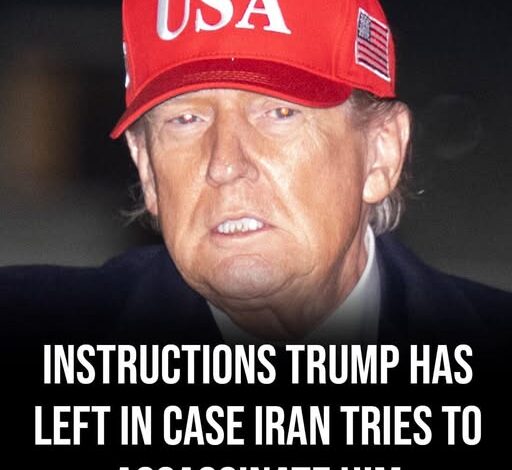
Here are the instructions Donald Trump has left if Iran tries to assassinate him!
In the theater of modern geopolitics, few statements have carried the apocalyptic weight of the declarations made by Donald Trump regarding the security of his person and the sovereignty of the United States. During a series of high-stakes remarks delivered throughout 2025, the political landscape was forever altered by a rhetoric that attempted to balance a fleeting promise of global stability with an unprecedented, ironclad menace. While he frequently spoke of a desire for nations to exist in a state of peaceful coexistence, that olive branch was perpetually wrapped in barbed wire. He vowed, with a chilling lack of ambiguity, that any attempt by the Iranian regime to orchestrate an assassination against him would not merely result in a diplomatic rupture, but would serve as the catalyst for the total, systematic obliteration of the Iranian state.
This warning transcended the typical bravado associated with campaign trails or standard executive posturing. Trump claimed to have formalized this threat by leaving behind a set of explicit, standing instructions that authorized the use of overwhelming, disproportionate force. The message sent to Tehran was designed to be as clear as it was severe: the life of one American leader was tethered to the continued existence of an entire nation’s infrastructure and governing body. It was an evolution of the concept of deterrence, shifting from the defense of borders to the defense of an individual, framed as the personification of the state itself.
Today, as we navigate the turbulent waters of 2026, those words have moved from the realm of hypothetical warning to the forefront of a global crisis. The Middle East is currently dominated by headlines that read like a chronicle of an escalating world war—airstrikes lighting up the horizons of major cities, retaliatory drone swarms darkening the skies, and the world-shaking confirmation of the death of a Supreme Leader. The strategic landscape has shifted so violently that the declarations of 2025 now feel like the first tremors of an earthquake that is currently tearing the region apart. The philosophy articulated by Trump—deterrence through the promise of absolute erasure—is no longer a theoretical deterrent; it has become the primary lens through which international observers view the potential for a total regional collapse.
The gravity of these instructions raises profound and uncomfortable questions regarding the norms of international engagement and the principle of proportionality. For decades, the global order has operated on the understanding that military responses should be measured against the scale of the provocation. Trump’s stance, however, challenged this fundamental pillar of diplomacy. It suggested that a singular act of political violence could justify a response of such magnitude that it would effectively end a civilization’s current form. This “loaded weapon” philosophy of governance implies that the machinery of war is already primed, waiting for a specific, personal spark to ignite a catastrophe that could engulf the entire globe.
Observers and intelligence analysts are now grappling with the true nature of these “standing instructions.” The central debate rests on whether these orders were primarily symbolic—a masterclass in political theater designed to project an image of untouchable strength to a domestic base—or if they represent a genuine, documented shift in military engagement protocols. In the world of high-stakes statecraft, the distinction between a bluff and a loaded revolver is the difference between a tense peace and a global conflagration. As the casualties mount and the rhetoric on both sides reaches a fever pitch, the world is holding its breath, waiting to see if the “obliteration” promised in 2025 is an active mission profile or a relic of a past administration’s rhetoric.
The current escalation has been exacerbated by reports of tragic collateral damage, most notably the devastating strike on a girls’ elementary school in Iran that reportedly claimed the lives of 175 children. While the Trump administration has vehemently denied American involvement in that specific tragedy, the incident has served as a lightning rod for international outrage and a rallying cry for those seeking further retaliation. The fog of war is currently so thick that facts are often replaced by narratives of vengeance, and in such an environment, the “instructions” left by Trump act as a haunting subtext to every military maneuver.
This atmosphere of mutual suspicion is further complicated by domestic concerns within the United States. As the possibility of a broader conflict looms, public discussion has turned toward the logistical realities of such a war, including the renewed conversation regarding a military draft. For the first time in generations, the American public is confronting the possibility that a conflict initiated by personal threats and regional assassinations could demand a level of national sacrifice not seen since the mid-20th century. The approval ratings of the current administration reflect a nation deeply fractured by these prospects—loyalists see the hardline stance as the only way to ensure American safety, while critics view it as a reckless march toward an avoidable Armageddon.
The Iranian response has been equally uncompromising. Following the loss of high-ranking officials and the targeting of strategic sites, the regime has signaled that it views the current American posture not as a deterrent, but as an existential declaration of war. Between the coordinated airstrikes and the cyber-attacks targeting Western infrastructure, the “peaceful coexistence” Trump once spoke of has vanished, replaced by a cycle of violence that seems to have no off-ramp. Every drone launched from a hidden desert base and every interceptor missile fired from a carrier strike group brings the world one step closer to the “total obliteration” that was once just a dark promise made during a speech.
Ultimately, the instructions Donald Trump left behind represent more than just a military directive; they are a testament to a shift in how power is projected in the 21st century. It is a world where the lines between the personal and the political have blurred into nonexistence, and where the safety of a leader is bought with the threat of a nation’s destruction. As 2026 unfolds, the true nature of those instructions will likely be revealed not in a declassified document, but in the smoke and fire of the Middle East. The global community remains caught in an agonizing wait, watching to see if the wrong spark will finally ignite the powder keg that has been carefully prepared over the last year.