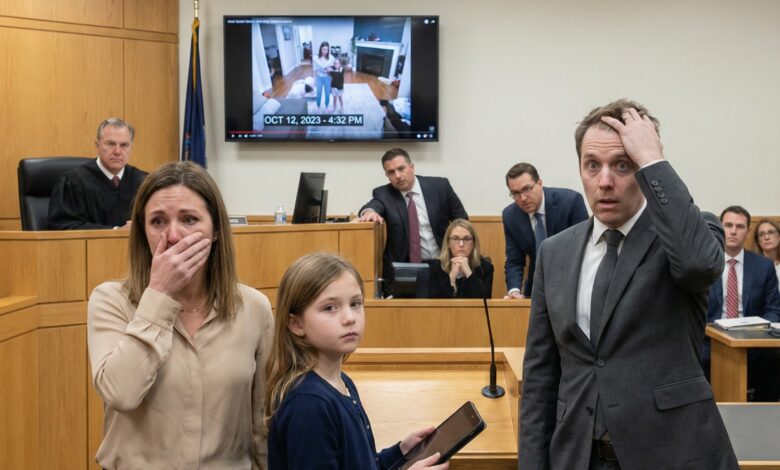
My husband filed for divorce, and my ten-year-old daughter asked the judge, “Your Honor, can I show you something Mommy doesn’t know?”
…standing in our kitchen at 2:13 a.m., the timestamp glowing clearly in the corner of the screen.
He wasn’t calm.
He wasn’t composed.
He was shouting.
Not at me.
At Harper.
The audio crackled for a moment, then his voice filled the courtroom—sharp, cutting, unmistakable.
“Stop crying,” he snapped. “Do you have any idea how much stress you cause? If you tell your mother about this, you’ll ruin everything. Do you want that? Do you?”
A collective intake of breath swept the room.
Harper’s small voice followed, shaky and terrified.
“I just wanted Mommy…”
Then the sound of something hitting the counter. A glass. Shattering.
I felt like I couldn’t breathe.
The video continued—short, mercifully short. Caleb pacing. His hands clenched. His face twisted in a way I had seen only in private, only when doors were closed. Then his voice again, colder this time.
“Don’t say a word. This stays between us. I’m the only one keeping things together here.”
The screen went black.
No one moved.
No one spoke.
Caleb was staring straight ahead now, his face drained of all color. His lawyer slowly sat down, as if her body had decided before her mind could catch up.
The judge didn’t look at me.
He didn’t look at Caleb.
He looked at Harper.
“Is this why you recorded it?” he asked gently.
She nodded. “I thought… if I forgot, then maybe it didn’t happen. But I couldn’t forget.”
The judge closed his eyes for a brief moment. When he opened them, the neutrality was gone.
“Ms. Dawson,” he said to me, “did you know about this video?”
I shook my head, tears streaming freely now. “No, Your Honor.”
He nodded slowly.
Then he turned to Caleb.
“Mr. Dawson,” he said, his voice firm but controlled, “you described your wife as emotionally volatile. You described yourself as a stabilizing presence. This video suggests the opposite.”
Caleb opened his mouth.
“No,” the judge said quietly. “You’ve said enough.”
The ruling didn’t come that day. But something far more important did.
The truth was finally seen.
Weeks later, the judge granted me primary custody. Caleb received supervised visitation—pending therapy, parenting classes, and a full psychological evaluation.
As we left the courthouse, Harper slipped her hand into mine.
“I’m sorry I didn’t tell you sooner,” she whispered.
I knelt down in front of her, right there on the steps. “You protected yourself the best way you knew how,” I said. “That was brave.”
She looked up at me. “I was scared.”
“I know,” I said. “But you spoke anyway.”
And in that moment, I understood something I will carry for the rest of my life:
Children don’t need perfect parents.
They need safe ones.
And sometimes, the smallest voice in the room
is the one that tells the clearest truth.
Harper didn’t just change the case.
She changed the story.