Clint Eastwood: The Rise of an American Icon
Long before Clint Eastwood became the embodiment of American toughness—a man defined by few words, unwavering calm, and a stare that could stop a scene cold—he was simply a young man searching for direction. Raised in San Francisco in a modest household, Eastwood’s path to greatness was neither obvious nor easy. Fame didn’t come quickly, and confidence wasn’t something he was born with. It was earned, slowly and deliberately.
The Quiet Beginnings of an Icon
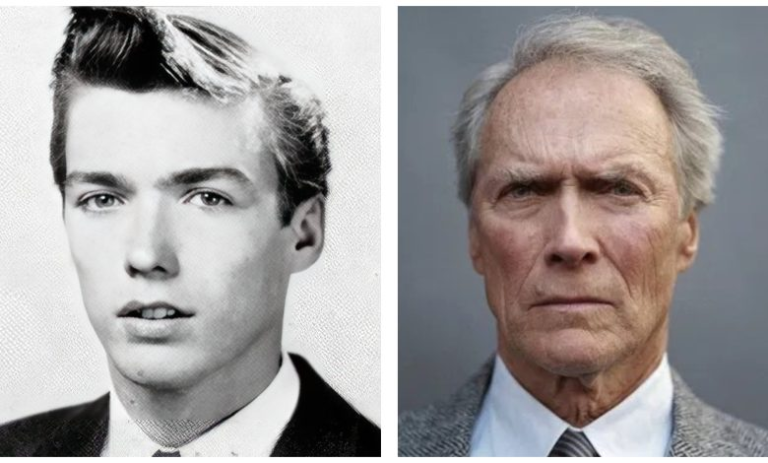
Early images of Eastwood look strikingly different from the legend audiences know today. His features were softer, his expression reserved, his presence understated. There was no sign yet of Dirty Harry’s intensity or the unflinching gunslinger who would redefine the Western genre. Tall and lean, he stood out physically, earning the nickname “Samson” during his school years, but personality-wise, he was shy and introspective.
Growing up during the Great Depression shaped him deeply. His father’s search for steady work forced the family to move often, pushing Clint from one school to another. Constantly being the new kid taught him to observe rather than speak, to rely on himself, and to remain emotionally guarded—traits that later became central to his on-screen authority.
A Brush With Death That Changed Everything
At just 19, Eastwood was drafted into the U.S. Army. During his service, he survived a terrifying plane crash into the frigid Pacific Ocean. Against overwhelming odds, he swam through freezing waters to reach safety.
The experience left a permanent mark. Eastwood later acknowledged that surviving the crash gave him a heightened awareness of life’s fragility. That realization sharpened his focus, strengthened his resolve, and brought a quiet authenticity to his performances that audiences instinctively felt—even if they couldn’t explain why.

Rejection, Doubt, and Relentless Persistence
Hollywood success did not arrive easily. Early auditions were often discouraging. Casting agents criticized his appearance, his delivery, even his demeanor. Some thought he was too stiff. Others believed he lacked charisma. One famously remarked that he didn’t smile enough—an ironic critique, considering that same restraint would later become his trademark.
What others saw as limitations, Eastwood treated as raw material. He didn’t try to change himself to fit the industry. Instead, he waited for the industry to catch up.
Redefining the Hero
His first real breakthrough came with the television series Rawhide, where he gained visibility and experience. But true stardom arrived when he traveled to Italy to star in a series of Westerns directed by Sergio Leone.
These films introduced a new kind of hero: quiet, morally complex, and impossible to ignore. With minimal dialogue, a poncho, a cigar, and a piercing gaze, Eastwood transformed the Western and captivated global audiences. The silent intensity once criticized by casting directors became his greatest strength.
Mastery Beyond Acting
Unwilling to remain confined to one role, Eastwood stepped behind the camera, launching an equally powerful career as a director and producer. His films—Unforgiven, Million Dollar Baby, Mystic River, and Gran Torino, among others—earned critical acclaim and multiple Academy Awards.
His directing style mirrored his life philosophy: restrained, purposeful, and deeply human. Each project reflected the lessons learned from instability, survival, and persistence.
A Legacy Built, Not Given
Clint Eastwood’s journey proves that legends are not born fully formed. They are shaped by hardship, patience, and an unshakable belief in staying true to oneself. From a quiet, uncertain young man to one of the most respected figures in cinematic history, Eastwood’s life stands as a powerful reminder that resilience often speaks louder than words.