The Nurse Who Brought Light Into My Darkest Days!
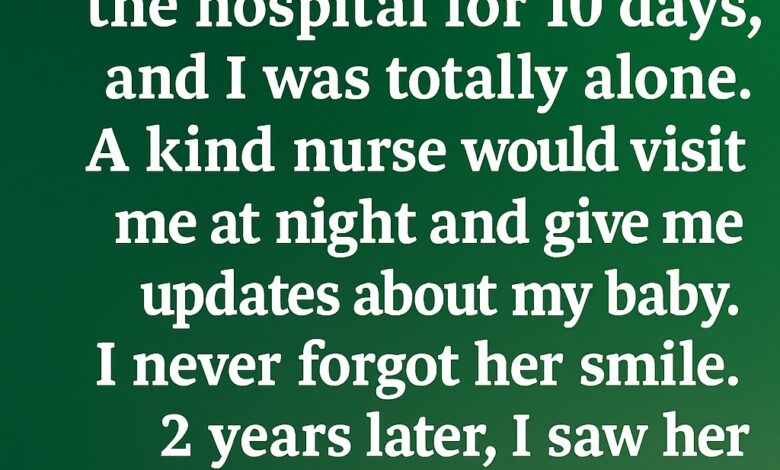
I came closer to dying the day my son was born than I ever have in my life. What was supposed to be a joyful moment collapsed into chaos—alarms, rushing footsteps, whispered medical terms I didn’t understand. When it was over, my baby was whisked to the NICU, and I was left in a recovery room where the walls felt too white, too quiet, too empty. We spent ten days in that hospital. Ten long, bruising days where fear sat on my chest like a weight. My family couldn’t be there, and my son was too fragile for me to hold. I had never felt more alone.
But every night, when the rest of the ward had gone dark, she appeared.
A nurse—small in stature, soft in voice, steady in ways I didn’t understand back then—would slip into my room. She’d pull up a chair beside my bed, her presence calm, like she had stepped out of the storm and onto my little island. She’d tell me how my son was doing, gently, never sugarcoating, never rushing. Her updates weren’t just medical information—they were hope delivered in the quiet hours when I needed it most. She stayed long after her shift ended, listening to me cry, letting me be afraid, reminding me that my son was fighting, and so was I.
Her smile became the one thing I relied on. The nights were terrifying without her, and manageable with her. Then, just as quickly as she entered my world, I healed enough to leave the hospital, and life moved on. I thought of her often, but people like her—angels disguised as nurses—float in and out of lives silently. I assumed I would never see her again.
Two years later, on an ordinary evening, her face filled my television screen.
It was the 10 o’clock news, a segment about local heroes who shaped their communities through kindness that didn’t make headlines. And there she was—the same eyes, the same calm smile that had held me together during the darkest nights of my life. The reporter introduced her as the coordinator of a volunteer program providing comfort and late-night support to families with critically ill newborns. She had built an entire network of care around the belief that no parent should face fear alone.
Listening to her speak was like reopening a sealed memory. Her voice, gentle but steady, carried the same reassurance I clung to in those ten days. Then the reporter shared something that froze me in place: years ago, before she ever became a nurse, she had lost her own infant shortly after birth.
Suddenly everything made sense.
Her tenderness. Her patience. The way she never rushed my fear. The way she sat with me as if she had nowhere else to be. She wasn’t just performing her duty—she was choosing, again and again, to stand with mothers in a place where she once had no one standing with her. She had taken the most painful loss a person can face and transformed it into a vow to never let another parent walk that path alone.
That realization moved through me like a shock. All the nights she stayed beside me, the calm she offered, the way she made me believe I could survive what felt impossible—it was her past speaking to my present. Her own grief became the bridge that saved me.
When the segment ended, I felt something I couldn’t ignore: the need to thank her, not from fear this time, but from clarity. I contacted the hospital, half expecting privacy rules to shut the conversation down. Instead they welcomed the message and promised to pass it along.
A few days later, a handwritten note arrived.
She remembered me. She remembered my son. She remembered those nights we spent piecing hope together in a room too quiet for comfort. She wrote that seeing parents find their footing again was the greatest reward she could ever ask for, and that my message meant more to her than I could know. Her words were simple, but I felt their weight. She wasn’t a stranger who had stumbled into my life—she was someone who had chosen to offer light because she knew exactly what darkness felt like.
Now, when life becomes heavy, I think of her. I think of those long hospital nights, the machines beeping down the hall, my fear sitting like a stone in my stomach. I think of the door opening, the soft shuffle of her shoes, the quiet compassion that followed her in like warm air.
She taught me something without ever saying it outright: most of the goodness in the world happens quietly. It doesn’t demand attention or recognition. It lives in simple moments—a chair pulled up beside a scared mother, a calm voice delivering hope, a smile offered when someone is on the edge of breaking.
Her kindness didn’t just get me through ten days in the hospital. It reshaped how I try to move through the world. Because of her, I understand the power of small mercies. I understand how one person’s gentleness can become a lifeline. And every day, I try in my own imperfect way to pass that same light forward—quietly, thoughtfully, the way she did.
Some people change your life with grand gestures. Others do it with a chair pulled up in the dark and a willingness to stay.