The Night a Rude Waitress Taught Me the Power of Compassion
The Tip That Changed the Evening
Some dinners stay with you—not for the flavor of the meal, but for the moment that rearranges something inside you.
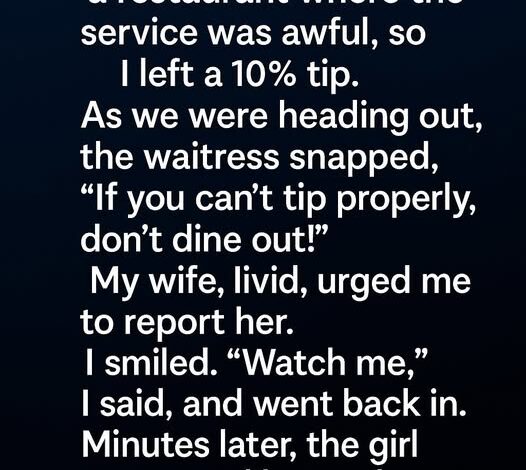
My wife and I had stopped at a small roadside restaurant after a long day, just hoping for calm. The food was fine, but the service was slow, distracted, uneasy. When the check came, I left a simple ten-percent tip—nothing vindictive, just routine—and we headed toward the door.
Then her voice broke the quiet:
“If you can’t tip properly, don’t dine out!”
It was sharp, almost brittle, and my wife’s face flushed with indignation. “You can’t let that go,” she said. “You should report her.”
But there was something in the waitress’s tone—a tremor that didn’t sound like rudeness, but fatigue barely holding itself together. I told my wife softly, “Watch me,” and went back inside.
The manager met me near the counter, bracing for a complaint. I explained what had happened, but not in the way he expected. “She seemed more overwhelmed than ungrateful,” I said. “Her hands were shaking. She looked… worn down.”
The manager exhaled, the kind of sigh that carries weeks of weight. He told me she’d been covering double shifts for a coworker while caring for a sick relative. The whole staff was running on fumes. “Thank you for telling me this way,” he said quietly. “Most people don’t.”
When I walked back through the dining room, she was bent over a table, scrubbing too hard, waiting for the fallout. Instead, I slipped a folded note and some bills into the tip jar.
The note read:
“Everyone has hard days. I hope tomorrow feels lighter.”
I didn’t wait for her to see it. My wife and I stepped outside into the cool night.
Moments later, footsteps hurried behind us. The waitress stood there, eyes wet, her apron streaked with tears. “I’m sorry,” she said, voice breaking. “My mom’s in the hospital. I just… snapped. I didn’t mean it.”
My wife’s anger melted as quickly as it had flared. She touched the woman’s arm and said, “It’s okay. We all have those days.”
On the drive home, my wife turned to me, her voice quiet.
“I thought you were going to get her in trouble.”
I shook my head. “Sometimes,” I said, “people don’t need correction. They need grace.”
And that night, in a tired little restaurant, grace proved louder than pride—and far more nourishing than any meal.