The Unbreakable Bond Of Unconventional Love
I never expected the quiet life I’d built in rural Kentucky—fragile as it was—to shatter the way it did. One moment, I was planning a future with my fiancé and our daughter. The next, he was gone. Lily was only four when he decided fatherhood wasn’t the life he wanted, choosing instead the glittering promises of the city.
There was no warning. No conversation. Just absence.
From that point on, everything became about survival. I worked two jobs, stretched every dollar, and tucked Lily into bed each night with the kind of love I hoped would soften the blows life had already delivered too early. She grew into this bright, observant, steady little soul—my mirror, my anchor, my entire world.
My relationship with my family, especially my mother, Eleanor, was far more complicated. Eleanor clung to tradition like a lifeline. She never forgave me for having a child “out of wedlock,” a phrase she wielded like a weapon she believed was righteous. Her disapproval simmered quietly beneath every holiday, every visit, every tight-lipped smile.
But nothing prepared me for the barbecue.
It was held at my sister Clara’s immaculate home—fresh paint, manicured yard, everything in its place. A place where my mother felt comfortable showing off her idea of what a “real family” looked like.
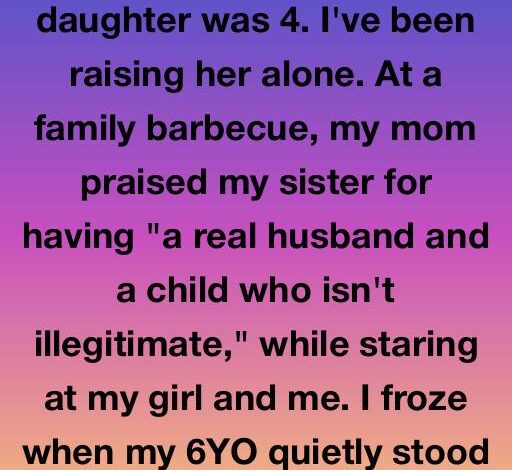
With a wine glass in hand and her filter long dissolved, Eleanor praised Clara for having “a real husband and a child who isn’t illegitimate,” pausing just long enough to let her gaze land directly on Lily.
The conversation died. My stomach dropped. Shame and fury tangled inside me until I couldn’t speak, couldn’t even move. I felt the weight of everyone’s silence pressing me into the chair.
And then my daughter—my small, fierce Lily—rose to her feet.
She crossed the lawn with a calmness far beyond her six years. Standing before my mother, she lifted her chin and said, with a clarity that made the entire world go still:
“My mommy is the realest wife because she never needed a husband to be a whole family.”
The effect was immediate. Eleanor’s face drained of color. The silence around us thickened. Adults stared at the ground, the sky, anywhere but at the little girl who had just rewritten the definition of family with a single sentence.
Then Lily did something even stranger. She reached into her tiny purse, pulled out a folded piece of paper, and handed it—not to Eleanor—but to Clara.
Then she quietly returned to her game.
Clara opened it. Her breath caught. Tears filled her eyes before she even finished reading. The note was written in crayon, a thank-you to Clara for “letting us stay in your garage.”
I stared at Clara, completely lost. We didn’t live in her garage. We lived in our own house.
At least… I thought we did.
With trembling hands and a choked voice, Clara told the truth. Months earlier, my home had been sliding toward foreclosure—a secret I thought I had hidden well. But she had found out. She knew I would never accept help directly, not with the pride I carried like armor.
So she and her husband Thomas bought the house when the bank took it. Quietly. Anonymously. Then they let me “pay rent” that was really a disguised, extremely low mortgage—one they knew I could manage. They protected my home, my dignity, my independence without ever asking for recognition.
The “garage” Lily mentioned? She assumed the little apartment I rented out to a student for extra income was Clara’s doing. Her innocent words had exposed both my hidden struggle… and Clara’s hidden generosity.
But then came the deeper cut—the real reason my mother’s cruelty had erupted with such venom.
Clara confessed that Eleanor herself had been born out of wedlock, and that the shame had been weaponized against her throughout her entire childhood. Every insult she hurled at Lily, every harsh judgment she threw my way, came from the same toxic legacy she’d been branded with.
All these years, her rigid, unforgiving standards weren’t about me at all. They were her attempt to outrun the pain she had never escaped.
And my daughter—my tiny warrior—had spoken the words that freed her.
I didn’t approach my mother with anger. I approached her with tears. On that lawn, surrounded by stunned relatives, we finally talked—truly talked—about the life she’d lived and the wounds she’d never healed.
From that moment, everything changed.
My mother softened. She found purpose and peace she had never known, eventually starting a support group for single mothers—women she once would have silently condemned. Clara helped me secure my own official mortgage and gently handed back the deed to my home. And Lily? She became the heart of our family, the one who reminded us that truth, spoken with innocence, can break generational chains.
I learned something I’ll never forget:
Cruelty often hides a wound. Pride often hides love. And sometimes, the youngest voice in the room carries the wisdom the rest of us spend a lifetime searching for.
If you’ve ever seen a child’s honesty change everything, you know how powerful that moment can be.