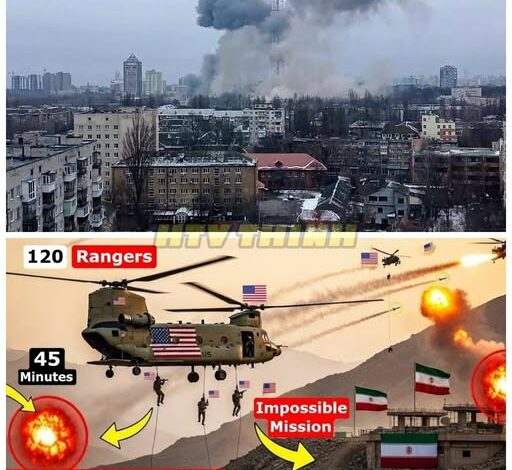
45 Minutes in Hell: The Fictional Story of an Elite Ranger Assault Deep in the Mountains!
In the high-altitude theaters of modern warfare, where the air is thin and the silence is absolute, the margin for error does not exist. High in the frozen serration of a remote mountain range, jagged cliffs slice through the stratosphere, and narrow valleys act as acoustic traps that swallow the very sound of a heartbeat. Here, a team of elite Army Rangers prepared for an operation that would be etched into the annals of special operations history. It was a mission designed to last exactly 45 minutes—a window of time so narrow that it transformed the concept of a “clock” into both a predatory enemy and a singular lifeline. This is the fictional chronicle of “45 Minutes in Hell,” an assault that pushed the boundaries of human resilience, tactical precision, and the sheer audacity of special operations.
Modern special operations units are the scalpel of a nation’s military power. Unlike conventional forces that utilize overwhelming mass and sustained firepower, units like the Rangers are engineered for the “impossible” environments—locales where a standard army would be paralyzed by terrain or logistics. Their training is a grueling gauntlet of mountain warfare, close-quarters battle (CQB), and survival behind enemy lines. In the fictional scenario of this mountain assault, the objective was singular and high-stakes: infiltrate a sovereign, fortified installation, extract high-value intelligence, and vanish before the regional response force could mobilize.
The target was a marvel of defensive engineering—a fortress carved directly into the granite heart of a massive peak. Satellite reconnaissance revealed a complex that was nearly invisible to the naked eye, shielded by the mountain’s natural geometry. The facility boasted reinforced bunkers, underground transit tunnels, and sophisticated drone control centers. To military planners, the math was clear: a traditional aerial bombardment would fail against the hardened rock, and a large-scale ground assault would be detected miles away. The only viable option was a precision strike by a small, highly specialized team capable of navigating the “vertical battlefield.”
Preparation for the mission was an exercise in meticulous obsession. For weeks, intelligence officers and Rangers studied topographical maps and high-resolution digital renders of the complex. The challenges were staggering. The base sat above a sheer thousand-foot drop, accessible only through narrow canyon “choke points” guarded by automated turrets and thermal-imaging guard towers. Landing a helicopter anywhere near the site was a gamble against radar detection. The final plan relied on a “low-observable” approach—a high-stakes insertion under the shroud of darkness, utilizing specialized gear and a synchronized strike on multiple entry points.
On the night of the operation, the air at the staging area was thick with the scent of gun oil and the quiet intensity of professionals. Each Ranger carried a loadout tailored for the specific demands of the mountain: PVS-31 night vision optics, suppressed carbines, breaching charges, and encrypted communication links that allowed for silent coordination. Their commander reviewed the timeline one last time. There would be no second chances; once the first boot hit the ground, the 45-minute countdown to “Hell” would begin.
The insertion was a masterclass in aviation skill. Pilots navigated low-altitude flight paths, threading through canyons at speeds that defied the darkness. When the helicopters reached the primary drop zone, the Rangers disembarked into the biting cold of the alpine night. The aircraft peeled away instantly, leaving the team alone in the hostile silence. Guided by their optics, the Rangers moved across the rocky ridges like shadows. In mountain warfare, a single loose stone can sound like a gunshot; every step was a calculated risk.
As they reached the outer perimeter, the team executed a silent “triage” of the enemy’s defenses. Small elements broke off to neutralize observation posts with surgical precision, while the main breaching element moved toward the heavy, reinforced doors of the tunnel system. The placement of the charges was handled with the care of a jeweler. When the detonation occurred, it wasn’t a thunderous blast but a controlled, directional punch that breached the steel without alerting the entire valley. The clock was now live.
The interior of the facility was a disorienting maze of industrial corridors and humming server racks. Inside these tunnels, the battle shifted to the intense, claustrophobic world of CQB. Rangers moved in “stacks,” clearing rooms in seconds, their movements a fluid dance of suppressive fire and rapid advancement. The echoes of suppressed gunfire and shouting defenders were amplified by the stone walls, creating a sensory overload that tested their discipline.
By the twenty-minute mark, the operation reached its crescendo. While the security elements held the corridor junctions, a technical specialist hacked into the facility’s main terminal. This was the heart of the mission: the extraction of data that could prevent a global conflict. The download progress bar was a agonizingly slow witness to the passing seconds. Outside, the facility’s alarms were screaming, and long-range scanners picked up the signature of enemy reinforcements—a rapid-response unit of gunships and armored vehicles—approaching the mountain.
The final ten minutes were a race against total encirclement. The technical specialist signaled “Data Secure,” and the Rangers began a fighting withdrawal. Exiting a mountain fortress is often more dangerous than entering; the element of surprise is gone, and the defenders have had time to consolidate. The Rangers utilized flashbangs and smoke to mask their retreat through the tunnel network, emerging back onto the frozen slopes just as the first enemy searchlights began to sweep the ridges.
The extraction was a blur of adrenaline and heavy rotors. The helicopters returned to the extraction point, hovering precariously over a narrow ridge as the Rangers piled in. As the aircraft banked sharply away from the mountain, the first enemy reinforcements arrived, their tracers lighting up the night sky where the Rangers had been only moments before. The mission had lasted exactly 45 minutes.
In the aftermath, back at the staging area, the silence returned—but it was a different kind of silence. It was the quiet of a team that had looked into the abyss and performed with flawless synchronization. While the details of “45 Minutes in Hell” are fictional, the principles it illustrates are very real. Success in special operations isn’t defined by the volume of fire, but by the economy of movement, the mastery of technology, and the unwavering trust between soldiers when the stakes are at their absolute peak. This story captures the imagination because it reflects the enduring truth of the special operator: that with enough training and courage, even the most formidable fortress can be breached in less time than it takes to eat a meal. It serves as a tribute to the precision of the few against the fortified many, a reminder that in the world of the elite, the clock is the ultimate arbiter of fate.